
The short answer
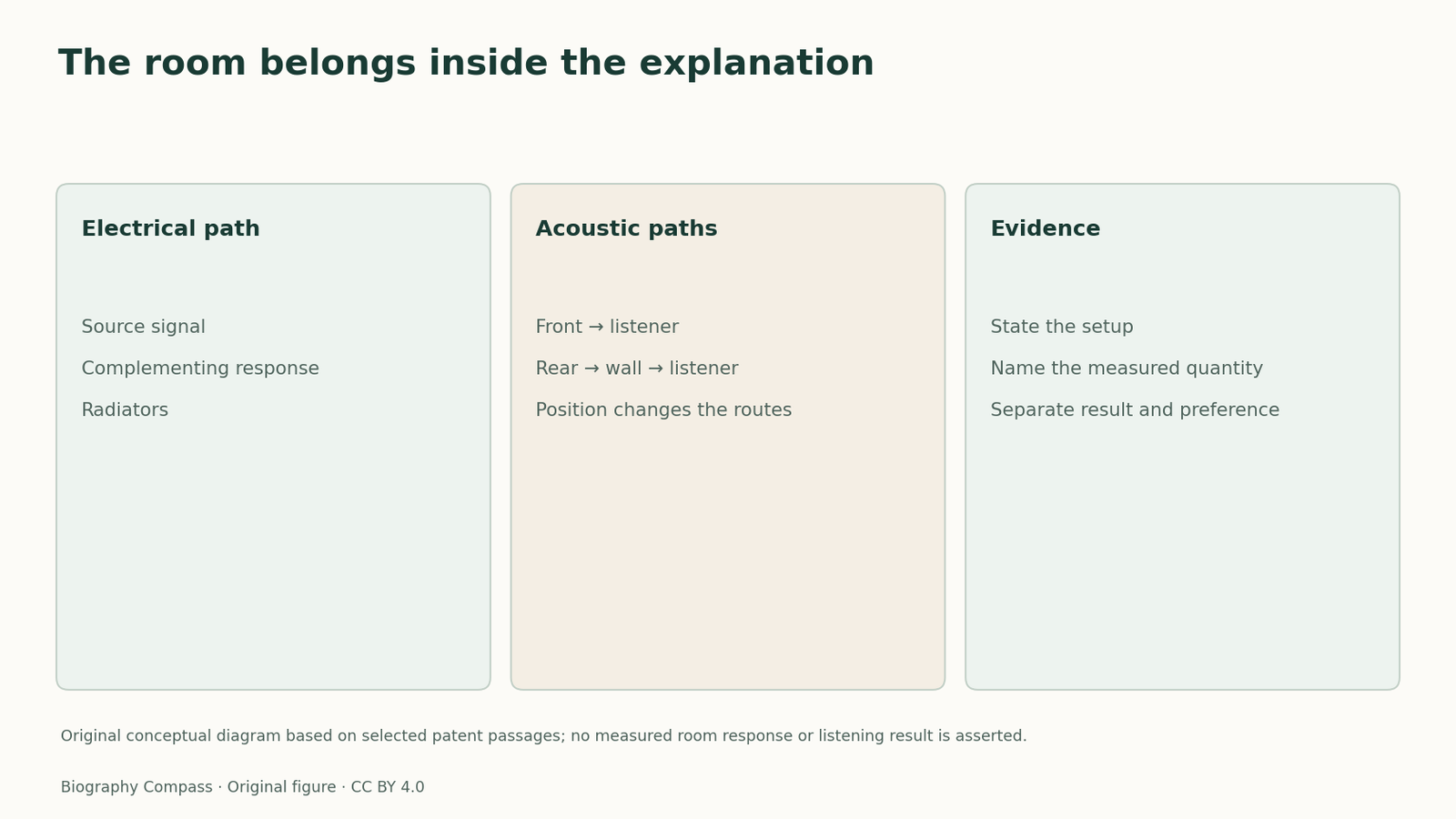
A diagram that ends at a loudspeaker cabinet misses the point of this design. The selected technical records make the wall, the electrical response and the listener’s position part of the explanation.
Evidence and interpretation
Parts, paths and evidence
Each kind of record answers a particular question about the proposed arrangement.
| Question | Useful evidence | Question still open |
|---|---|---|
| Cabinet arrangement | Front and rearward radiators. | Sound at every possible seat. |
| Signal treatment | The complementing circuit is specified. | Preference in an untested setup. |
| Room path | Wall and listener location are part of the model. | Every room behaving identically. |
| Listening judgment | A defined listener and criterion. | Universal fidelity from a single preference. |
Follow the sound beyond the cabinet
The selected patent embodiment places four small radiators on each of two rear baffles and one on a front baffle. It directs rearward sound towards a wall and includes a complementing circuit.
The related 1973 patent explicitly identifies the Bose 901 arrangement and discusses radiated power response rather than only the sound measured on one forward axis.
A driver count describes hardware, but the paths describe the listening arrangement. The direct path and the reflected paths reach the listener through different routes. Moving the cabinet or changing the reflecting surroundings changes those routes even when the electrical signal remains the same.
Equalisation is part of the proposed system
The specification describes measurements at a fixed listening position and a comparison used to determine a complementing response. It explicitly considers the combined loudspeaker-and-room transfer, not only a cabinet in isolation.
This is why “nine ordinary drivers in a box” is incomplete. A proposed electrical response, orientation and room relationship can be as important as the list of parts. Conversely, describing that system does not validate every performance claim within it. An inventor’s preferred measurement and an independent listener’s judgment are different evidence.
Sources for this section: [1]
A useful comparison needs controlled questions
Imagine comparing two hypothetical arrangements using the same music. One is moved to a different wall, while the other stays fixed. A listener’s preference could reflect position as well as the equipment. To compare the arrangements meaningfully, record placement, room, signal path, listening location and the criterion being assessed.
Do not turn one measurement into every possible conclusion. A frequency-response curve at one point concerns a stated setup; it is not a map of all seats. A preference statement concerns a listener and material; it does not establish that the recording’s original space has been reproduced exactly. These limits make a comparison more informative, rather than less.
Reading task: what changed?
Classroom prompt: a cabinet is unchanged, but a large absorbent object is introduced behind it. Which claim can be made from the design explanation alone: that the reflected path may change, that the product will certainly sound worse, or that every seat will change identically?
Reference answer: only the first. The other claims need measurements or observations under specified conditions. The task teaches what follows from a system boundary; it is not a recommendation for treating a room or a report of a listening trial. No company illustration or protected technical chart has been reproduced.
Continue the chronology
Related history guides
Biography context
Explore United States through connected lives
Connected biographies
The working life
1929–2013
Amar Bose
Engineer, teacher and audio entrepreneurBose built a company around sustained engineering research.Read biographyQuick answers
Common questions
- Why does the room belong in a Bose 901 explanation?
- The design uses wall reflections and a complementing circuit, so room paths and electrical response both matter.
Primary and institutional sources
How this history was checked
Selected passages and records support the discussion below. Original reasoning and invented classroom cases are labelled; no whole-archive or product-testing claim is made. This article was reviewed on 4 November 2026.