
The short answer
The key idea is easier to see in a small counting problem than in an award list. Start with three quanta and two available modes, then ask which apparent differences disappear when particle labels carry no physical meaning.
Original worked counting example
Three quanta in two distinct modes
Exactly three particles is a classroom constraint; it is not a claim that photon number is conserved in thermal radiation.
| Country | Labelled assignments | Number of those assignments | Occupation states after removing particle labels |
|---|---|---|---|
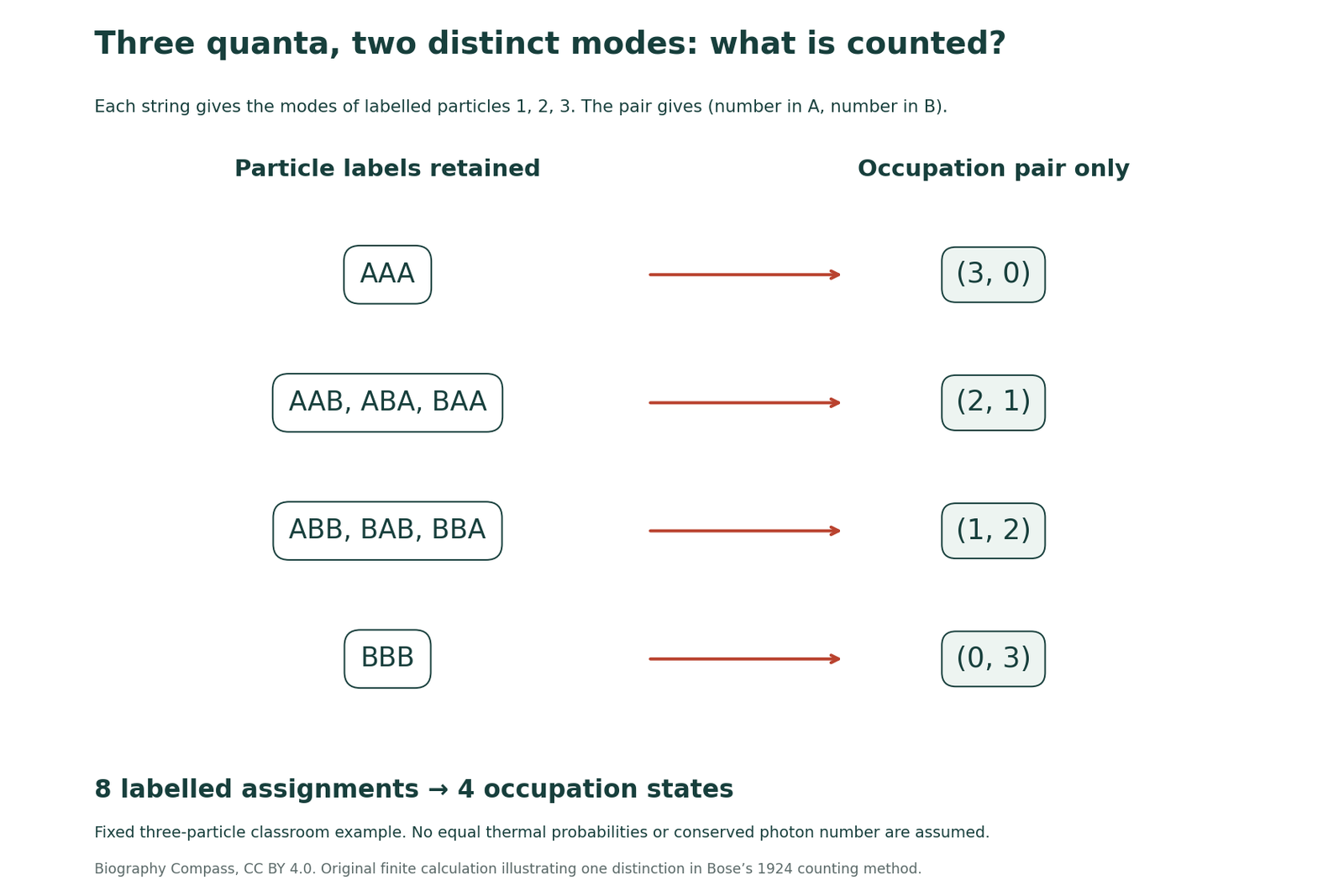
| (3,0) | AAA | 1 | 1 |
| (2,1) | AAB, ABA, BAA | 3 | 1 |
| (1,2) | ABB, BAB, BBA | 3 | 1 |
| (0,3) | BBB | 1 | 1 |
Chronology
A timeline of the turning points
A letter seeking assessment and publication
Bose sent Einstein the paper and requested help with German publication.
German manuscript received
The paper identifies Einstein as its translator.
A radiation result opened another problem
Einstein’s appended note points toward an ideal-gas extension.
Material-particle theory developed
Einstein extended the statistical method beyond the photon application.
Begin with the problem Bose actually set
Bose’s paper aimed to derive Planck’s radiation law using light quanta and statistical reasoning. It considered distributions among cells of phase space rather than beginning with individually named photons. The total energy constrained the calculation. Its success was a result about radiation, not the manufacture of a new particle or a laboratory condensate. The collected volume preserves the German publication and an English rendering, allowing a reader to check the setup, counting step and concluding note separately.
Sources for this section: [1]
What the original counting step includes
For a frequency interval, the paper asks how quanta are distributed among available cells. It counts empty cells, cells occupied by one quantum, cells occupied by two, and so on. The number of cells and the number of quanta are different quantities. The calculation then finds the most probable distribution under its constraints. The paper also introduces a factor of two for polarisation in its cell count. An elementary illustration can isolate the occupation idea, but cannot replace these physical ingredients or the thermodynamic argument that yields the radiation formula.
Sources for this section: [1]
First count three labelled particles in two labelled modes
Our classroom example has two available modes called A and B, and exactly three particles. If the particles carry physical labels 1,2 and 3, each has two choices, so there are 2³=8 assignments. Written as strings for particles 1 through 3, they are AAA, AAB, ABA, BAA, ABB, BAB, BBA and BBB. Here AAB and ABA differ because a different named particle occupies B. This is an explicitly selected finite example, not a list copied from Bose’s paper or a measurement of a photon gas.
Sources for this section: [1]
Now remove the particle labels from the description
When swapping identical particles does not make a new state, the description keeps only the number in each mode. The eight strings collapse into four occupation pairs: (3,0),(2,1),(1,2)and(0,3). The pair(2,1)receives three different labelled strings, but it is one occupation state in the new description. The modes remain distinct; removing particle labels does not remove the labels A and B from the available states. This separation is the point of the exercise and the original teaching figure supplied with this guide.
Sources for this section: [1]
Four states do not automatically mean four equal probabilities
Counting states and assigning physical probabilities are different tasks. Energies, constraints and the statistical ensemble matter. In a thermal radiation field, photon number is not generally fixed; our choice of exactly three quanta isolates one small part of the reasoning. The example therefore does not derive Planck’s full law, establish equal probabilities for the four pairs or describe a complete Bose–Einstein condensate. It shows why retaining artificial particle labels changes a counting problem. The original paper supplies the larger physical and thermodynamic calculation.
Sources for this section: [1]
The letter and the translator’s note establish different contributions
The 4 Juneletter asks Einstein for an assessment and help arranging publication, including translation into German. The published paper identifies Einstein as translator and appends his comment that the method also applies to an ideal gas. Those records distinguish Bose’s radiation work from Einstein’s extension to material particles. The later experimental achievement of dilute-gas condensation was recognised by the 2001 Physics Nobel. It should not be read back into 1924 as something the two men had already made in a laboratory.
Try the counting again, then check the answer
Question: put exactly two identical quanta into three distinct available modes A, B and C. List the occupation triples. How many labelled assignments would there be for two distinguishable particles, and does this establish a thermal probability distribution?
Answer: the six triples are(2,0,0),(0,2,0),(0,0,2),(1,1,0),(1,0,1)and(0,1,1). Two labelled particles each have three choices, giving 3²=9 assignments. As before, the difference concerns whether particle exchange creates a new description. Neither list by itself specifies energies, temperatures or the probability assigned to each state.
Sources for this section: [1]
Connected biographies
People and research
1894–1974
Satyendra Nath Bose
Theoretical physicist and university teacherSatyendra Nath Bose found a new way of counting light quanta while deriving Planck’s radiation law. Einstein translated his 1924 paper into German and extended its method to a gas of material particles, beginning a wider theory of quantum statistics.Read biography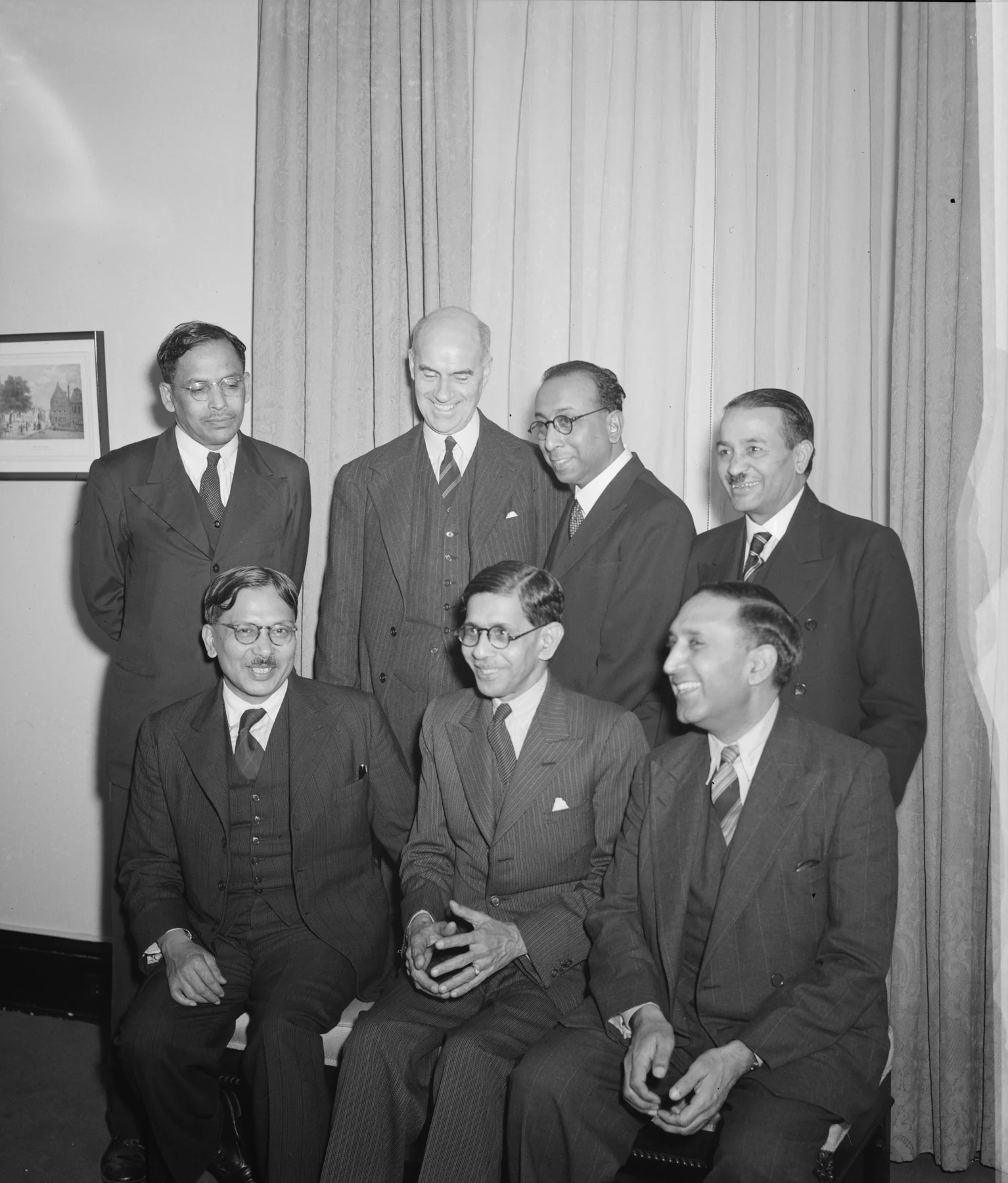
1893–1956
Meghnad Saha
Astrophysicist, research organiser and parliamentarianMeghnad Saha connected atomic ionisation with the changing spectra of stars. He also built research and teaching programmes, helped establish nuclear-physics facilities in Calcutta and entered Parliament to argue about science and national development.Read biographyQuick answers
Common questions
- Are modes A and B indistinguishable in the example?
- No. The available modes are distinct. It is the exchange of identical particle labels that does not produce another occupation state.
- Does the worked example derive the full Planck radiation law?
- No. It isolates a counting distinction. The original derivation also needs phase-space cells, energy constraints, polarisation and thermodynamic reasoning.
Primary and institutional sources
How this history was checked
Read the named original records alongside the worked classroom aids. The diagrams are original explanations, not copies of experimental plots or new measurements. This article was reviewed on 27 October 2026.
- S N Bose National Centre collected papersPlancks Gesetz und Lichtquantenhypothese(1924), German publication and English rendering
- S N Bose National Centre archiveLetter from Bose to Einstein,4 June 1924
- S N Bose National CentreBiographical resume:1924–1925 paper chronology
- Nobel PrizePhysics 2001: dilute-gas condensation prize