
The short answer
How do a bodily enclosure and herbal materials change a sculpture’s setting?
Compare the records
What the sources allow us to say
Read the object record alongside the contextual account.
| Record | Evidence | Reading limit |
|---|---|---|
| Museum records | House of Hope uses repeated structural units and sensory material. | Versions need their own dates and object records. |
| Exhibition context | Connects the work with ritual and bodily experience. | A response is not proof that every visitor felt the same thing. |
Begin with the documented components
MoMA identifies House of Hope as a work made in 1996–1997 with herbs, spices, natural binders, string, wood and steel. Its gallery account describes bead strands suspended above steps and a surrounding painted environment. Each component affects a different aspect of the encounter. The structure organises a space, the steps suggest bodily movement, and aromatic materials extend the work beyond the visible. A material list becomes useful when it is connected with the visitor’s position and senses.
Sources for this section: [2]
Compare two realised settings
The archival essay describes differences between the Tokyo and New York presentations. Boonma considered the first frame too conspicuous and the room too spacious for the intimacy he sought. The later New York setting developed a more encompassing painted atmosphere. These observations show that installing the same project involves more than transporting its parts. The relation among frame, room and body can change the experience. Attribute the criticisms to the documented artist account instead of presenting a curator’s reconstruction as a new interview.
Sources for this section: [3]
Test what a photograph leaves out
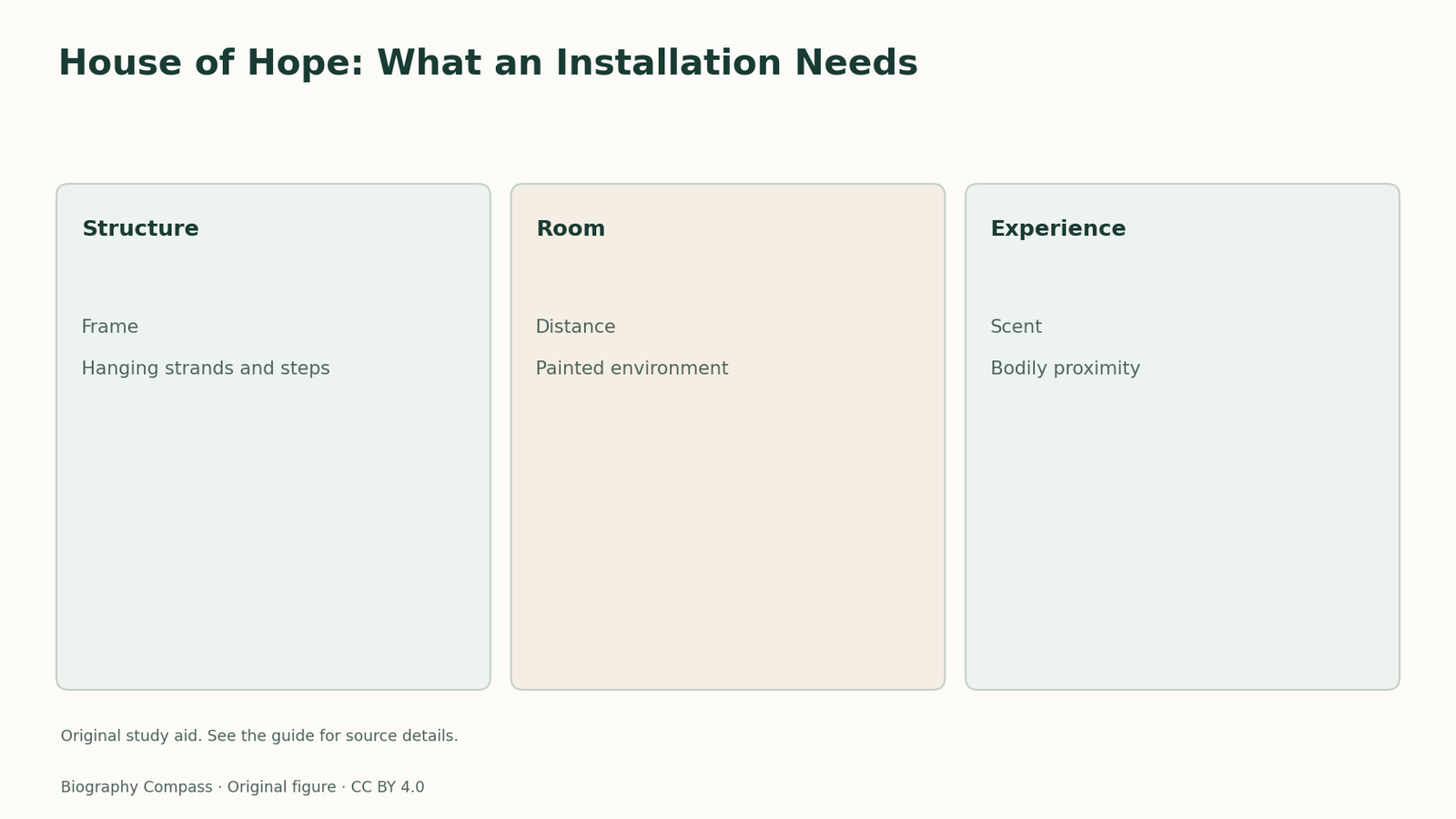
Draw three labelled boxes for structure, surrounding room and sensory experience. Add an arrow wherever a change in one might alter another. A supported answer would connect room size with perceived intimacy and herbal materials with scent. It would also acknowledge that a photograph can show hanging strands but cannot deliver their aroma. The exercise makes a practical limit visible without dismissing photographic records. Such records remain valuable for comparing arrangements, provided that their visual evidence is not made to stand for the whole bodily encounter.
Continue the chronology
Related history guides
Biography context
Explore Thailand through connected lives
Connected biographies
Read the artist’s biography
1953–2000
Montien Boonma
Sculptor and installation artistA Thai artist who used sculpture, scent and architectural enclosures to investigate bodily experience and hope.Read biographyQuick answers
Common questions
- Why can two installations of House of Hope feel different?
- The archival account shows that the frame, room proportions and surrounding treatment affected the atmosphere Boonma sought.
Primary and institutional sources
How this history was checked
The listed records support the facts. Observation exercises and arguments are Biography Compass editorial interpretations. This article was reviewed on 7 November 2026.