
The short answer
A measurement can rule out one possibility without selecting a unique alternative. Overlapping ranges make that distinction visible before any more elaborate classification is attempted.
Selected records and original analysis
Compatibility is a set of surviving possibilities
The two lengths are historical selected ranges; the test observations are invented.
| Observation | First selected range | Second selected range |
|---|---|---|
| Historical intervals | 340–980 µm | 500–1500 µm |
| Invented 700 µm | Compatible | Compatible |
| Invented 400 µm | Compatible | Outside interval |
Chronology
A timeline of the turning points
Selected record
The 1977 regional account prints both selected length ranges.
Original learning example
New stipulated inputs and an independently checked reference answer.
The regional record and its limits
Bergquist’s Hawaiian shallow-water key says that more forms remained to be described or recorded and that some listed species were omitted. It supplements living-specimen characters with skeletal elements.
A key is therefore a record with a geographic and historical scope. The selected pages do not establish a current worldwide classification or show that one measured feature is a complete diagnosis.
Sources for this section: [1]
Two selected entries, not a copied key
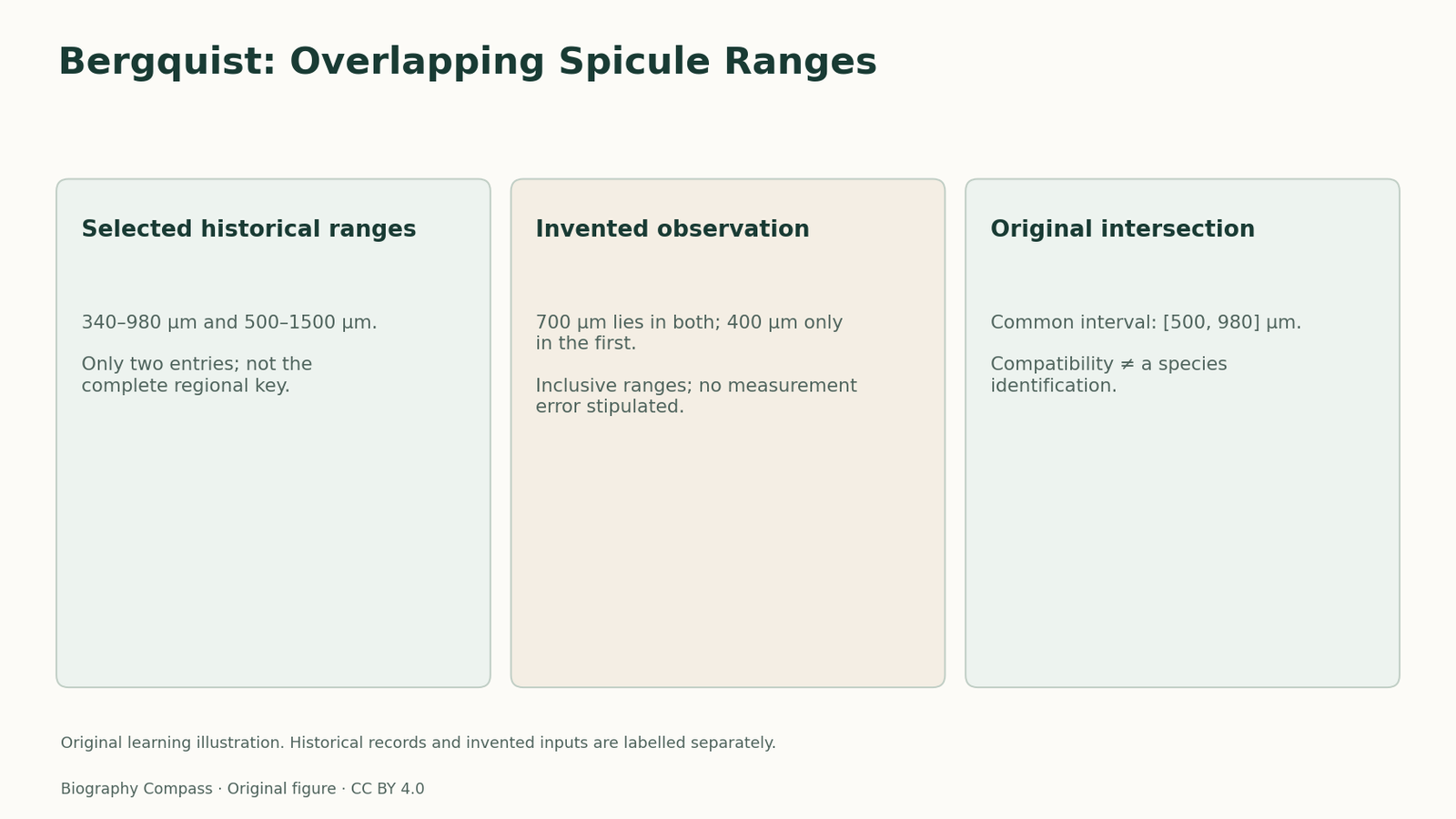
Printed 55 lists strongyle or strongyloxea lengths of 340–980 µm for Tethya sp. and 500–1500 µm for Tethya cf. diploderma. The associated descriptions also distinguish cortical and other characters.
We use only those two length intervals. The qualifiers sp. and cf. remain visible; ranges for other skeletal elements and the rest of the key are not reproduced. An interval is a statement about a selected character, not a promise that every species occupies a disjoint numerical band.
Sources for this section: [1]
Original task: an observation in the overlap
Invent a length observation of 700 µm, assume no measurement error, and treat both printed intervals as inclusive. Which selected entries are numerically compatible? Find their common interval. Repeat the compatibility test at 400 µm. Do not identify an actual specimen from this calculation.
Reference answer: the overlap is [max(340, 500), min(980, 1500)]=[500, 980] µm. The invented 700 lies in both ranges and cannot separate the two entries. At 400, the first interval is compatible and the second is not. That rules out the second on this selected character under the stated assumptions, but does not identify the first against every other taxon.
Sources for this section: [1]
Choose the next observation for a reason
A useful next comparison would concern a character on which the remaining alternatives differ. Merely measuring the same uninformative length more precisely will not remove the overlap for a value well inside it. A record should preserve the specimen association, the feature measured and its units so that another observer knows what was compared.
This is an interpretation of two historical intervals. It supplies no collection, chemical-preparation or laboratory procedure, and it does not silently modernise the names or turn a partial key into a complete identification service.
Sources for this section: [1]
Continue the chronology
Related history guides
Biography context
Explore Hawaiian shallow waters through connected lives
Connected biographies
Researcher and context
Quick answers
Common questions
- Does 700 µm identify a species?
- No. It is compatible with both selected ranges, and the comparison omits other taxa and characters.
- Is the exercise a current worldwide key?
- No. Its historical regional scope and its two-entry limit are explicit.
Primary and institutional sources
How this history was checked
The cited selections support the historical explanation. The new examples state their own assumptions and do not reconstruct an uninspected experiment. This article was reviewed on 31 October 2026.