
The short answer
Turning a film into a musical changes more than the soundtrack. A song occupies live performance time: it needs a reason to begin, a dramatic relationship to speech and a situation that is different when it ends.
Compare creative decisions
A choice needs a dramatic job
Use the distinctions to explain a decision rather than attach a label after making it.
| Decision | Useful question | Possible failure |
|---|---|---|
| Speech | What information must be precise? | Singing information merely to fill time. |
| Song | What pressure, desire or relationship changes? | A number that leaves the scene stationary. |
| Rehearsal | What does an idea do in the shared space? | Assuming the paper plan guarantees the effect. |
Chronology
A timeline of the turning points
Opening number announced
A production notice names UB2.
Director interview
Chadha discusses theatrical reinvention.
A new form, not a sequel
In her 2015 interview, Chadha described a theatrical remake rather than another screen sequel. She also recalled a golden horse that looked promising on paper but did not work onstage and was moved outside the theatre.
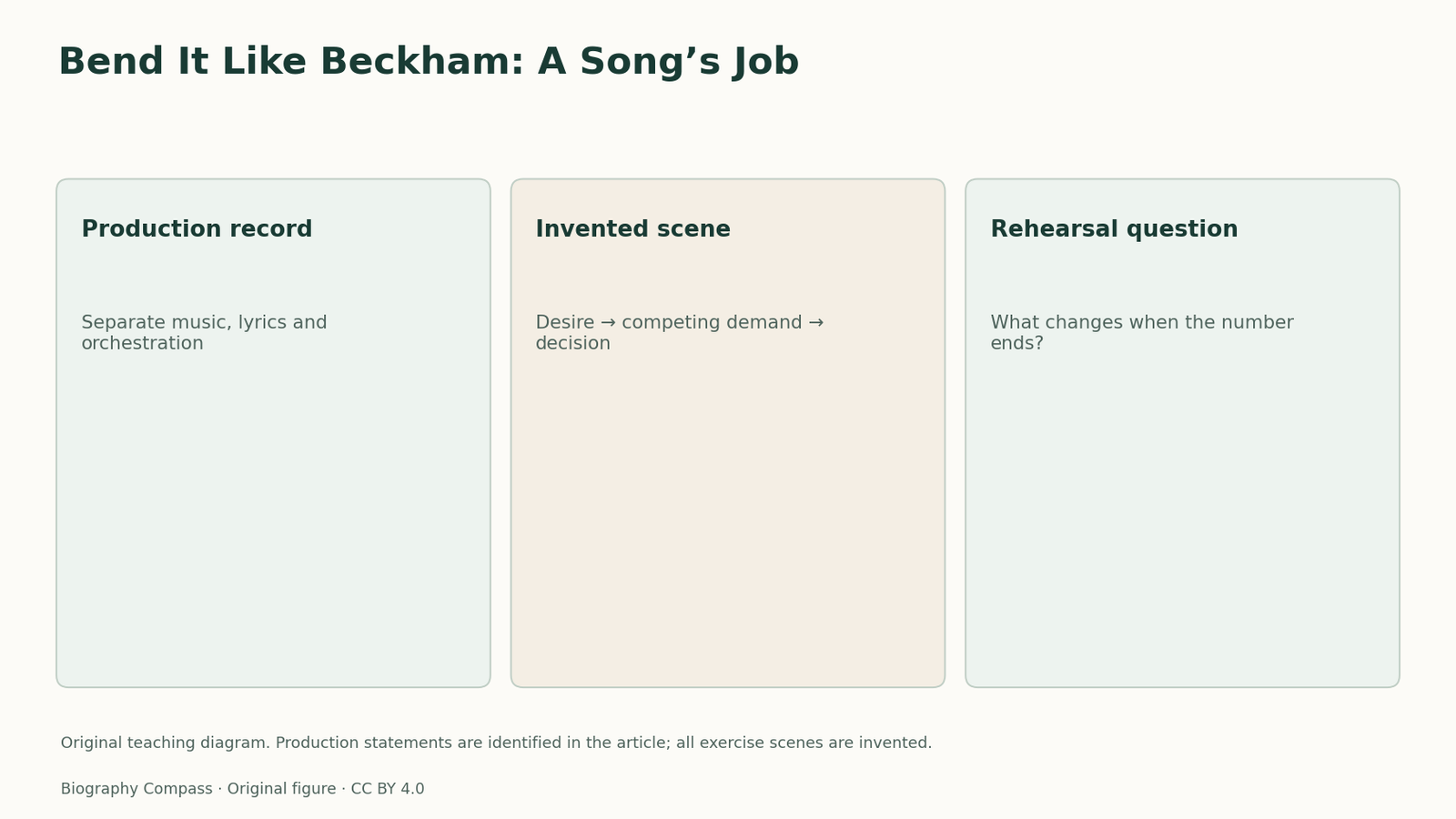
The anecdote separates intention from a rehearsal result. An object can be attractive as a drawing yet distract in performance. The same question applies to a song: what changes when people actually sing, move and share a space?
Sources for this section: [1]
The score had several authors
The original cast-album catalogue credits Howard Goodall with music, Charles Hart with lyrics, and Goodall with Kuljit Bhamra for orchestrations. It describes a meeting of Bhangra and musical-theatre idioms.
Official London Theatre’s March 2015 announcement identifies UB2 as the opening number. That is a dated production record; the embedded performance has not been listened to for this study.
The credits separate composing a tune, shaping verbal rhythm and distributing sound among performers. They do not by themselves tell us exactly how a particular musical phrase works. Here they provide the starting point for a new dramatic design, rather than a substitute for close listening.
Original exercise: give a number a turn
Invent a scene unrelated to the film’s characters: a trainee cook wants to leave a family shop for a competition; a parent needs help serving a queue. Plan a number in three beats: the cook’s desire, the parent’s competing demand, and a decision that changes what happens next. No lyrics or melody from the production are supplied or required.
Identify one piece of information that remains spoken, one action that could recur musically, and the final change. Do not end with both people merely repeating what they wanted at the start.
Reference answer: make singing consequential
One plan keeps the competition deadline in speech, then builds a repeated serving action into the number. The cook initially rushes against the queue; the parent takes over the repeated task, making room for departure. The ending changes the working arrangement, even if the parent still has reservations.
This is one possible structure, not a cultural template. You cannot infer a character’s musical idiom from ancestry, and adding an instrument is not sufficient to represent a community. Decide whose energy shapes each section and what performers are doing while they sing. The production records establish collaboration; the exercise designs a different, explicitly invented scene.
Continue the chronology
Related history guides
Biography context
Explore United Kingdom through connected lives
Connected biographies
The filmmaker’s wider career
Living
Gurinder Chadha
Director and screenwriterHer popular films explore belonging through family conflict.Read biographyQuick answers
Common questions
- Does the exercise reproduce the musical’s lyrics or score?
- No. It supplies a different fictional scene and asks for a dramatic structure, without borrowing a melody or lyric.
Primary and institutional sources
How this history was checked
The director’s interview, a cast-album credit record and a contemporaneous opening-number announcement are compared here. No recording or full performance was consumed. This article was reviewed on 31 October 2026.