
The short answer
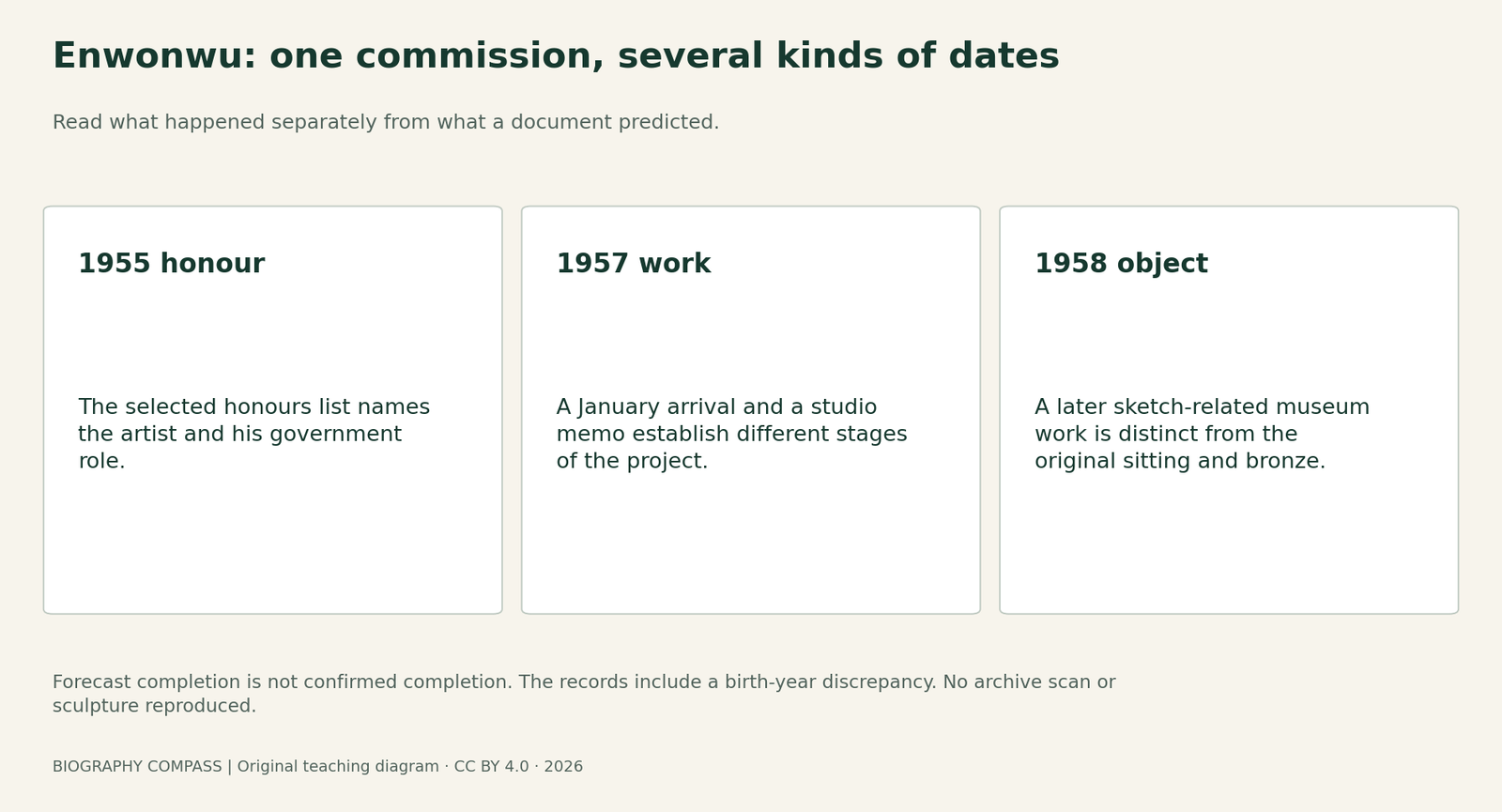
The sculpture’s history is clearer when a commission, a journey, sittings, a proposed casting schedule and a later museum object are treated as separate events. Three contemporary records provide a useful test of what each kind of evidence can establish.
Original source-reading aid
Match the claim to the evidence
A record can establish one stage of the story without proving every later claim.
| Country | Evidence it supplies | Limit |
|---|---|---|
| 1955 honours list | Name, role andhonouryear. | No sitting or completion date. |
| 20 January 1957 arrival | Travel to Britain and administrative entry. | Not a production completion certificate. |
| Studio memo | Completed and anticipated stages at the time of writing. | Forecasts do not prove eventual outcomes. |
| 1958 museum object | A specific later work and its medium. | Not a date for every study or the bronze. |
Chronology
A timeline of the turning points
Begin with an honour that predates the studio work
The National Archives displays a 1955 honours-list extract naming Benedict Enwonwu as an Art Supervisor in Nigeria’s Federal Information Service. It supports the MBE year used here despite inconsistent dates in later biographies. It does not give the award’s artistic rationale or date a portrait sitting. The distinction prevents two prestigious events in an artist’s life from collapsing into a single royal endorsement. The foundation’s broader account remains useful, but a specific official record has the stronger basis for this particular year.
Travel establishes presence before it establishes production
The selected passenger list records arrival at Plymouth on 20 January 1957 aboard the Accra. Enwonwu’s entry identifies him as a government artist and gives a London address. That is evidence of travel and administrative description. It does not establish that he modelled the Queen on the day he landed. The entry also appears to give his birth date as 14.7.18, unlike the 1917 date used by his foundation and the Nigerian Copyright Commission. A contemporary official form can be strong evidence for its main event while containing a biographical discrepancy.
A memo catches the project while it is still changing
Christopher Eastwood’s selected memo reports two completed palace sittings and further sittings expected at William Reid Dick’s studio. It describes the studio, the work in progress and an estimate for finishing and casting. These future-tense statements reveal planning and negotiation. They are not a certificate that every projected date was met. The memo extract was inspected here; the complete Colonial Officefile was not reviewed. That distinction preserves the value of the document without claiming access to correspondence absent from the selected exhibit.
Sources for this section: [1]
Compare later accounts by asking what they are describing
The foundation’s reconstruction describes twelve sittings, a 1957 exhibition and eventual placement in Lagos. Nugent’s archival study places the sculpture within Enwonwu’s efforts to secure standing for his work across colonial institutions and art schools. The early memo’s smaller number of sittings need not refute a later total: one records a stage in an unfinished process. A disagreement about a completed total would require stronger evidence, such as the full scheduling and production record.
The 1958 sketch record identifies another object
Yemisi Shyllon Museum’s catalogue describes First Live Sketchof H. M.Queen Elizabeth II as a 1958 gouache-and-pastel work developed from an earlier live sketch. Its medium and later date distinguish that object from the life-size bronze and the original sitting. A museum title can preserve a relationship to a first sketch without making the catalogued sheet the earliest physical study. The catalogue and foundation also describe the initiative behind the commission differently. The available records establish a negotiated project, not a reason to erase either the artist’s proposal or the Queen’s agreement.
Worked exercise: edit a misleading chronology
Exercise: a draft says the 1955 honour proves the Queen sat that year; the January 1957 arrival proves the sculpture was finished on arrival; and the 1958 museum date disproves all 1957 studio work. Rewrite these three claims using the actual record types.
Suggested answer: the honours list records recognition and a government role. The passenger list records arrival; the memo supplies separate evidence of work in progress and projected completion. The museum record dates a particular later paper object linked to a sketch. None of these dates needs to displace the others. An improved chronology identifies what happened, what the document itself is and what remains unverified, rather than searching for one date to describe the entire commission.
What this reconstruction adds
Reading the records together makes the commission a process involving an artist, a sitter, a borrowed studio, administrators, exhibition arrangements and a destination. It also exposes ordinary historical problems: inconsistent birth years, retrospective totals and plans that need to be checked against outcomes. Those findings are more useful than a single first-artist slogan. They offer a method readers can apply to other commissions while keeping the limits of this selected-document review visible.
Connected biographies
People and wider work
1917–1994
Ben Enwonwu
Painter, sculptor, teacher and cultural adviserBen Enwonwu worked across sculpture, painting, teaching and government service during Nigeria’s transition to independence. His career connected inherited artistic knowledge, British art schools and a sustained argument for the standing of modern African artists.Read biographyQuick answers
Common questions
Primary and institutional sources
How this history was checked
Selected original records and institutional catalogues are linked by section. Access limits are explicit; exercises and figures are original teaching aids. This article was reviewed on 27 October 2026.
- The National ArchivesSelected honours, passenger and studio records
- Ben Enwonwu FoundationArtist biography
- Ben Enwonwu FoundationRoyal sculpture reconstruction
- Gabriella Nugent / Burlington ContemporaryArchival art-history study
- Yemisi Shyllon Museum of ArtFirst Live Sketch:1958 object record
- Nigerian Copyright CommissionArtist life dates