
The short answer
A court’s conclusion can be highly consequential while leaving part of the legal framework in force. This case offers a concrete way to distinguish criticism of a statutory provision from quashing a separate executive order.
Match the remedy to its object
Different instruments, different effects
Specify what the conclusion attaches to before describing its consequence.
| Instrument or measure | What follows | What does not follow |
|---|---|---|
| Executive order | May be the object of a quashing order. | A conclusion about every other instrument. |
| Statutory provision | Can be declared incompatible under the described mechanism. | Automatic invalidation through that declaration. |
| Individual detention decision | Needs its own relevant determination. | A result inferred from a headline. |
Chronology
A timeline of the turning points
The challenged framework
Legislation and a derogation order form different objects.
The appeals
The judges address the legal challenge.
A challenge to detention powers
The appeals concerned non-UK nationals detained under the 2001 anti-terrorism legislation without criminal charges. Bingham’s conclusion in paragraph 73 proposed quashing the designated derogation order and declaring section 23 incompatible with Convention rights.
The order and the statutory section were separate legal instruments. Treating both as one object makes it easy to misdescribe what the judges could change and what required a different response.
Sources for this section: [1]
What a declaration did not do
Hale’s paragraph 220 explains that a declaration of incompatibility does not invalidate the statutory provision or anything done under it. Government and Parliament then have to decide how to remedy the incompatibility.
That distinction is not a claim that a declaration is politically unimportant. It identifies the legal effect of this particular form of relief. A change in the force of an instrument and a reason for changing it through another process are not synonyms.
Sources for this section: [1]
Why the response remained a public question
In 2007 evidence to a parliamentary committee, Liberty criticised the government’s response to the declaration and the control-order regime that replaced detention powers. This is a campaigning organisation’s assessment, not the committee’s own finding.
Its criticism illustrates a further distinction: preserving a statute’s legal operation does not settle whether the political response protects rights adequately. Reading the judicial remedy and the advocate’s argument together keeps legal effect and evaluation visible without assigning either speaker the other’s role.
Sources for this section: [2]
Original instrument map
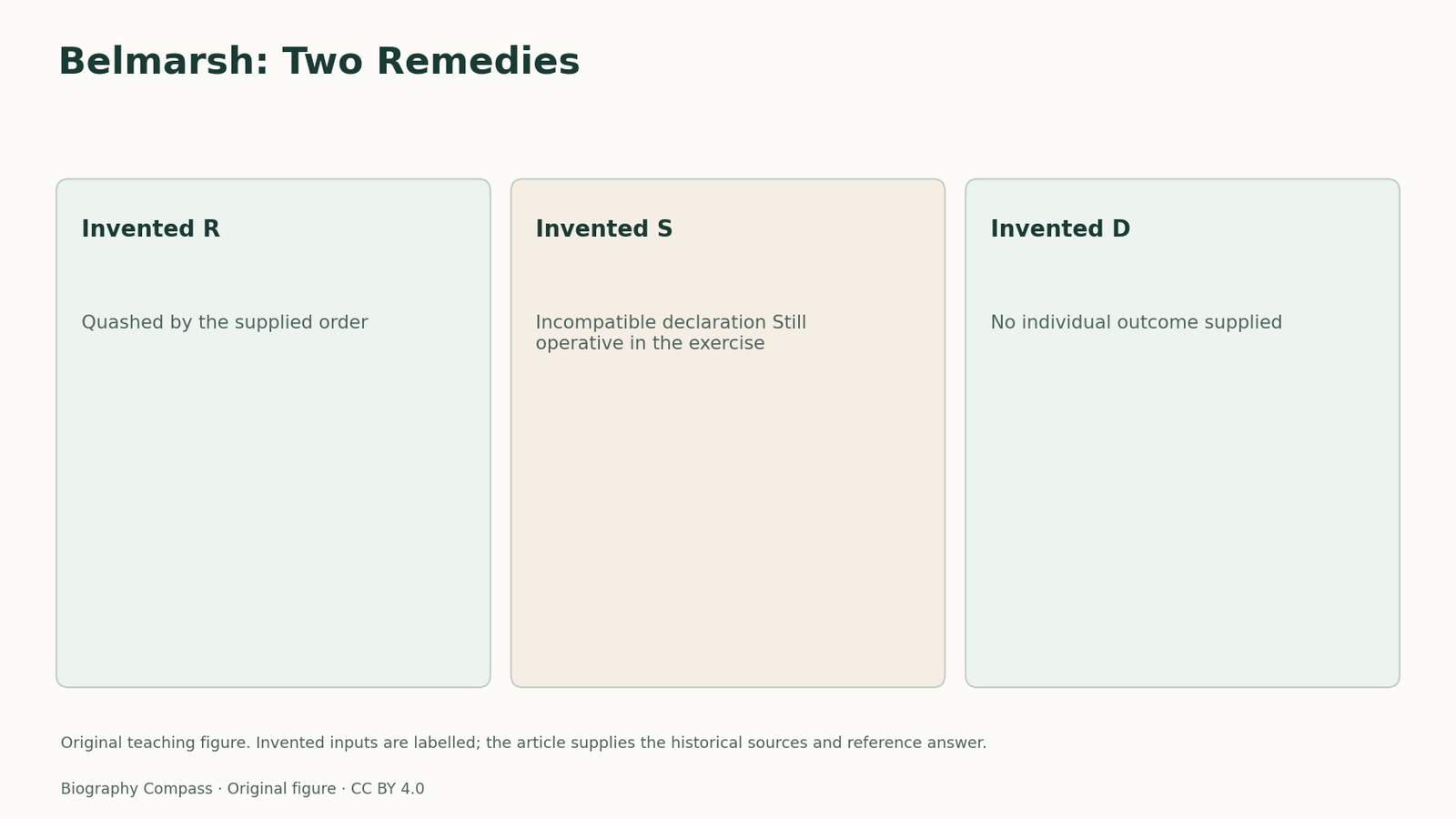
For this exercise invent Regulation R, Statute S and Detention Decision D. Stipulate that the order quashes R, declares S incompatible under the mechanism just described, and makes no determination about the separate decision D. Complete three labels: removed by this order; still operative despite the declaration; individual result not established.
Then repair this fictional headline: “The court erased the entire statute and proved every detention decision void.” Your answer must say what information the exercise does not supply rather than inventing a later outcome.
Sources for this section: [1]
Reference answer and historical limit
R is removed by the stipulated quashing order. S remains operative despite the declaration. D’s individual result is not established. The fictional headline merges three objects and assigns consequences that the supplied order does not give them.
The map teaches a remedial distinction; it is not a set of invented facts about the actual appellants. A different detention claim, later legislation or a different legal system would need its own evidence. The selected judgment passages do not support treating every adverse judicial comment as a power to repeal primary legislation.
Sources for this section: [1]
Continue the chronology
Related history guides
Biography context
Explore United Kingdom through connected lives
Connected biographies
The connected working life

1933–2010
Tom Bingham
Judge and public-law writerA commercial lawyer who became an influential judicial leader and explained the rule of law for a public audience.Read biographyQuick answers
Common questions
- Does the invented map decide every individual case?
- No. It supplies instrument-level conclusions and leaves a separate individual decision without an assigned result.
Primary and institutional sources
How this history was checked
The article uses the selected passages identified below. Original exercise inputs are supplied here, rather than presented as a historical dataset or a ruling on a present dispute. This article was reviewed on 31 October 2026.