
The short answer
How does Atomic Jaya use a fictional weapons project to question bureaucracy and national ambition?
Compare the records
Different records answer different questions
The distinctions below follow the identified sources.
| Record | What it establishes | Limit of the conclusion |
|---|---|---|
| Berlin writer profile | Identifies the 1998 satire and its early company context. | A biographical summary is not a performance transcript. |
| Checkpoint 2003 record | Documents a particular director and production arrangement. | Its role count should not be imposed on every revival. |
| Checkpoint 2013 record | Distinguishes first staging, revival, performers and sixteen characters. | Characters and credited performers are different quantities. |
A fictional scientific project exposes other problems
Atomic Jaya asks what might happen if Malaysia decided to construct an atomic bomb. The 2013 production description places physicist Mary Yuen inside a secret project led by General Zulkifli, where scientific work encounters ministers, smugglers, social ambition and a difficult moral decision. This is a satirical premise, not a historical report that such a weapons programme existed. The Berlin festival’s account connects the play with exaggerated national ambition. A useful reading therefore follows the relation between an expert’s responsibility and the pressures around the expert, rather than treating the script as a technical explanation of nuclear engineering.
The play and a particular production have different dates
Checkpoint records the first staging by Straits Theatre Company in Kuala Lumpur in 1998, its own first production in 2003 and a fifteenth-anniversary revival in 2013. Those dates identify an original play and subsequent performances. The 2003 entry credits Casey Lim as director, while the 2013 production credits Sulaiman with writing and direction. Changing directors does not create a different author of the script, but it can create a different performance. The records thus provide a concrete way to study a work’s continued life through new teams instead of flattening every revival into its first appearance.
Multiple characters do not require one actor each
The 2013 record names Claire Wong and Karen Tan as performers and describes a cast of sixteen characters. The 2003 record describes fourteen roles and a different performance arrangement. These production-specific counts should not be silently combined into one fixed casting rule. They instead indicate a theatrical problem: how can an audience recognise shifts between people when a performer takes more than one role? Voice, posture, movement, costume or staging could establish distinctions, but the inspected pages do not identify every actual transition. We read credits and descriptions, not a complete performance recording, so those possibilities remain questions for analysis rather than observations asserted about the actors’ work.
Role-mapping exercise and answer
Invent four characters: a scientist, a minister, a supplier and a canteen worker. Assign them to two imaginary performers and mark which pairs would need to appear in the same conversation. Ask where a change of voice alone might suffice and where a staging solution would be needed to avoid an impossible simultaneous appearance. A supported answer distinguishes a character count from a performer count and recognises that a script’s speaking relationships constrain the distribution. It also explains how rapid doubling could expose similarities between positions of authority or dependency. The map is an original exercise, not the actual casting of Atomic Jaya. The documented revival records give the problem a specific historical basis without supplying a universal solution.
Continue the chronology
Related history guides
Biography context
Explore Malaysia through connected lives
Connected biographies
People and practices to explore

b. 1973
Huzir Sulaiman
Playwright and theatre directorHuzir Sulaiman writes and directs theatre that brings political satire and intimate experience into collaborative performance, from Atomic Jaya to his work with Checkpoint Theatre.Read biography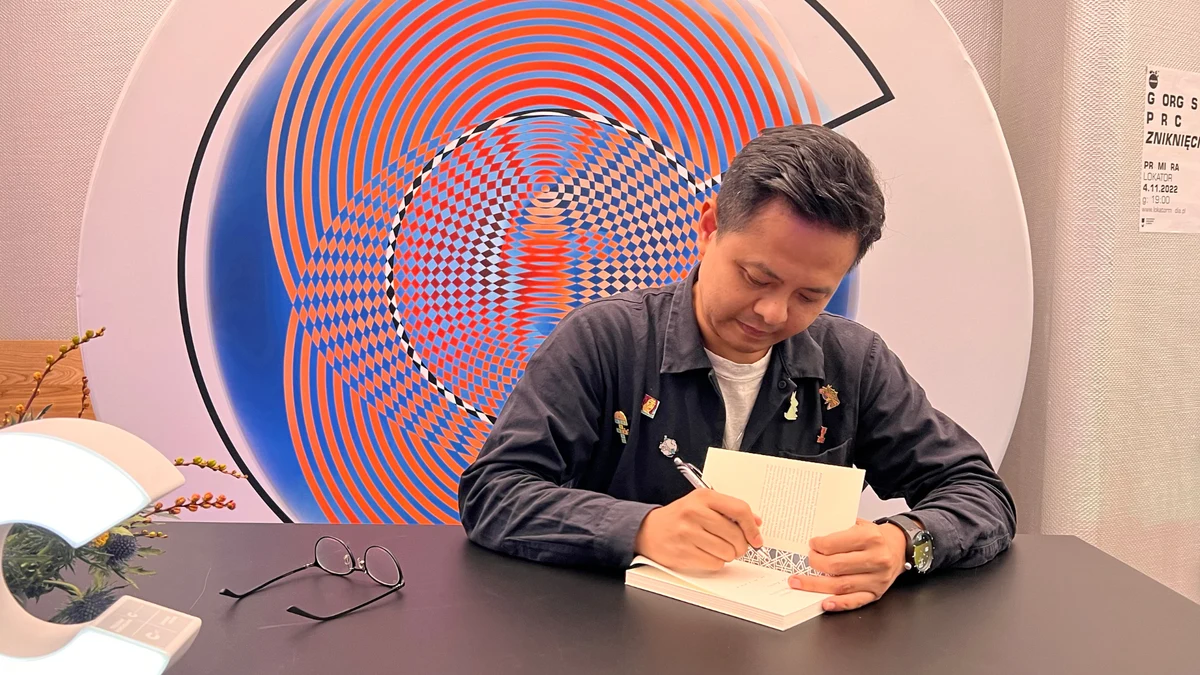
1977—
Alfian Sa’at
Singaporean poet, fiction writer and playwrightAlfian Sa’at writes poetry, fiction and plays in English and Malay, using everyday lives, historical memory and documentary theatre to explore Singapore’s social experience.Read biography1939–2002
Kuo Pao Kun
Playwright and theatre educatorKuo Pao Kun built institutions for theatre across languages.Read biographyQuick answers
Common questions
- Is Atomic Jaya based on an actual Malaysian atomic-bomb programme?
- The checked production records present an imagined programme as political satire. The guide does not treat that premise as an established historical event.
Primary and institutional sources
How this history was checked
Written catalogues, production records and interviews are distinguished from our own learning exercise. No complete film viewing, song listening or full-novel reading is claimed where only the identified written material was inspected. This article was reviewed on 7 November 2026.