
The short answer
A displayed line, a species mass and an average mass are different objects. A useful interpretation must connect them explicitly rather than count marks and call the count a number of constituents.
Evidence and original analysis
Two masses, four possible coordinates
Invented masses and allowed charge states.
| Isotope mass | z=1 | z=2 |
|---|---|---|
| 10u | 10 | 5 |
| 12u | 12 | 6 |
| Mean mass | 10.6u | Not a new isotope |
Chronology
A timeline of the turning points
Lecture
Mass spectra and isotope interpretation.
Original decoding
A stipulated mass-to-charge coordinate.
Read the line assignments
Aston’s lecture lists neon lines at 10, 11, 20 and 22. It assigns the first pair to second-order lines and the isotope masses to 20 and 22. It then relates a mixture of the two masses to a mean of 20.20.
This is a dated historical account. Its numerical estimates are not offered as a current abundance table. The essential distinction is that charge changes the displayed ratio without creating another isotope.
Sources for this section: [1]
Decode an invented spectrum
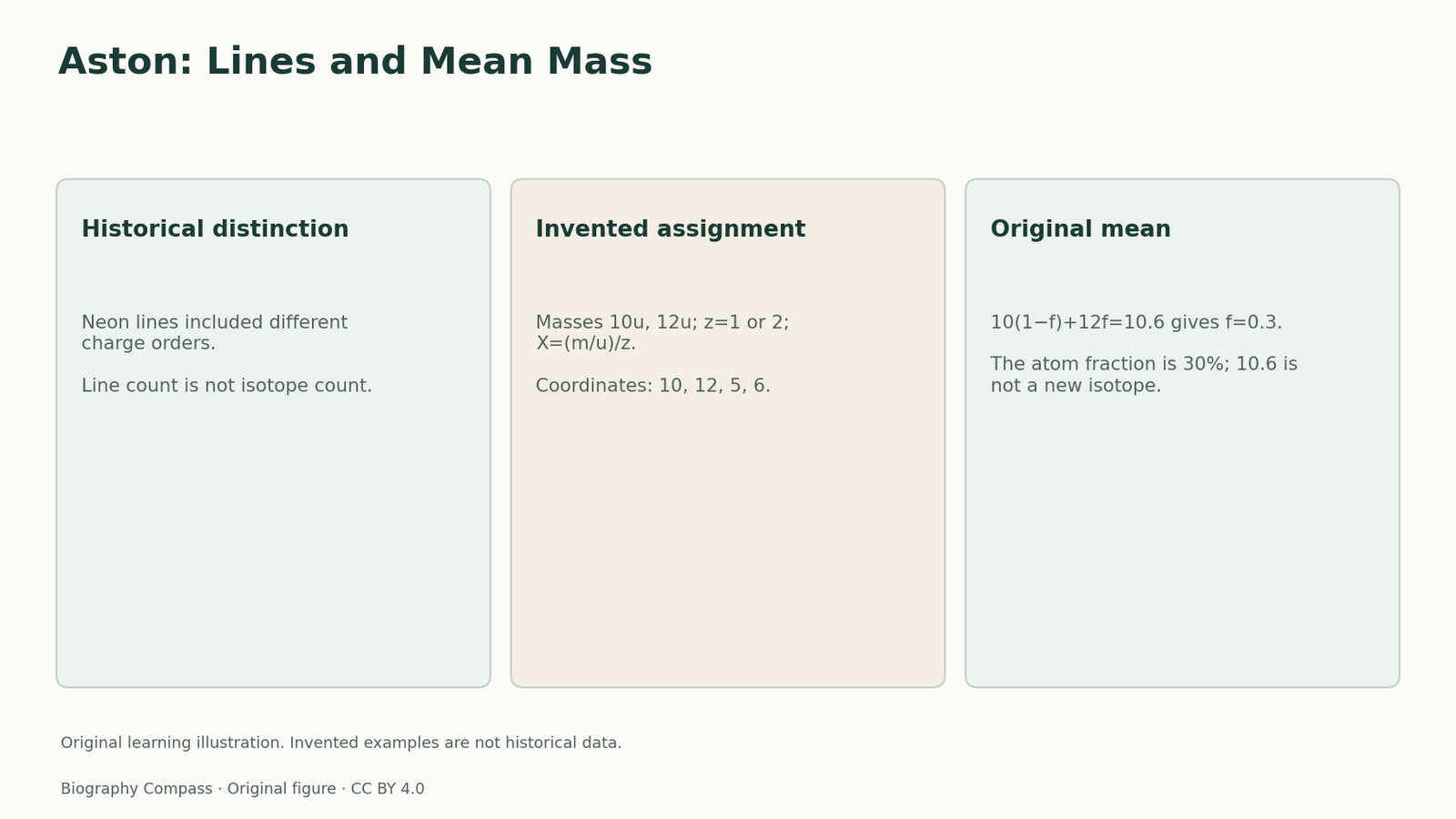
Suppose a specimen contains only isotope masses 10u and 12u, where u is an arbitrary common mass unit. Either isotope may carry charge number z=1 or z=2. Define a dimensionless teaching coordinate X=(m/u)/z. List the four possible coordinates.
A separate measurement gives the mean mass per atom as 10.6u. Infer the fraction of atoms belonging to the heavier isotope. Is 10.6 required to be a displayed line? Explain why the four peak heights alone have not been enough information for this exercise.
Sources for this section: [1]
Reference answer
The coordinates are 10 and 12 for z=1, and 5 and 6 for z=2. Four possible lines have arisen from two isotope masses. If f is the heavier atom fraction, 10(1−f)+12f=10.6, so f=0.3.
The mean 10.6u is not the mass of either constituent and need not appear as a line. Peak heights would require response and charge-state assumptions before they could be used as atom fractions. The fixture instead supplies the mean independently.
Sources for this section: [1]
Keep the coordinate conditional
X is a deliberately defined teaching coordinate, not a calibrated distance on Aston’s photographic plate. An actual spectrograph also requires its instrument relation and reference measurements. The exercise isolates assignment and averaging without claiming to reproduce that apparatus.
Sources for this section: [1]
Continue the chronology
Related history guides
Biography context
Explore United Kingdom through connected lives
Connected biographies
The researcher and the record
Quick answers
Common questions
- Do four lines mean four isotopes?
- Not in this fixture: two charge states produce four coordinates from two masses.
- Is the heavier fraction a mass fraction?
- No. The equation uses the fraction of atoms, because the supplied mean is per atom.
Primary and institutional sources
How this history was checked
Selected historical passages are distinguished from the original teaching model. Invented inputs are not reconstructed experimental data. This article was reviewed on 31 October 2026.