
The short answer
Why does a particle stay near a tightly focused beam rather than simply being pushed downstream?
Read the evidence
What counts as optical confinement
A trap needs a stable balance rather than only a detectable force.
| Contribution | Role | How to assess it |
|---|---|---|
| Scattering force | Pushes along propagation | Check whether another contribution can counter it |
| Gradient force | Can pull toward the focus | Check axial and transverse behaviour |
| Stable point | Small shifts produce a return | Compare force signs on both sides |
Momentum transfer and the intensity gradient
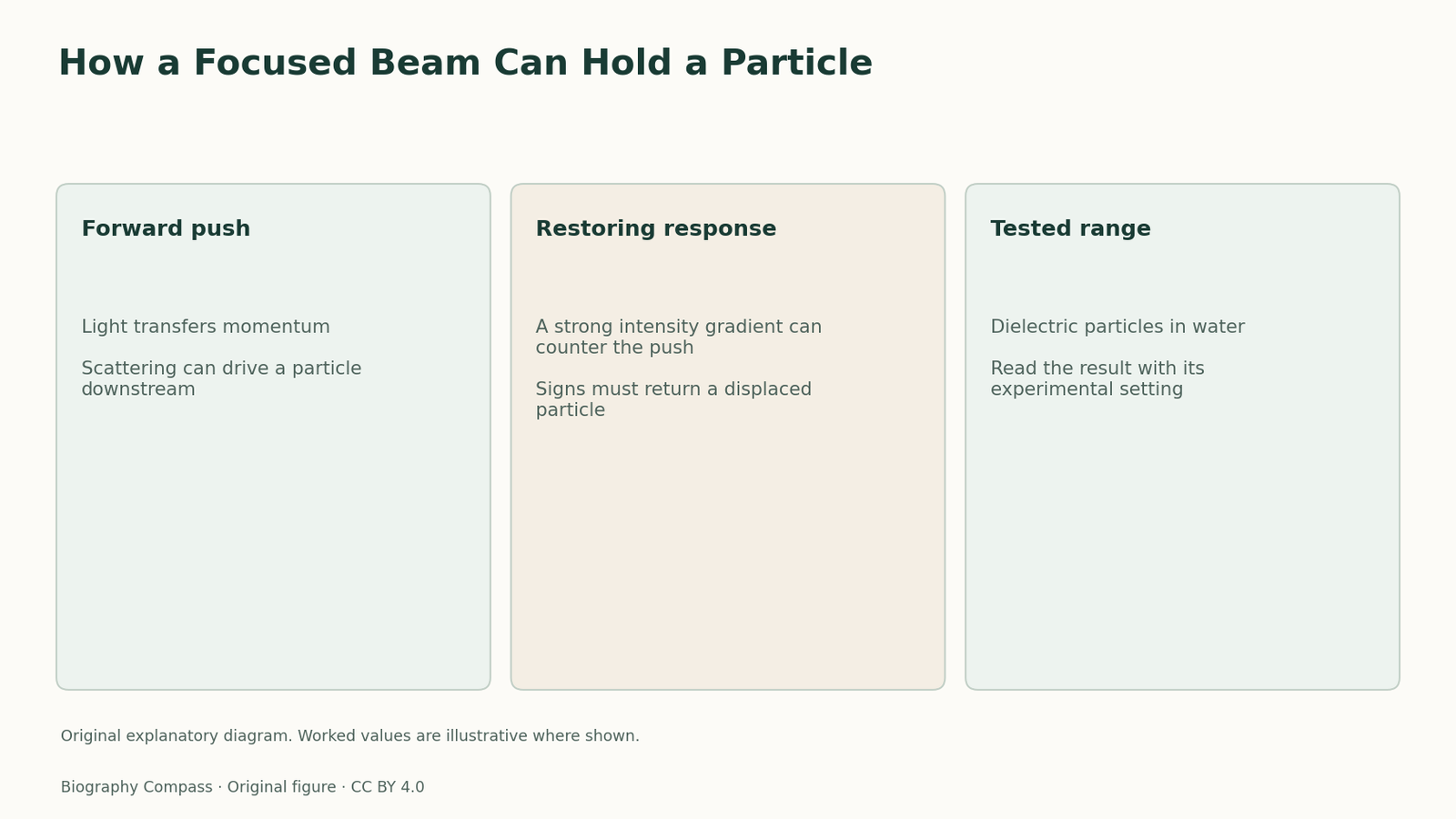
Light carries momentum. When it interacts with a particle, the change in the light’s momentum can exert a mechanical force. An effect often called scattering force can push a particle along the direction in which the beam travels. A spatial change in light intensity can provide another contribution. For a particle with appropriate optical properties in a focused beam, this gradient force can pull toward the more intense region. A useful trap has to balance the downstream push while also giving restoring forces for small displacements across the beam.
A balance point needs stability
Consider the force along the beam axis. At an equilibrium position the forward and backward forces cancel. But that fact alone cannot determine whether the particle stays there. Move it slightly downstream and ask which way the net force points. A stable balance returns it toward equilibrium. Move it upstream and the force should reverse direction. The three-dimensional question additionally requires confinement in the transverse directions. This is why the 1986 result was more than a demonstration that light could exert pressure. It showed a geometry that could hold appropriate particles near a focused region.
An invented set of force readings
Set downstream as positive. Suppose the net axial force is plus two arbitrary units a little upstream of a balance point, zero at the point and minus two a little downstream. Those signs tend to return the particle from either side. If the signs are reversed, the zero force at the centre instead marks an unstable balance. The numerical example does not provide laser settings or measured forces. It separates two logical conditions: finding a position with no net force, and knowing how the force changes when the particle is displaced.
Sources for this section: [1]
Read the size range with its setting
The authors reported trapping dielectric particles in water from approximately ten micrometres down to about twenty-five nanometres. That range refers to the objects and medium in the study. It does not imply that the same optical response occurs for every material or environment. The mechanism can be described with different approximations for small particles and for particles large compared with a wavelength. Both descriptions still have to account for how the direction of the forces allows confinement. The headline result is a single focused beam that does more than drive particles forward.
What the earlier comparison reveals
Earlier forms of optical holding could use a second beam or exploit a balance with weight. In the 1986 article, strong focusing lets the optical gradient itself provide the axial restoring part. This is a comparison between mechanisms, not a claim that previous work played no role. A reader can test any proposed description of a trap by asking what counters the forward push and what restores a displaced object in each direction. Those questions also explain why a beam that plainly moves a particle does not automatically constitute a pair of optical tweezers.
Continue the chronology
Related history guides
Biography context
Explore United States through connected lives
Connected biographies
Researchers and collaborators
1922–2020
Arthur Ashkin
Experimental physicist and optical trapping researcherRead Arthur Ashkin’s path from Columbia and Cornell to Bell Labs, his work with Dziedzic, Bjorkholm and Chu, and the development of optical tweezers.Read biography
1948–
Steven Chu
Experimental physicist and former U.S. Secretary of EnergySteven Chu moved from mathematics and physics training into experimental research at Bell Labs, Stanford and Berkeley, followed by service as U.S. energy secretary.Read biography1959–
Donna Strickland
Optical physicistDonna Strickland developed chirped pulse amplification as a doctoral researcher, then pursued ultrafast optics through laboratories in Canada and the United States.Read biographyQuick answers
Common questions
- What distinguishes stability from balance?
- Stability requires a return force after a small displacement from the balance point.
- Did the paper show trapping for all materials?
- It reported a size range for tested dielectric particles in water.
Primary and institutional sources
How this history was checked
Dates, legal milestones and historical claims are checked against the official and institutional records below. This article was reviewed on 13 November 2026.