
The short answer
A steer skull became a widely debated image of dry land. The original record and Rothstein’s later account support different kinds of historical claim.
Compare the evidence
What each record can establish
The subject, production and publication evidence have separate origins.
| Record or element | Source | Useful claim |
|---|---|---|
| Object record | Library of Congress 2017760596 | Maker, caption, place and date |
| Retrospective interview | Rothstein’s account | What he remembered about the series and its use |
| Related dry-ground photograph | Separate archive identifier | Another subject in the same regional work |
Identify the object under discussion
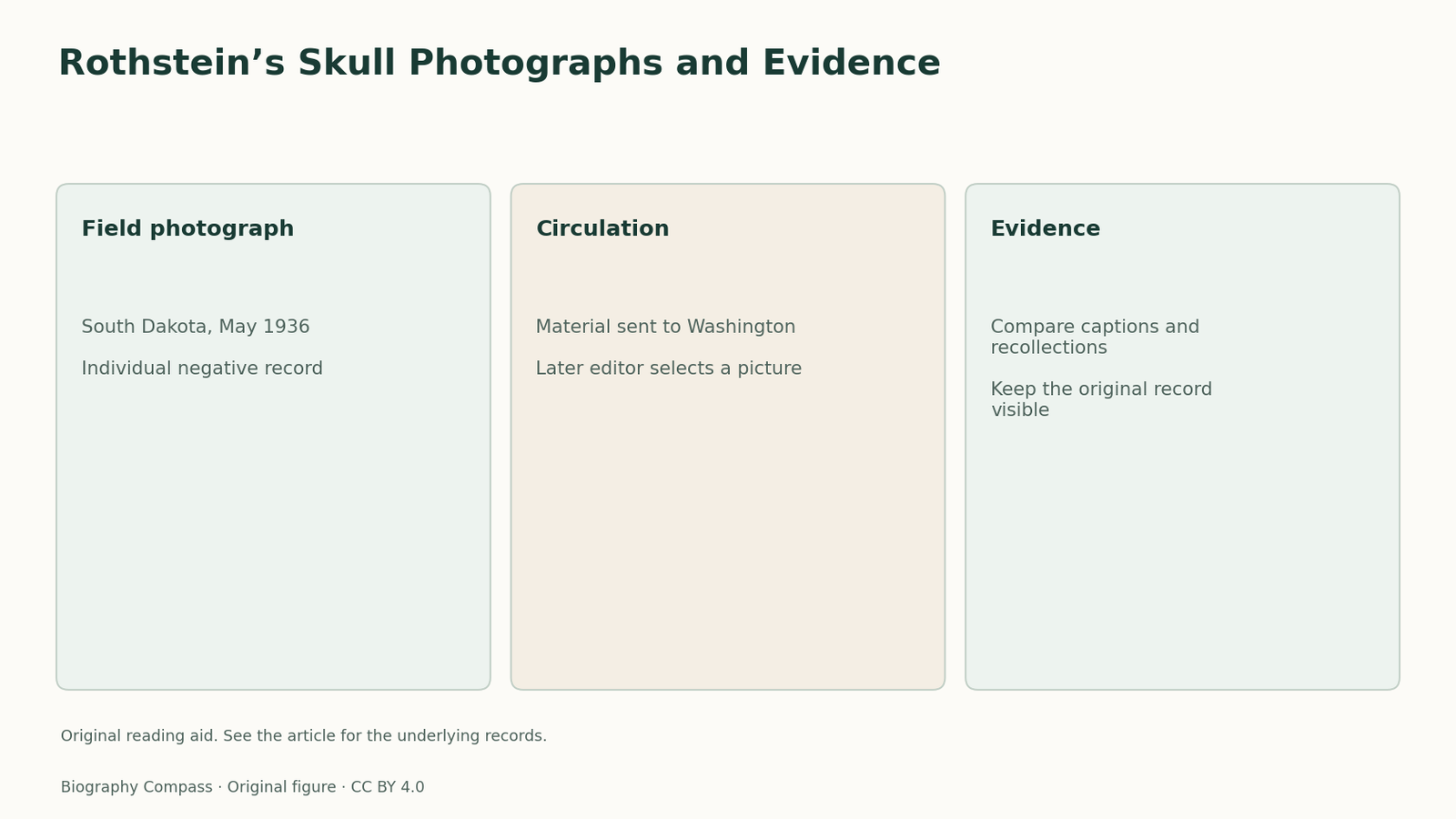
The Library of Congress attributes item 2017760596 to Arthur Rothstein and dates it to May 1936 in the South Dakota Badlands. The object record supplies the caption and a stable route to the image. Begin with that place and date, then consider what the caption asks a viewer to notice. It relates a steer skull to dry ground. It does not by itself establish a cause of drought, an original location for the skull or the identity of a later publication. These are separate questions that require evidence beyond the maker’s name and the thing pictured.
Read the account of making and using the image
In a 1964 interview with Richard Doud, Rothstein distinguished his making of the photograph from the way it was later used. He recalled that an Associated Press picture editor selected a frame from material sent to Washington. A Franklin D. Roosevelt Library teaching resource describes Rothstein repositioning the skull in the course of the series. Put the two accounts next to the object record. Together they give reasons to ask about arrangement, caption and circulation. Treat the recollection as evidence of what Rothstein reported decades later. A claim about the wording or placement of a particular newspaper story would still need the story.
Compare the other May records
The Library also catalogs Rothstein photographs of dry ground and of a road under construction in the Badlands area in the same period. The dry ground can be considered without the skull as a central object. The road record adds evidence of activity in the region. These records support a comparison of choices about subject and scale. They cannot settle from appearance alone whether every surface was typical of the surrounding area. Use the caption and date for each object, then decide what additional evidence would be needed to turn the visual observations into an account of land use or weather.
State exactly what the evidence supports
A useful caption gives Rothstein’s name, the Badlands and May 1936, followed by the item identifier. A longer discussion can add the photographer’s recollection of circulation and the documented question about the arrangement of the subject. Keep those statements distinct from an interpretation of the skull as a symbol. The same picture can be studied as a view of a real place, as a deliberately composed image and as material selected for publication. That sequence helps explain why debate over one use of the photograph should be checked against a particular caption and context. In a research note, identify who supplied each statement and when. That small practice keeps a 1964 recollection and a 1936 negative from appearing to come from one record.
Continue the chronology
Related history guides
John Vachon and the FSA Picture File
Follow John Vachon’s move from federal picture filing to the Omaha assignment and see how a book selected five images from a larger body of work.
Read the timelineNovember 1939Wolcott’s Juke Joint Photograph and Caption
Compare Marion Post Wolcott’s November 1939 Clarksdale photographs and learn how caption cards, negative identifiers and later records distinguish them.
Read the timelineBiography context
Explore United States through connected lives
Connected biographies
Photographers and related work
1915–1985
Arthur Rothstein
Documentary photographer and magazine editorArthur Rothstein moved from Roy Stryker’s federal photographic unit into magazine work, developing a career in both making and selecting pictures.Read biography1898–1969
Ben Shahn
Painter, printmaker and documentary photographerBen Shahn made paintings, photographs and prints that placed the work and lives of ordinary people within larger histories.Read biography1903–1975
Walker Evans
Photographer, editor and teacherA photographer and editor who found lasting visual complexity in ordinary places, objects and public encounters.Read biographyQuick answers
Common questions
- Was the skull photograph made in Oklahoma?
- The Library of Congress identifies this item as a May 1936 photograph from the South Dakota Badlands.
- Can a caption establish how the scene was arranged?
- Use the object record for the catalog identification and consult the interview or other production evidence for the arrangement.
Primary and institutional sources
How this history was checked
Dates, legal milestones and historical claims are checked against the official and institutional records below. This article was reviewed on 13 November 2026.
- International Center of PhotographyArthur Rothstein
- Library of CongressTenant Farmers
- Smithsonian Archives of American ArtOral history interview with Arthur Rothstein
- Library of CongressSteer skull in the South Dakota Badlands
- Library of CongressDry and parched earth in the Badlands
- Library of CongressArthur Rothstein Papers
- National Museum of American HistoryDust Bowl in Images
- Franklin D. Roosevelt Presidential LibraryFSA picture interpretation guide
- Library of CongressRoad under construction, Badlands extension