
The short answer
How did camouflage, wartime employment and harbour movement reshape Lismer’s painted scene?
Read the evidence
Sources, interpretation and production roles
The records answer different questions about this work. The final exercise is an original teaching model.
| Record or question | Supported reading | Boundary or contrast |
|---|---|---|
| Museum convoy account | Documents a coordinated harbour departure and its wartime context. | A gathering of ships is not merely a neutral view of traffic. |
| Dazzle description | Establishes an intended protective purpose. | The guide does not claim a measured success rate. |
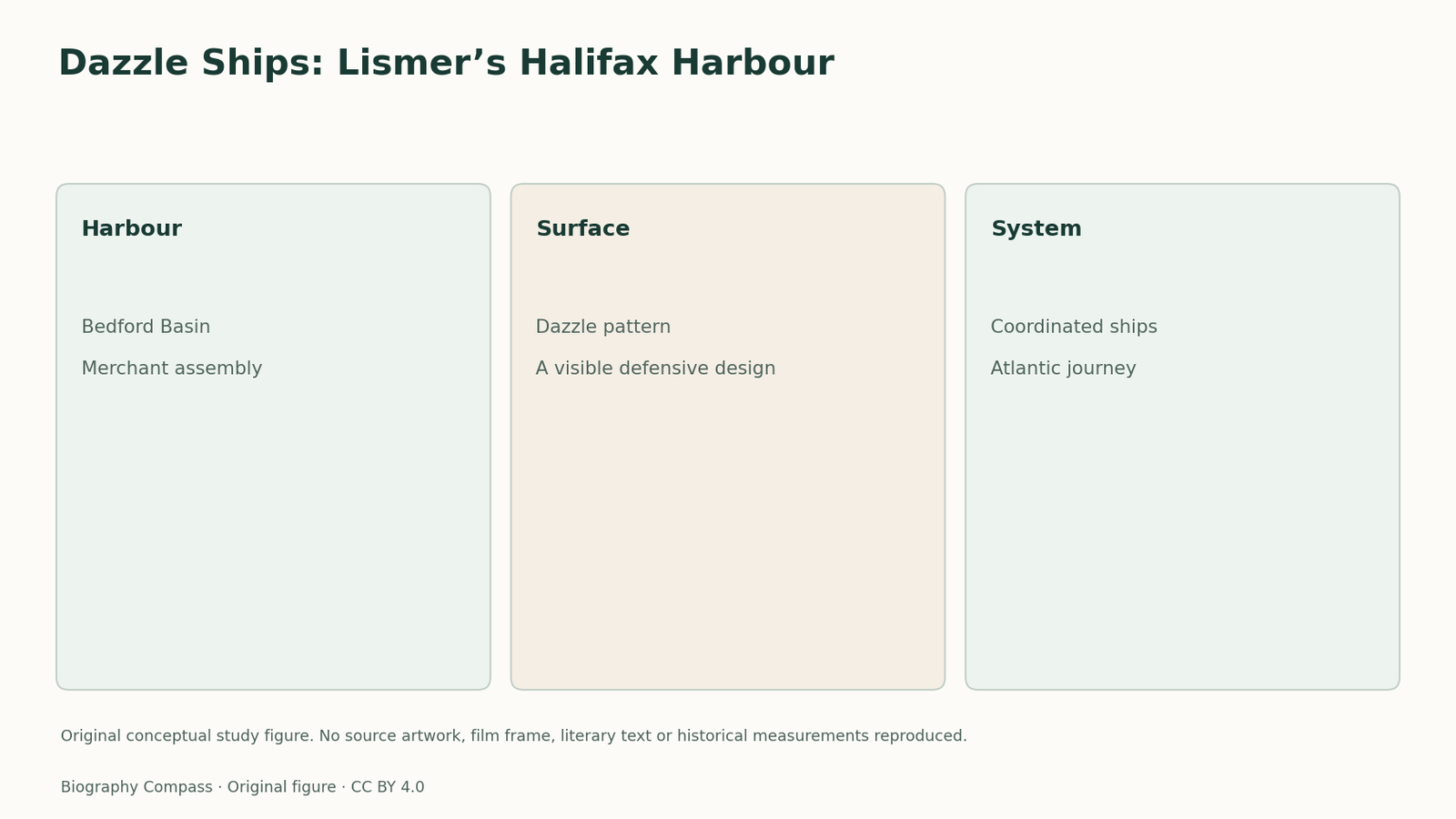
| Original surface/system model | Separates a vessel’s pattern from group organisation. | It is a conceptual comparison, not a naval reconstruction. |
A harbour picture with a logistical subject
Convoy in Bedford Basin depicts merchant ships assembling near Halifax for an Atlantic crossing. The Canadian War Museum’s account explains the harbour’s role in transporting food, supplies and people. It places the convoy system within a response to losses from submarine attacks in 1917. This is more than a picturesque gathering of vessels. The painted subject concerns ships brought into relation for a coordinated journey, making organisation part of what the image represents.
Sources for this section: [3]
Dazzle does not mean disappearance
The same museum account identifies the patterned surfaces as dazzle camouflage, intended to help protect vessels from submarine attack. The crucial distinction is between a visible pattern and ordinary ideas of concealment. A strongly marked ship need not be trying to blend into the sea like a uniform patch of colour. Here the guide’s interpretation asks how a painting can make that contradiction legible: an arresting surface can belong to a defensive system. The record establishes the intended purpose, not a measured guarantee that the patterns defeated a particular attack.
Sources for this section: [3]
A city where art and war work overlapped
Lismer was principal of the Halifax art school while he made wartime images. The Art Canada Institute account documents his efforts to expand teaching and museum activity; Parks Canada identifies his official harbour record. These roles place the work within an inhabited, institutional city. The convoy was not an isolated artistic spectacle, and the painter was not a visitor without local responsibilities. His separate Olympic painting adds a further harbour event rather than another title for the same canvas. Attention to these differences makes the Halifax work a group of related studies of a city at war.
Original exercise: surface and system
Draw three plain rectangles to stand for invented ships, with no historical vessel silhouettes. In one plan leave them uniform; in another add an invented pattern of broad patches. Describe the change in visibility without claiming a proven military effect. A reference answer can say that the patterned surfaces attract attention and break up a continuous outline, while recognising that this exercise does not test real observation at sea. Now arrange the rectangles as isolated travellers and then as a coordinated group. Ask what additional information would be needed to explain the group’s movement: route, escort and timing are useful answers. Relate the two parts of the model to Lismer’s documented subject. Pattern concerns a vessel’s surface; convoy organisation concerns relationships among vessels. The painting can bring both into one harbour scene without making them the same protective mechanism. This gives the reader a concrete way to discuss the work’s military context and visual interest while leaving effectiveness claims to evidence that the inspected records do not supply.
Continue the chronology
Related history guides
Biography context
Explore Canada through connected lives
Connected biographies
People and related creative practices
1885–1969
Arthur Lismer
Canadian painter, illustrator and art educatorArthur Lismer combined landscape painting with a sustained educational career in Halifax, Toronto and Montreal, making public access to art a central commitment.Read biography1885–1970
Lawren Harris
Painter and art theoristA Canadian painter and writer whose landscapes and later abstractions joined formal experimentation with a search for spiritual meaning.Read biography1890–1945
Franklin Carmichael
Canadian painter, graphic designer and teacherFranklin Carmichael connected landscape painting with commercial design, watercolour advocacy and a substantial teaching career at the Ontario College of Art.Read biographyQuick answers
Common questions
- Was dazzle intended to hide ships completely?
- The guide distinguishes its visible patterned surface from simple blending-in, without claiming an unverified effectiveness result.
- Is the Olympic painting the same work?
- No. It is a separate harbour painting discussed in the institutional record.
Primary and institutional sources
How this history was checked
Sources include production records, institutional collections and the specifically identified passages discussed here. Interpretations and teaching models are distinguished from credits and publication facts. This article was reviewed on 8 November 2026.