
The short answer
In July 2019 Ariel elevated Mellody Hobson to co-CEO alongside founder John W. Rogers Jr. Its announcement paired that appointment with a proposed equity transfer. The episode is a useful study of succession without an immediate founder exit: executive titles, ownership and investment responsibilities changed in different ways.
Chronology
A timeline of the turning points
An existing firm
John W. Rogers Jr. founded Ariel; Hobson’s later leadership did not make her the original founder.
Hobson joins full-time
After student internship experience and Princeton graduation, Hobson began the career that developed through client services and marketing.
President
Her promotion placed her in a central operating role long before the co-CEO title was adopted.
Ownership before the transition
Rogers’s later client letter identifies an earlier Hobson share purchase during the financial crisis, part of her accumulated ownership.
Co-CEO appointment
Ariel announced Hobson’s elevation alongside Rogers and described their continuing division of responsibilities.
Target for a separate transaction
The announcement scheduled the proposed share transfer for completion by this date. The announcement itself is not a closing confirmation.
The transition recognized a long operating partnership
Ariel’s July 2019 change did not install an outsider at a newly created company. Rogers had founded the firm in 1983. Hobson joined full-time in 1991, developed experience in marketing and client services, and became president in 2000. By the time Ariel announced shared chief-executive leadership, the two had worked together for almost three decades.
That background explains the company’s emphasis on continuity. Rogers’s client letter described Hobson as an existing co-leader whose responsibilities had outgrown the distinction in their formal titles. This was his account of their partnership, not independent proof that every organizational problem had been solved. Nevertheless, the appointment formalized a relationship supported by a substantial record of operating work rather than treating succession as a single ceremonial handover.
Co-CEO did not mean identical daily work
The 11 July announcement named Hobson co-CEO while retaining Rogers as chairman, co-CEO and chief investment officer. It explicitly said he would continue overseeing research and managing Ariel’s flagship domestic equity portfolios. The title change therefore did not announce his retirement or transfer every investment decision to Hobson.
Rogers’s accompanying letter described Hobson’s continuing focus as running Ariel’s business. The distinction connected two essential sides of an investment-management organization: developing and overseeing investment work, and maintaining the operating enterprise that serves clients. Shared leadership aligned the formal titles more closely with that existing division. It did not make either person the only contributor to the firm’s activities or make its research teams unnecessary.
Equity was a separate part of the announcement
The ownership proposal addressed a different imbalance. Rogers wrote that Hobson had already accumulated shares through grants and purchases, including a purchase during the 2008 downturn. He nevertheless considered their existing holdings insufficiently aligned with their contributions and future leadership. The planned sale was presented as part of a generational transition that would preserve continuity.
The company projected that, after the proposed transaction, Hobson would hold 39.5 percent and Rogers 34.1 percent. Employees and board members were assigned 21.8 percent in that account, with outsiders holding the remaining 4.6 percent. These numbers concerned ownership of the management business. They were not allocations of individual clients’ accounts or percentages of every company held in Ariel-managed portfolios.
A larger stake was not an outright majority
The projected figures would place Hobson above Rogers as an individual shareholder, but 39.5 percent is less than half. Describing that holding as an outright majority would change the meaning of the announcement. It also would obscure the continuing interests of Rogers, employees, directors and other owners. The transition was not described as a sale of the whole business to one person.
Timing matters too. The executive appointment was announced as effective, whereas the share transfer was scheduled to close on or before 19 July 2019. That release alone does not establish the actual closing date. Its historical value is the contemporaneous explanation of intended ownership and leadership changes, rather than evidence that those projected percentages remained fixed indefinitely.
Sources for this section: [1]
The adviser and the mutual funds had different governance
The announcement also referred to Ariel Investment Trust, the mutual-fund organization advised by Ariel Investments. Hobson’s roles in the management firm and as chair of the Trust’s trustees were connected but distinct. A stake in the adviser was not ownership of the mutual funds’ assets, and serving as a trustee was not simply another name for running the adviser.
The Trust’s later published governance charter helps clarify this institutional separation. It assigns its independent trustees responsibility for nominating independent board candidates and specifies a majority-independent board. That later document is not substituted for the exact rules in force during every moment of 2019; it illustrates why the firm’s executive succession and the funds’ oversight should not be collapsed into a single ownership story.
Later records show continuity without freezing 2019
Ariel’s July 2026 regulatory brochure still identifies Rogers and Hobson as co-CEOs, while describing ownership through a holding company and a joint indirect controlling interest. It does not reproduce the announcement’s projected 2019 individual stakes as an unchanged current ownership table. The later structure is evidence of continuing shared leadership, not a reason to backdate every subsequent arrangement to the original announcement.
The case therefore concerns how an established firm communicated changes in authority, equity and succession while retaining its founder’s investment role. Neither the leadership titles nor the proposed share percentages established future investment returns. The useful historical distinction is between the organization’s structure and its commercial promises, not a recommendation that readers buy a fund because they admire its leaders.
Biography context
Explore United States through connected lives
The wider career
Follow Hobson’s education, operating leadership, board service and philanthropy beyond the 2019 transition.
Explore the biographiesUrsula BurnsA different leadership transition
Compare an internal rise at Xerox, where chief-executive and board-chair responsibilities also had distinct histories.
Explore the biographiesConnected biographies
People connected with the wider business history
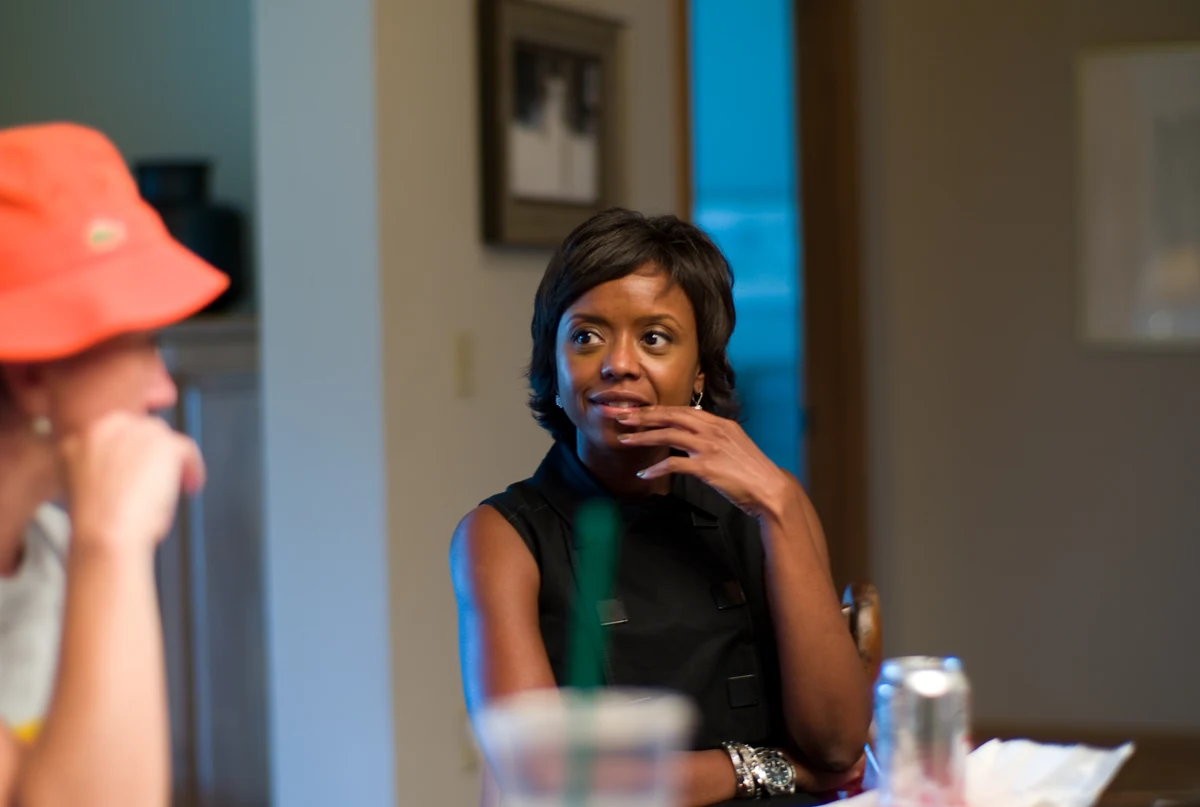
1969–present
Mellody Hobson
Asset-management executive, corporate director and financial-literacy advocateMellody Hobson developed a career in client services, management and ownership at Ariel Investments, becoming co-CEO in 2019. Her work also extended to corporate boards, financial education and philanthropy connected with universities and cultural institutions.Read biography
1958–present
Ursula Burns
Engineer, former Xerox chief executive and business leaderUrsula Burns advanced from a Xerox engineering internship to leadership of the company. As CEO, she oversaw its expansion into business services and later separation into two companies, while also supporting engineering education and public advisory work.Read biographyQuick answers
Common questions
- Did John Rogers retire when Hobson became co-CEO?
- No. The 2019 announcement retained him as chairman, co-CEO and chief investment officer, with continuing research and portfolio-management responsibilities. Hobson’s emphasis remained operating the business.
- Did the proposed 39.5 percent stake amount to majority ownership?
- No. It was larger than the projected 34.1 percent Rogers stake but below half the firm. Largest individual shareholder and outright majority owner are different descriptions.
- Did the July 11 announcement confirm that the share sale had closed?
- No. It announced the executive appointment and described a separate transaction expected to close by 19 July 2019. The projected figures are not a substitute for a closing confirmation or a current ownership record.
- Did ownership of Ariel Investments mean owning its clients’ investments?
- No. Ariel Investments was the advisory business. Client accounts and mutual funds were distinct from the adviser’s own equity, and the mutual-fund Trust had separate trustee oversight.
Primary and institutional sources
How this history was checked
The contemporaneous company release and founder’s client letter establish what Ariel actually announced. Later regulatory and governance documents supply explicitly dated context, not invented evidence of the precise 2019 closing or investment results. This article was reviewed on 21 October 2026.
- Ariel InvestmentsMellody Hobson Elevated to Co-CEO of Ariel Investments, 11 July 2019
- Ariel InvestmentsJohn W. Rogers Jr.: People and Promotions, 2019 client letter
- Ariel InvestmentsForm ADV Parts 1 and 2A, 28 July 2026
- Ariel Investment TrustGovernance Committee Charter, revised 23 August 2022
- Ariel InvestmentsClient Relationship Summary, 10 April 2026