
The short answer
Being named in a category and receiving an adverse decision are different propositions. This historical document exercise tests what the law establishes, what a regulation must add and what a claimant’s file must show.
Evidence before conclusions
What each record can establish
Separate the historical document from the original exercise and from evidence of an outcome.
| Record | Can establish | Does not establish |
|---|---|---|
| Statute | Categories, qualifications and regulatory authority. | The outcome of each individual claim. |
| Regulation | The operative additional conditions. | Whether a particular file satisfies them. |
| Claim file | Evidence used for a named decision. | A complete account of national effects. |
Chronology
A timeline of the turning points
Act
Statutory authority precedes particular regulations.
Category test
Check conditions and the stated exception.
Outcome test
A payment conclusion needs additional evidence.
Start with the enacted provision
The Unemployment Insurance (No. 3) Act received assent on 31 July 1931. Section 1 required regulations after consultation with an advisory committee. It specified several categories, rather than automatically deciding every insured person’s claim. The married-women category depended on a prescribed contribution condition and included an exception concerning the husband’s circumstances. Read those qualifications before drawing a conclusion from a category label.
Sources for this section: [1]
Original exercise: three incomplete files
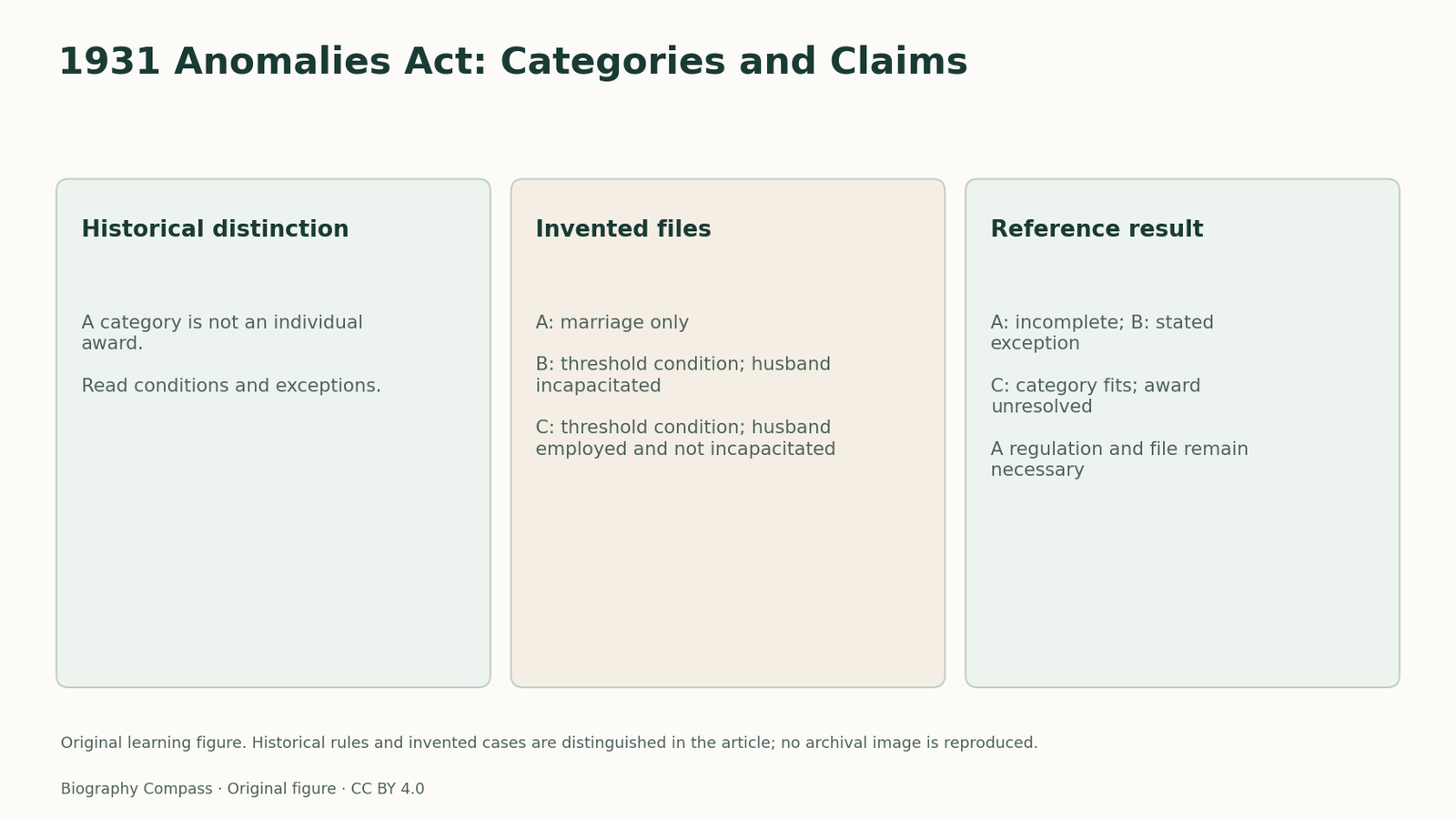
These are invented files for practising document reading, not records of real claimants. In file A the only information is that the claimant is married. In file B, stipulate that her contributions are below the prescribed threshold but that her husband is incapacitated from work. In file C, stipulate that her contributions are below that threshold and that her husband is employed and is not incapacitated from work. Assume no information about membership of the Act’s other categories.
For each file, answer two questions: is the information enough to place the claimant within the married-women category described in section 1(2)(d), and is it enough to determine the amount of her benefit? Do not invent a contribution threshold or treat the absence of a document as proof of a claimant’s conduct.
Sources for this section: [1]
Reference answers and the missing document
A is incomplete: marriage alone does not supply the contribution facts or test the exception. B falls within the stated exception to this particular category. That answer does not establish that she is outside every other category or has proved all conditions for payment. C meets the stipulated description of this category, but that still does not calculate a benefit award.
For a payment decision, request the applicable regulation and its effective date, the contribution record, the relevant household facts and the decision record. Explain exactly which missing item could change your answer. A strong response names the gap; it does not turn uncertainty into a finding of fraud or assume that every category member received the same result.
Sources for this section: [1]
Place the dispute in a political career
Bondfield’s ministerial record was controversial within the labour movement. Her experience as a union organiser did not remove the tensions of administering unemployment policy during the Depression. She did not join the National Government and lost her seat in 1931. Those political events are distinct from a later claimant’s adjudication.
Extension task: compare two hypothetical headlines, “the law authorised additional conditions” and “this claimant lost payment.” The first requires the statute; the second needs an individual outcome record. Neither statement, by itself, establishes the total number affected. This exercise concerns the historical document, not present eligibility rules.
Sources for this section: [2]
Continue the chronology
Related history guides
Biography context
Explore United Kingdom through connected lives
Connected biographies
The career behind the question
1873–1953
Margaret Bondfield
Trade unionist and politicianHer career tests the distance between representing workers and administering a national system under severe economic pressure.Read biographyQuick answers
Common questions
- Did marriage alone establish membership of this category?
- No. The text also required contribution conditions and specified an exception; the file must be tested against them.
- Does the exercise estimate how many women lost benefit?
- No. Its three files are invented and contain no population or administrative-outcome data.
Primary and institutional sources
How this history was checked
The named historical passages support the context. Case records, numbers and reference answers below are original teaching material, not recovered individual files. This article was reviewed on 31 October 2026.