
The short answer
Why can disorder suppress diffusion without simply making every collision stronger?
Read the evidence
Slow transport is not the whole argument
A mathematical model, a physical mechanism and a measurement play different roles.
| Record or test | What it establishes | What remains different |
|---|---|---|
| 1958 random-lattice paper | Gives a model and conditions for absent diffusion. | Does not label every disordered material an insulator. |
| Nobel lecture | Explains the localisation problem and later theoretical development. | A retrospective account does not remove the original assumptions. |
| A low-conductivity measurement | Reports an observable property of a sample. | Needs additional evidence to identify localisation as its cause. |
The question was whether diffusion occurred at all
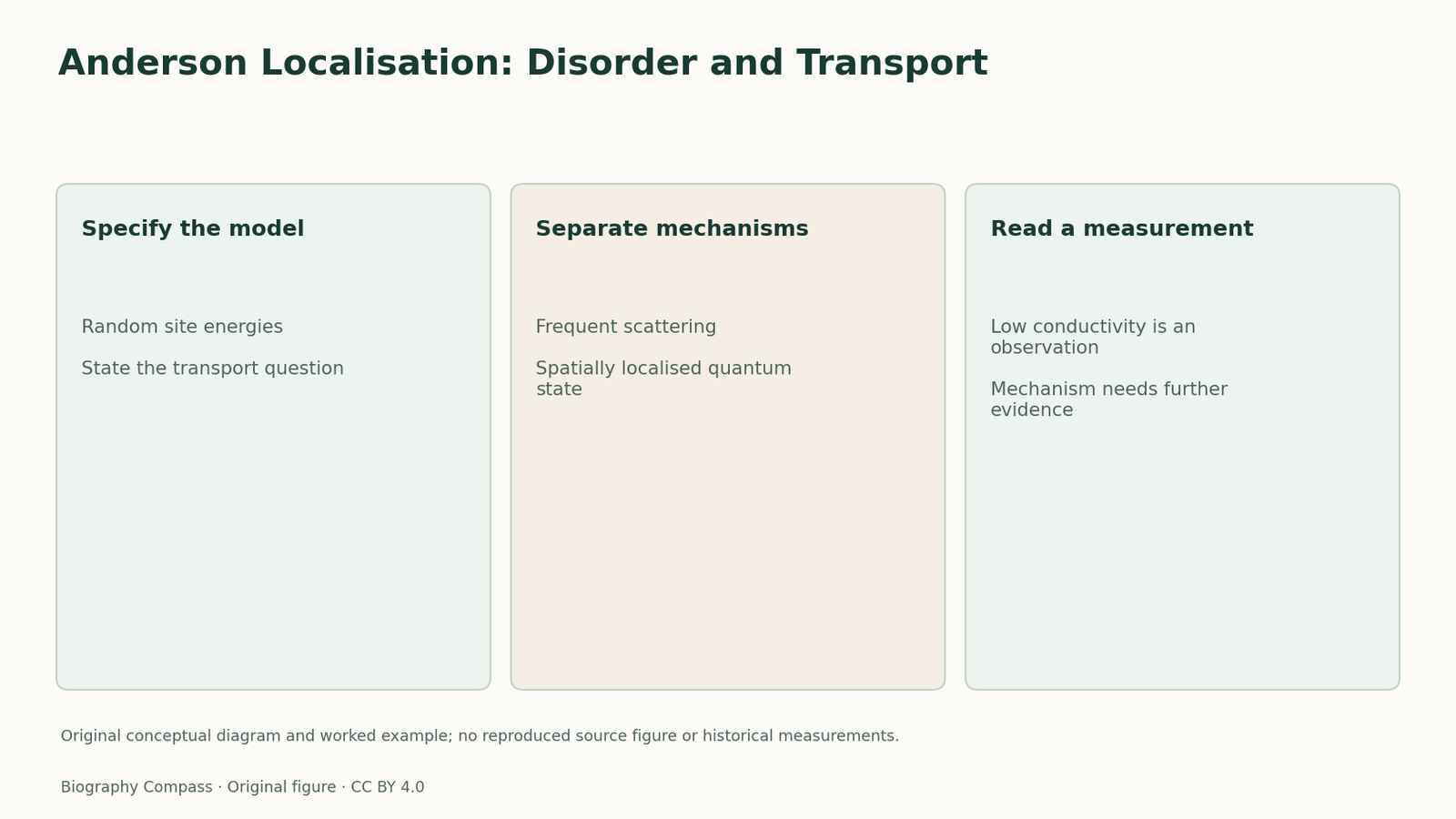
Anderson’s 1958 article introduced a deliberately simple model for processes such as spin diffusion and impurity-band conduction. The energies assigned to different lattice sites varied randomly. Within that model, the paper identified conditions under which diffusion did not occur. The result was not merely a calculation that every random lattice conducted a little less efficiently. Its importance came from allowing a qualitative change in transport: a quantum system could fail to spread through the lattice under specified conditions.
Sources for this section: [4]
A collision picture misses part of the problem
An everyday picture of resistance imagines a moving object losing progress through repeated collisions. Localisation requires a different level of description. A quantum state has spatial amplitudes whose relationships matter, and a model can yield states concentrated within a region rather than extending throughout a sample. Anderson’s Nobel lecture revisits the development and limitations of the original argument. The distinction is why increasing a scattering rate in a classical sketch does not by itself reproduce the localisation result. The nature of the state, the disorder and the model’s assumptions have to be considered together.
Sources for this section: [5]
The theorem was about a model, not every material
The original abstract identifies a random-site-energy model and criteria for transport. A later institutional account places that contribution within the much broader physics of real materials. Reading the two together prevents an overgeneralisation: the result does not say that every imperfect crystal, every glass or every disordered conductor is an insulator. Real systems differ in dimensionality, interactions and other physical conditions. Those differences are research questions rather than exceptions to be ignored. The model’s value is that it isolates a mechanism clearly enough for subsequent theory and experiment to test and extend.
A transport-classification exercise
Consider three invented reports. In the first, a classical particle takes longer to cross a sample as collisions become more frequent. In the second, a specified quantum random-lattice model has states that remain spatially localised and does not support the diffusion under discussion. In the third, a laboratory measures a low conductivity but has not identified the cause. The second directly addresses the localisation question. The first illustrates scattering in a different model; the third is an observation requiring additional interpretation. A low measured conductivity alone does not prove Anderson localisation. The supported answer separates a transport measurement, an explanatory mechanism and a model result. These report cards contain no fabricated historical conductivity values or numerical reconstruction of the 1958 calculation.
Continue the chronology
Related history guides
Feynman’s Paths: Amplitudes, Not Trajectories
Read Feynman’s 1948 path-integral formulation beside his teaching on interference, with a worked example separating amplitudes from probabilities.
Read the timeline2004Graphene 2004: Isolation and Field Effect
Read the 2004 carbon-film experiment as both materials preparation and an electrical test, separating a thin specimen from evidence of gate-controlled carriers.
Read the timelineBiography context
Explore United States through connected lives
Connected biographies
Researchers and related approaches
1923–2020
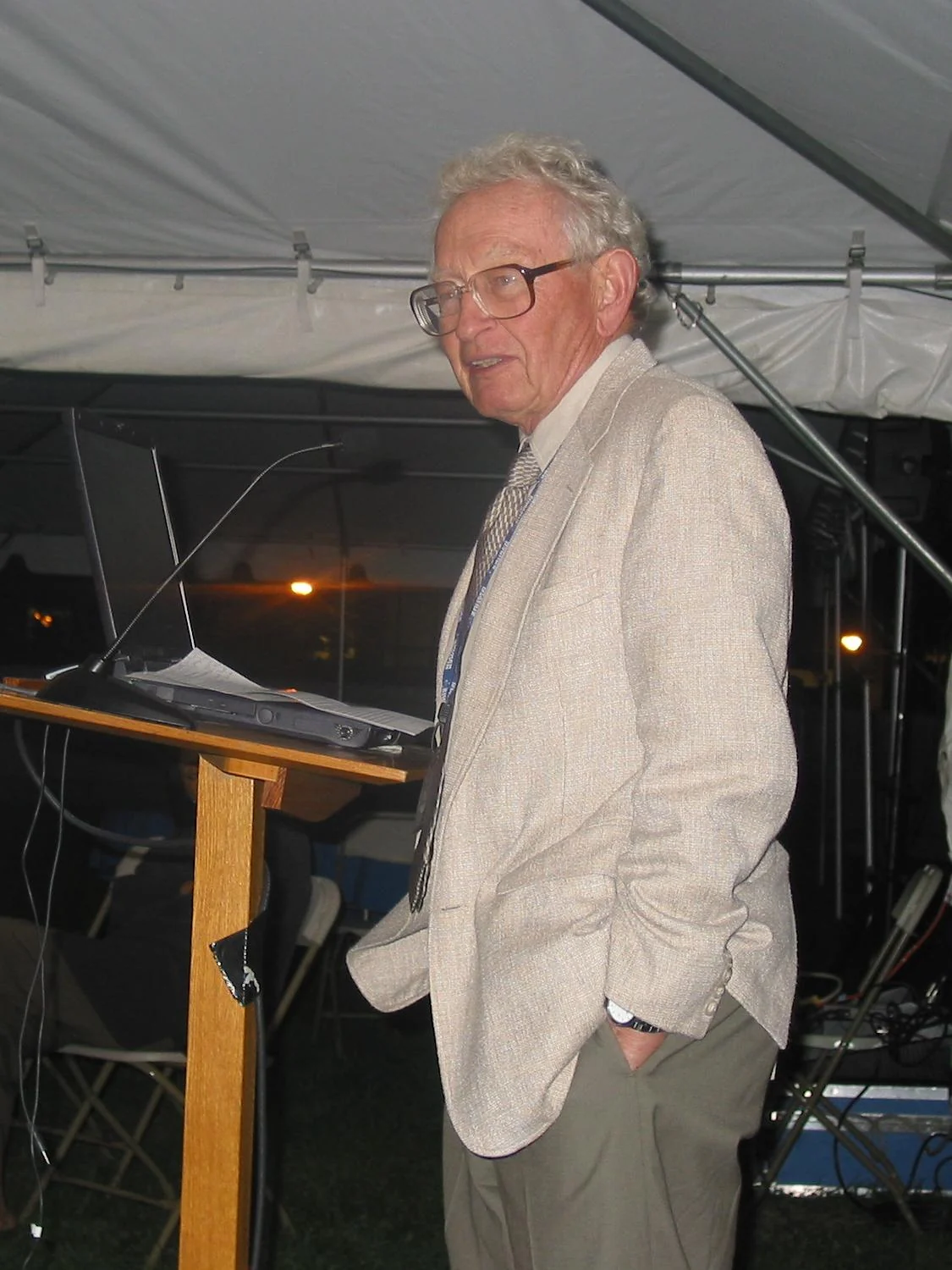
Philip Anderson
Condensed-matter theoretical physicistPhilip Anderson developed condensed-matter theory through Bell Laboratories, Cambridge and Princeton, connecting microscopic models with collective material behaviour.Read biographyQuick answers
Common questions
- Does Anderson localisation mean every disordered material is insulating?
- No. The original result concerns a specified model and conditions; transport in real materials depends on further physical features.
- Is localisation the same as more frequent classical collisions?
- No. It concerns the spatial character and transport properties of quantum states, not simply a larger collision count.
Primary and institutional sources
How this history was checked
The original abstract establishes the model’s stated result. Anderson’s lecture and institutional histories supply context without substituting for a real-material measurement. This article was reviewed on 7 November 2026.
- Nobel Prize OutreachPhilip W. Anderson — Facts
- Nobel Prize OutreachPhilip W. Anderson — Biographical
- Princeton UniversityNobel laureate and Princeton physicist Philip Anderson dies at age96
- P.W. Anderson / American Physical SocietyAbsence of Diffusion in Certain Random Lattices
- Philip W. Anderson / Nobel LectureLocal Moments and Localized States