
The short answer
A date beside Akiko Yosano’s name may identify a translation project, a particular printing or a modern reissue. Start with the Japanese title and catalogue record, then use her afterword and the surviving drafts to understand why the versions differ.
Compare the records
Version, physical books and the date on a copy
Three kinds of record can coexist without contradiction.
| Record or role | Bibliographic identity | How to use it |
|---|---|---|
| Shinyaku, 1912–1913 | Kanao Bun’endō; four books: upper, middle, lower 1 and lower 2. | Identifies the first major published version; Yosano later calls it abridged. |
| Shinshinyaku, 1938–1939 | Kanao Bun’endō; six volumes. | Identifies the substantially renewed later rendering. |
| NDL item 945399 | Shinyaku upper book; the record notes later printing numbers and a 1913–1914 range. | Cite this copy’s details without treating them as the first issue of the whole project. |
| Kadokawa Zen’yaku text used by the museum | A later published form used for comparison with the Shinshinyaku drafts. | Trace the edition statement; a changed title alone does not establish another original translation. |
Chronology
A timeline of the turning points
Shinyaku issued
The CiNii record lists upper, middle and two lower books.
Work interrupted
Yosano’s afterword describes interruption following Tekkan’s death.
Shinshinyaku issued
Kanao Bun’endō published the six-volume new translation.
The title may change
The museum study compares the later text in a Kadokawa edition titled Zen’yaku Genji Monogatari.
Read the titles before comparing passages
CiNii Books records Shinyaku Genji Monogatari, published by Kanao Bun’endō from February 1912 to November 1913, as four physical books: upper, middle, lower part one and lower part two. Its record for Shinshinyaku Genji Monogatari gives the same publisher, dates of 1938–1939 and six volumes. Both attribute the original work to Murasaki Shikibu and the modern Japanese rendering to Yosano. The extra shin in the later title is therefore a useful bibliographic clue, not a decorative variant to discard during a search. Retaining the Japanese title helps distinguish two substantial projects within one translator’s career.
Yosano explains why she returned
In the later afterword Yosano describes the earlier Shinyaku as an abridged account and expresses dissatisfaction with its interpretation and prose. She wanted to produce a more complete replacement. Her account also names a publishing collaboration: Kanao Bun’endō commissioned the first version, with prefaces by Mori Rintarō and Ueda Bin and illustrations by Nakazawa Hiromitsu. Tekkan’s death in 1935 interrupted the later work, and renewed contact with the publisher helped bring it toward publication. These details make the second project more than an updated spelling of an old text. The afterword is Yosano’s own retrospective explanation of her ambitions and circumstances.
Sources for this section: [3]
A catalogue date can belong to a later printing
The National Diet Library record for digitized item 945399 is headed Shinyaku Genji Monogatari, upper volume. It gives a Taishō 2–3 publication range, corresponding to 1913–1914, and explicitly notes an upper-volume tenth printing or edition and a middle-volume seventh. That does not overturn CiNii’s 1912 start for the original series. The records describe different physical copies and publication states. When citing a passage, use the date and edition of the copy actually consulted, while keeping the first issue’s dates separately. A digitization date is a further event and should not replace either of them.
Drafts show what revision involved
Sakai City catalogues surviving autograph drafts by Genji chapter. A study by museum curators Akiho Morishita and Tomomi Adachi examines the thirteen-sheet Hana no En draft, discussing seven selected sheets. It identifies changes such as poems initially marked by placeholders, later additions of subjects and objects, and revisions of dialogue or forms of address. The comparison uses an accessible Kadokawa text titled Zen’yaku Genji Monogatari for the later translation. These are observations about a defined sample, not proof that every chapter followed an identical process. They show why comparing only the length of the two editions would miss decisions about clarity and narrative presentation.
Build a passage citation that another reader can find
For a practical exercise, take one passage you want to discuss and record five items: chapter title, translation title, publisher, publication or printing date, and page or digital image number. Add the translator separately from the original author. Then ask whether your copy is the 1912–1913 Shinyaku, the 1938–1939 Shinshinyaku or a later reissue of one of them. If the title is Zen’yaku, follow the edition’s own publication statement rather than assuming it is a third original project. A parallel note for a second version makes a comparison reproducible even when chapter pagination differs.
Use the afterword as an argument, too
The afterword does more than describe publication. Yosano also proposes a two-author account of Genji’s composition, assigning later portions to another writer. That is her interpretive hypothesis, not a settled fact established by the modern catalogue records. Reading it this way preserves her role as a critic as well as a translator, while separating claims about the ancient work’s authorship from evidence about her own books. The materials consulted here comprise bibliographic records, that afterword and the museum’s selected manuscript study; they do not amount to a cover-to-cover reading of either complete translation.
Connected biographies
People connected with this history
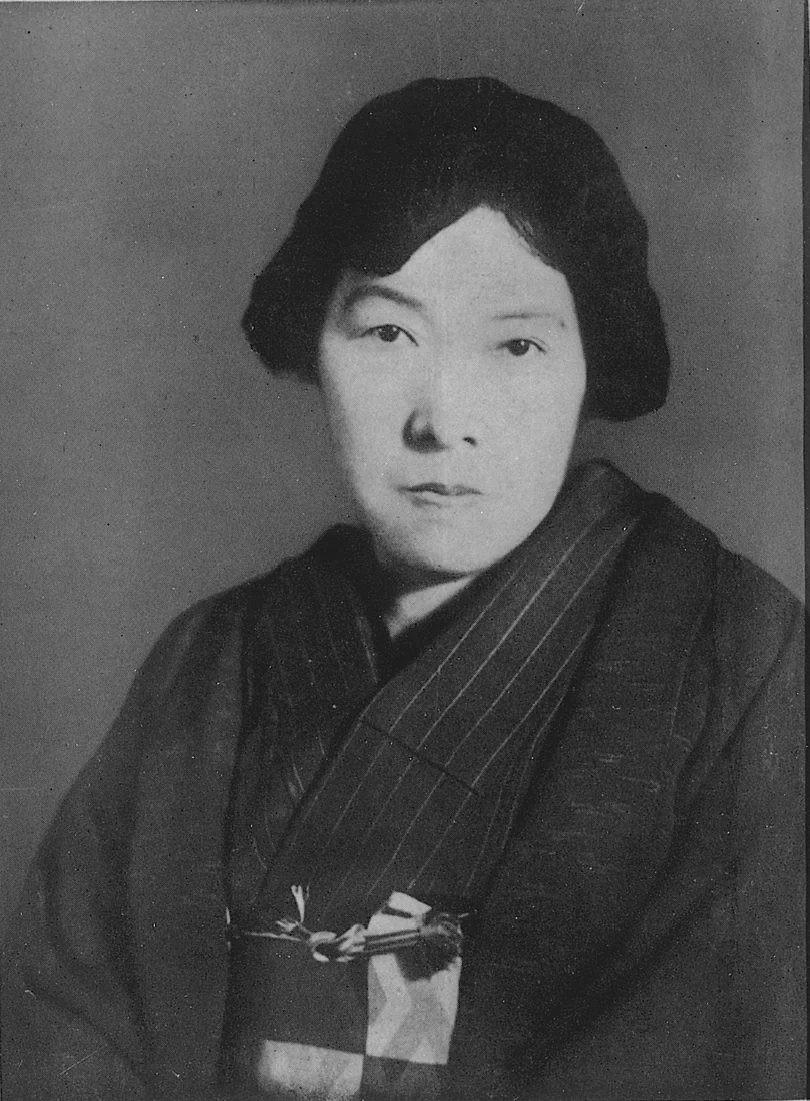
1878–1942
Akiko Yosano
Poet, essayist, educator and translatorAkiko Yosano made tanka, public essays, educational work and translation part of one prolific literary career. Her two major modern Japanese versions of The Tale of Genji also reveal a writer willing to revisit and reshape her earlier work.Read biographyQuick answers
Common questions
- Are these English translations?
- No. Yosano rendered classical Japanese into modern Japanese. An English Genji edition will have its own translator and publication history.
- Why do some records give 1913 rather than 1912?
- A catalogue may describe a particular later printing. The NDL item discussed here explicitly records later printing numbers, while CiNii dates the original series from 1912.
- Does the guide claim to compare every chapter?
- No. It identifies the versions through publication records and uses the museum’s defined Hana no En sample to explain revision.
Primary and institutional sources
How this history was checked
These records distinguish contemporary publications and technical documents from later institutional recollections. This article was reviewed on 27 October 2026.
- National Institute of Informatics, CiNii BooksShinyaku Genji Monogatari: Kanao Bun’endō, February 1912–November 1913; four physical books
- National Institute of Informatics, CiNii BooksShinshinyaku Genji Monogatari: Kanao Bun’endō, 1938–1939; six volumes
- Akiko Yosano / Aozora BunkoAfterword to Shinshinyaku Genji Monogatari: Japanese text and transcription bibliography
- National Diet Library, JapanShinyaku Genji Monogatari, upper volume: later printing catalogue record, digitized item 945399
- Sakai CityAkiko Yosano: catalogue of digitized autograph Genji translation manuscripts
- Akiho Morishita and Tomomi Adachi / Sakai City MuseumStudy of the autograph Shinshinyaku Genji Monogatari Hana no En manuscript, Sakai City Museum research bulletin, printed page 33 onward