
The short answer
A count compresses a record. It may preserve how many events occurred while discarding when they occurred, even when the events themselves have equal amplitudes.
Evidence and original analysis
Same total, different windows
Rates are event counts divided by each window’s duration.
| Train | Full second | First half / second half |
|---|---|---|
| A | 4 events/s | 8 / 0 events/s |
| B | 4 events/s | 4 / 4 events/s |
| Lost by total alone | Exact times | Change within the second |
Chronology
A timeline of the turning points
Lecture
Frequency, response pattern and amplification discussed.
Original comparison
Event times supplied, not experimentally recorded.
What the lecture separates
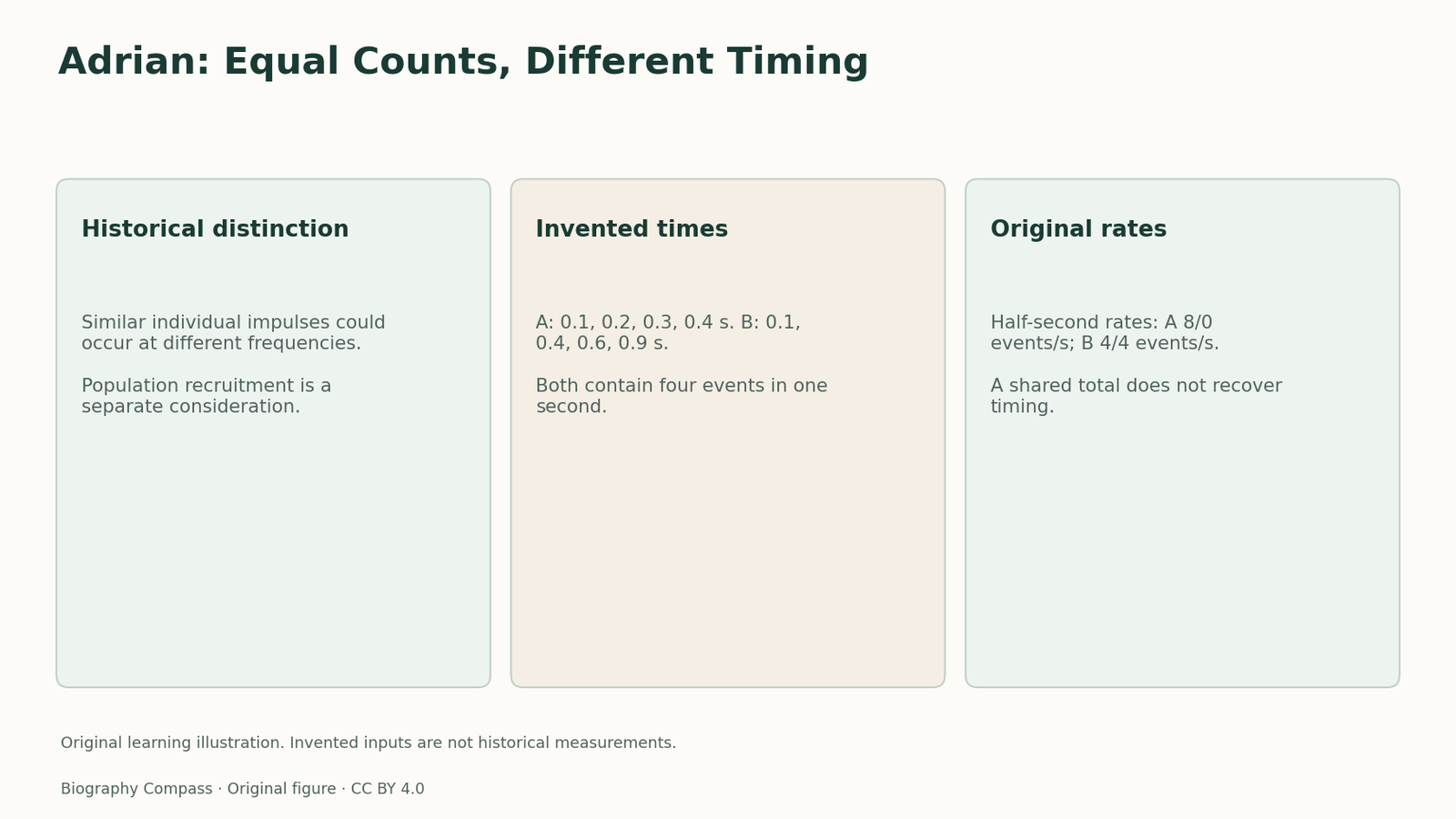
Adrian credits earlier all-or-none research and improvements in amplification. With Zotterman he recorded from an individual muscle receptor: impulses could retain similar form while their frequency changed. The selected passages also distinguish adaptation and the recruitment of additional fibres.
A single-fibre result therefore does not eliminate population effects. Nor does it imply that one frequency number recovers a stimulus or a person’s experience. The exercise asks the narrower information question: what is lost by keeping only a total?
Sources for this section: [1]
Two invented one-second records
Give all events equal amplitude. In seconds, train A has events at 0.1, 0.2, 0.3, 0.4; train B at 0.1, 0.4, 0.6, 0.9. Use the full interval 0≤t<1, then the halves 0≤t<0.5 and 0.5≤t<1.
Calculate events per second for each full interval and each half. Is the equal full-interval rate enough to say the trains have the same time pattern? The specified interval boundaries avoid double-counting an event on a boundary.
Sources for this section: [1]
Reference answer
Each train contains four events in one second: 4 events/s. A puts all four in the first half, giving 8 events/s there and 0 in the second half. B puts two in each half, giving 4 events/s in both.
The equal total rates therefore hide a marked redistribution over time. An observer given only “four events in one second” cannot reconstruct either sequence. The records also do not identify a physiological cause: adaptation is one historical topic, not a diagnosis derived from this toy pair.
Sources for this section: [1]
Choose a summary for a question
A total count answers a total-count question. Windowed counts reveal a coarse time pattern; exact times retain more information still. None alone supplies a universal neural code. These invented records contain no real subject, stimulus intensity, clinical trace or inferred sensation.
Sources for this section: [1]
Continue the chronology
Related history guides
Biography context
Explore United Kingdom through connected lives
Connected biographies
Researcher and context
Quick answers
Common questions
- Does equal total rate imply equal timing?
- No. Both constructed trains have the same total rate and different half-window rates.
- Does the example prove adaptation?
- No. It demonstrates information loss in a summary, not the cause of a physiological response.
Primary and institutional sources
How this history was checked
Selected records support the historical explanation. Invented inputs and original calculations are labelled separately. This article was reviewed on 31 October 2026.