
The short answer
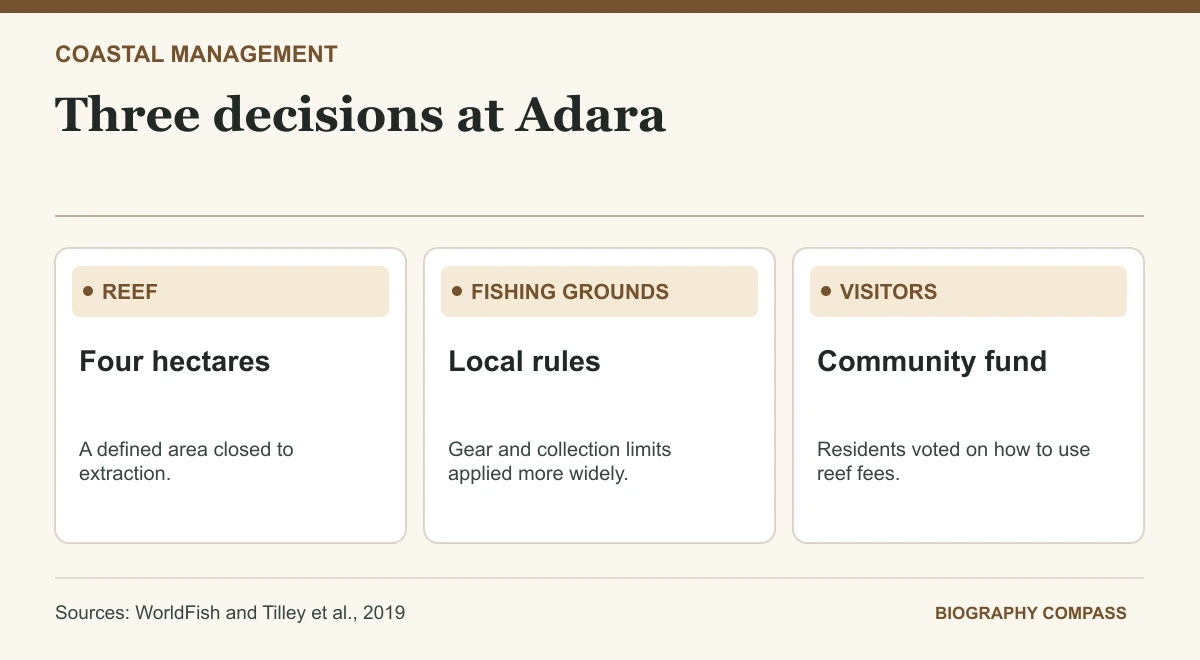
The people of Adara on Ataúro Island had two uses for the same reef. Families fished or gathered food there, and visitors came to see the underwater life. A community process culminating in April 2016 drew a small area closed to extraction and set wider rules for the surrounding fishing grounds.
Compare the records
What was managed, and by whom?
Read the boundary on the field researchers’ map alongside their account of the meetings that produced it.
| Decision | Measure | People affected |
|---|---|---|
| Close part of the reef | A 0.04 km² area was closed to extraction. | Women who gathered seafood helped determine where it would lie. |
| Regulate other fishing grounds | Separate gear and collection restrictions applied more widely. | Local and visiting fishers needed to know the applicable rule. |
| Collect a reef fee | Visitors diving or snorkelling in the closure contributed. | Residents decided how to spend the community fund. |
Chronology
A timeline of the turning points
Community management discussions
WorldFish began supporting work with Adara on a fisheries management plan.
Rules formally recognised
Residents, local officials and outside partners marked the launch.
Field research published
The study documented the boundaries, local decisions and revenue arrangements.
Choosing a closure that people could live with
The study describes consultations led locally with help from fisheries officials and WorldFish. Women gathered food in the shallows, so placing a no-take area on the reef would displace work that could be missed in a discussion limited to boat owners. Women’s focus groups helped agree its location. The eventual boundary reflects a decision about livelihoods as much as a choice about reef habitat.
Why the rules extended beyond four hectares
The permanent closed area occupied about four hectares directly in front of the community. Other rules applied across a larger area, including restrictions on certain nets and on taking turtles. A diver entering the small closure and a fisher working outside it therefore encountered different obligations. The study’s map is useful precisely because a phrase such as community-managed waters does not identify which specific rule applies at a given location.
What visitor fees show
Divers and snorkellers contributed a reef fee. Researchers reported that an elected committee kept the proceeds until the community opened the collection box and voted on their use. Early decisions supported a water line and a kindergarten. Those are observable institutional outcomes. Determining how much the closure changed fish abundance would require ecological evidence over time, taking account of differences between sites and the conditions before the rules began.
Continue the chronology
Related history guides
Connected biographies
People connected to this history
Quick answers
Common questions
- Was all fishing around Adara prohibited?
- The permanent closure covered a defined part of the reef. Other rules applied to surrounding fishing grounds.
- How were visitor fees spent?
- The field study reports community votes on spending, including support for water infrastructure and a kindergarten.
Primary and institutional sources
How this history was checked
Dates, legal milestones and historical claims are checked against the official and institutional records below. This article was reviewed on 19 November 2026.