In this biography
Quick facts
- Born
- 5 February 1995
- Birthplace
- Yasothon, Thailand
- Country
- Thailand
- Nationality
- Thai
- Known for
- Becoming badminton’s youngest women’s singles world champion and Thailand’s first world No. 1 player
- Discipline
- Women’s singles badminton
- World title
- 2013, Guangzhou
- Highest ranking
- World No. 1, first reached in 2016
- World junior titles
- 2009, 2010 and 2011
- Asian title
- 2015
- Olympic Games
- 2012, 2016, 2020 and 2024
Why this life matters
Ratchanok turned an unconventional childhood training route into Thailand’s first badminton world title, sustained elite performance across four Olympic Games and helped establish the country as a women’s singles power.
Timeline
Key moments
Born in Yasothon
Born on 5 February and raised largely in Bangkok after her parents moved for factory work.
Started at Banthongyord
Began playing on courts connected to the sweets factory where her parents worked.
Won three world junior titles
Captured the girls’ singles championship in three consecutive editions, beginning at fourteen.
Reached an Olympic quarter-final
Advanced to the last eight at her first Games in London before losing to Wang Xin.
Became senior world champion
Defeated Olympic champion Li Xuerui in Guangzhou to become the youngest women’s singles world champion.
Won the Asian championship
Beat Li Xuerui in a three-game final in Wuhan to claim the continental title.
Reached world No. 1
Won in India, Malaysia and Singapore across three successive weeks and became the first Thai player ranked No. 1.
Won another world medal
Took World Championships bronze; a separate BWF panel imposed no ban after finding no fault in a contaminated-meat anti-doping case.
Made the Tokyo Olympic last eight
Reached a second Olympic quarter-final and pushed Tai Tzu-ying to three games.
Played a fourth Olympics
Defeated Tai Tzu-ying in the group stage and reached another quarter-final in Paris.
A badminton education beside a sweets factory
Ratchanok Intanon was born in Yasothon in northeastern Thailand on 5 February 1995. Her parents moved to the Bangkok area for work at Banthongyord, a factory producing traditional egg-yolk sweets. Because the work involved hot sugar and open heat, factory owner Kamala Thongkorn directed the young Ratchanok toward the badminton courts connected to the business rather than leave her in a dangerous production space.
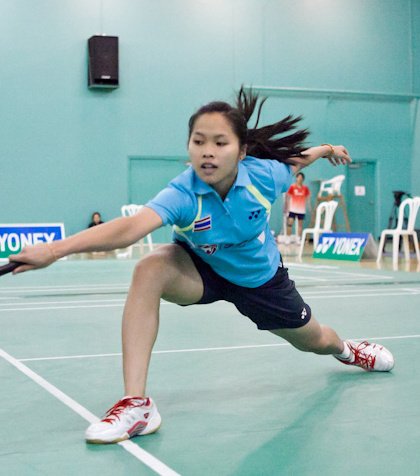
She started playing at about six and developed through the Banthongyord Badminton School. The setting made sport, family work and social mobility part of the same story. Ratchanok trained against older children, entered age-group events early and learned a game based on timing, touch and changes of pace rather than physical power alone.
Three junior world titles and a first Olympics
Ratchanok won the girls’ singles title at the BWF World Junior Championships in 2009, 2010 and 2011. The first victory came when she was fourteen. Winning three editions in succession established more than junior promise: it showed that she could keep adapting while moving from an unusually young champion toward the senior circuit.
At London 2012 she entered her first Olympic Games as the ninth seed. She won her group, advanced through the knockout round and took China’s Wang Xin to three games in the quarter-final. The equal-fifth finish placed a seventeen-year-old Thai player within one match of the Olympic medals and made the following season’s breakthrough less surprising than it appeared from outside the sport.
The 2013 world title
In 2013 Ratchanok won the India Open and arrived at the World Championships in Guangzhou as the fourth seed. She defeated Carolina Marín in the quarter-final and P. V. Sindhu in the semi-final, then faced world No. 1 and London Olympic champion Li Xuerui before a home Chinese crowd.
Ratchanok recovered from a seven-point deficit in the opening game and won the final 22–20, 18–21, 21–14. At eighteen years, six months and six days, she became the youngest women’s singles world champion and the first Thai player to win a senior BWF world title. The result turned the junior prodigy into a national sporting reference point while proving that a technically varied Thai training system could defeat the dominant programmes of the era.
Asian champion and world No. 1
Ratchanok added the Asian Championships title in 2015, again defeating Li Xuerui in a three-game final. In April 2016 she produced the most concentrated run of her senior career: victories at the India Open, Malaysia Open and Singapore Open on three consecutive weekends. The sequence demanded repeated travel, recovery and adjustment against changing opponents rather than one peak performance at a single event.
When the rankings were updated on 21 April, she became the first Thai badminton player to reach world No. 1. The ranking lasted two weeks, but its significance was not measured by duration alone. It recorded that results accumulated over the ranking period had placed a Thai singles player above every rival in the sport’s global system.
Resilience, scrutiny and a second world medal
The years after her first ascent included injury, changing rivals and public scrutiny. Ratchanok remained a title contender rather than repeating the singular dominance implied by an early world championship. Her continued presence mattered in a women’s singles era shaped by Carolina Marín, Tai Tzu-ying, P. V. Sindhu, Nozomi Okuhara, Akane Yamaguchi and later champions from a new generation.
At the 2019 World Championships in Basel she won bronze, her second senior world medal. That year a sample also produced an adverse finding for clenbuterol. The BWF Ethics Hearing Panel determined that contaminated meat caused the result and that she bore no fault or negligence, so it imposed no period of ineligibility. Recording both the violation and the official no-fault finding is essential to describing the episode accurately.
Four Olympic cycles and a wider Thai legacy
Ratchanok competed at Rio 2016 and served as Thailand’s opening-ceremony flag bearer, though Akane Yamaguchi ended her tournament in the round of sixteen. She returned to the quarter-finals at Tokyo 2020, losing a close three-game match to eventual silver medallist Tai Tzu-ying, and reached the last eight again at Paris 2024 after defeating Tai in the group stage.
Three Olympic quarter-finals did not produce an Olympic medal, but they demonstrate the length of her elite career. Between London and Paris, Thailand developed a deeper women’s singles group and Kunlavut Vitidsarn won the country’s first Olympic badminton medal in the men’s event. Ratchanok’s place in that wider story rests on the thresholds she crossed first: junior dominance, a senior world title and the world No. 1 ranking.
Quick answers
Frequently asked questions about Ratchanok Intanon
- Who is Ratchanok Intanon?
- Ratchanok Intanon is a world champion badminton player. Ratchanok turned an unconventional childhood training route into Thailand’s first badminton world title, sustained elite performance across four Olympic Games and helped establish the country as a women’s singles power.
- What is Ratchanok Intanon best known for?
- Ratchanok Intanon is best known for becoming badminton’s youngest women’s singles world champion and Thailand’s first world No. 1 player.
- When and where was Ratchanok Intanon born?
- Ratchanok Intanon was born on 5 February 1995 in Yasothon, Thailand.
Sources and further reading
How this biography was checked
Core dates and offices are checked against the sources below. This profile was last reviewed on 3 October 2026.
- Badminton World FederationBWF Annual Report 2013
- Badminton AsiaBadminton Asia Annual Report 2015
- OlympediaRatchanok Intanon Olympic profile and results
- OlympediaWomen’s singles results — London 2012
- OlympediaWomen’s singles results — Tokyo 2020
- OlympediaWomen’s singles results — Paris 2024
- The Nation ThailandRatchanok officially becomes world No. 1
- Badminton World FederationIntanon cleared by BWF Ethics Hearing Panel
- Badminton World FederationBWF Annual Report 2019 — World Championships medallists
- The Nation ThailandSchool owner’s kindness helped produce badminton star
- Wikimedia CommonsRatchanok Intanon photograph and CC BY 2.0 licence