
In this biography
Quick facts
- Born
- 1932
- Died
- 2016
- Birthplace
- Houston, Texas, United States
- Country
- United States
- Nationality
- Not independently established
- Known for
- Deep Listening
- Collaborator
- Heloise Gold
Why this life matters
Her work connected electronic experimentation with collaborative practices of attention and participation.
Timeline
Key moments
San Francisco
Moved from Texas.
Cistern session
Dempster, Panaiotis and Swanson.
Rensselaer
Joined the arts faculty.
Houston and the move west
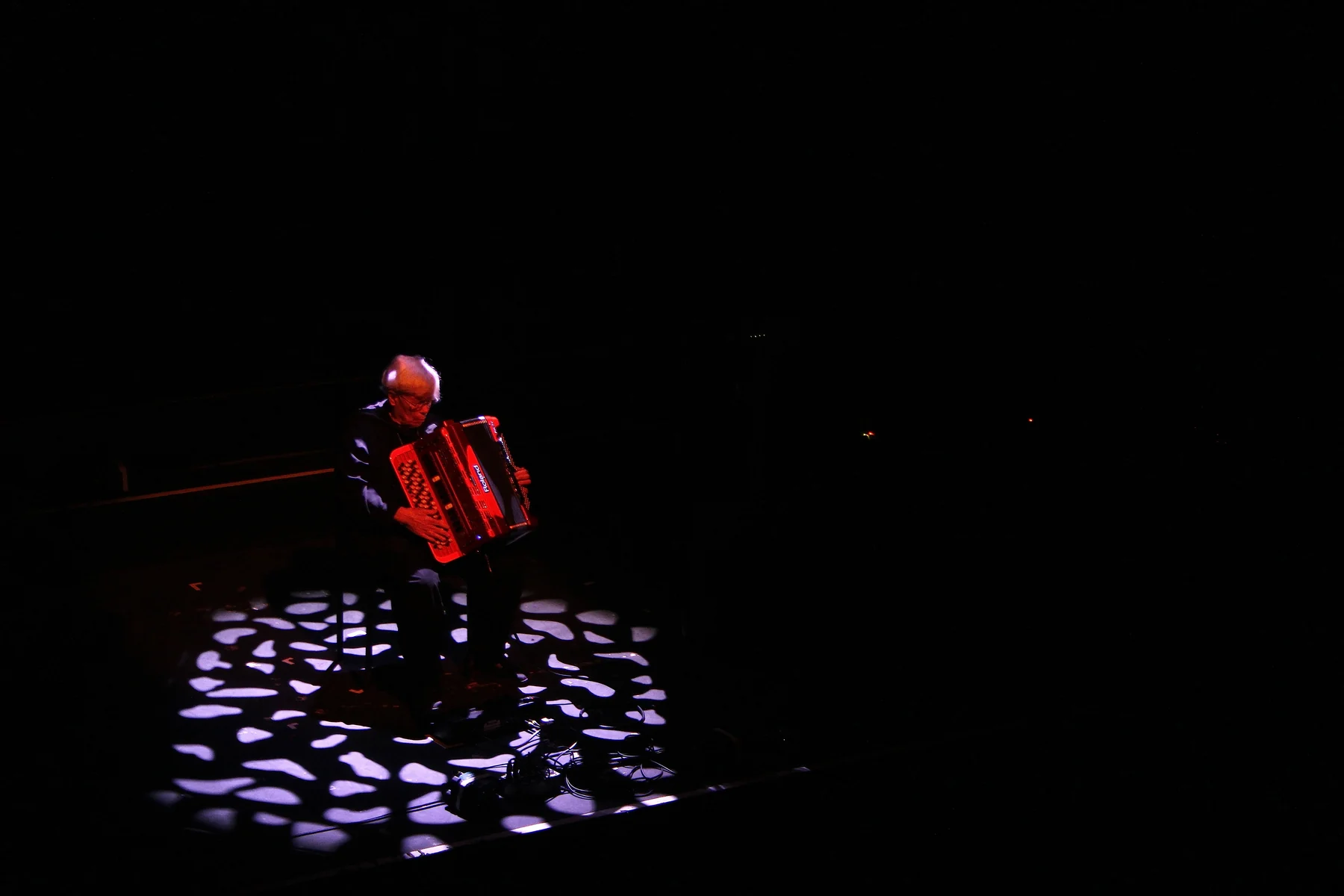
Oliveros grew up in Houston and moved to San Francisco in 1952. She studied with Robert Erickson while supporting herself through teaching. Her instruments included accordion, horn and tuba; the accordion remained central to a career that crossed expectations about concert instruments.
She recalled family piano teaching, radio static and outdoor sounds as formative experiences. Improvising with Terry Riley and Loren Rush at KPFA helped her recognise possibilities beyond a fully notated score.
Tape, electronics and education
She used tape delays and oscillators in live work, then developed an expanded instrument system. After directing the Mills tape-music centre, she established an electronic music programme at the University of California San Diego. Teaching students who did not read notation helped motivate participatory vocal work.
Sound Patterns won the Gaudeamus Prize in 1962. Her electronic compositions and improvisations belonged to a broader West Coast experimental community rather than a solitary invention story.
Listening as a collective practice
Sonic Meditations grew through work with a women’s collective. Later retreats and workshops developed with IONE and movement artist Heloise Gold. Their contributions made the practice a collaboration extending beyond Oliveros’s individual compositions.
The 1988 cistern session involved Stuart Dempster, Panaiotis and engineer Albert Swanson. Released as Deep Listening in 1989, the recording gave a name to a larger developing practice. Her 1970 essay against the label “lady composers” challenged the institutional barriers women encountered.
Late collaborations and teaching
Oliveros joined Rensselaer in 2001. At EMPAC she improvised with Laurie Anderson and worked with Tarek Atoui and students on instruments engaging sonic and tactile experience. These projects placed research and access alongside performance.
She continued performing and teaching into 2016 and died in Kingston, New York, that November. Her spouse, the writer and performance artist IONE, confirmed her death. The continuing listening community grew from people, institutions and experiments accumulated across decades.
Quick answers
Frequently asked questions about Pauline Oliveros
- Was prior musical training required?
- The practice welcomed participants beyond trained musicians.
Keep exploring
Lives connected to this story
- Toru Takemitsu
Compare an interpreter-specific plan with this attention-planning task.
- Arthur Boyd
Follow the neighbouring study to compare a different creative decision.
- Evelyn Glennie
Compare another performer’s account of listening and musical communication.
- Meredith Monk
Compare a different practice linking voice, place and performance.
- Steve Reich
Read a different use of ensemble listening and audible signals.
Sources and further reading
Explore the evidence
These references support the biography and offer further reading. Official records, first-person accounts and independent reporting provide different perspectives; image records document attribution and licensing.
- 1. IRCAM, 2018 biographyPauline Oliveros
- 2. Alan Baker, American Public Media, January 2003An interview with Pauline Oliveros
The written interview was read, not its audio. Its retrospective dates are not treated as an exact chronology of every score.
- 3. Rensselaer Polytechnic Institute, 30 November 2016Remembering the Sounds of the World’s Most Iconic Deep Listening Pioneer
- 4. EMPAC staff, 1 December 2016Pauline Oliveros: An EMPAC Retrospective
- 5. Center for Deep Listening, RensselaerDeep Listening