
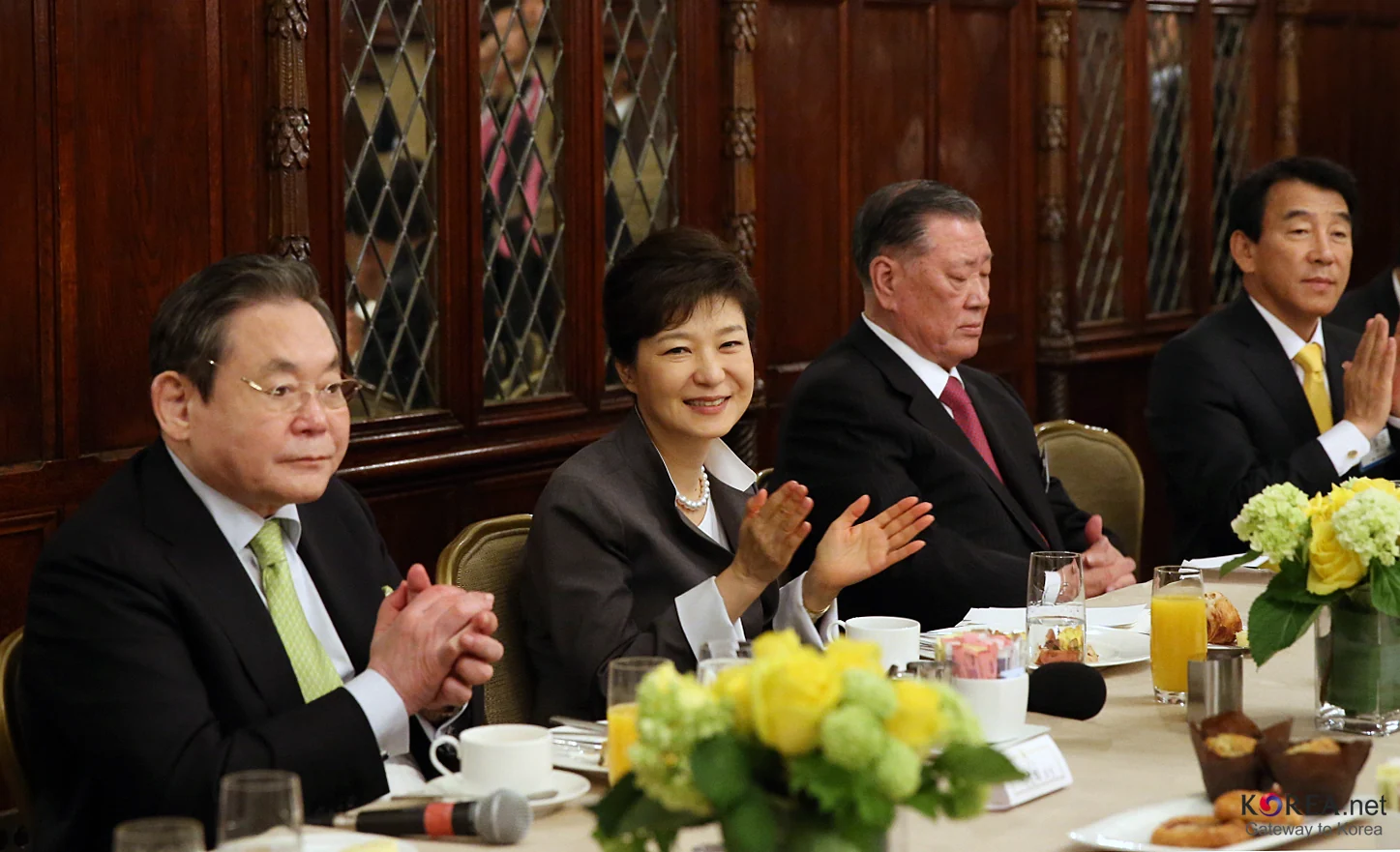
In this biography
Quick facts
- Born
- 9 January 1942
- Died
- 25 October 2020
- Birthplace
- Daegu is reported by Yonhap; the IOC biographical tradition gives Uiryeong
- Country
- South Korea
- Nationality
- Not independently established
- Known for
- Samsung’s New Management programme and international electronics business
- Birth
- 9 January 1942
- Samsung leadership
- From December 1987; stepped down in 2008, returned in 2010
- New Management
- Frankfurt, June 1993
- IOC membership
- Elected in 1996; resigned in 2017
- Death
- 25 October 2020
Why this life matters
His career links industrial strategy, professional teams, corporate accountability and the later public stewardship of an important private art collection.
Timeline
Key moments
Birth
Born on 9 January; records differ on birthplace.
Study and broadcasting
Graduated from Waseda in 1965 and joined Tongyang Broadcasting in 1966.
Group leadership
Became chairman after Lee Byung-chul’s death.
New Management
Called for quality-focused change at a Frankfurt executives’ meeting.
IOC election and separate criminal proceedings
Elected to the IOC in 1996; a bribery conviction in 1996 was followed by a presidential pardon in 1997.
Departure, conviction, pardon and return
Stepped down in 2008; sentence confirmed in 2009; pardon effective 31 December 2009; returned in March 2010.
Illness and death
Hospitalised after a heart attack in 2014; died on 25 October 2020.
Collection enters public museums
Family donation followed his death; museum research and registration continued.
A second-generation business career
Lee Kun-hee was born on 9 January 1942, the third son of Samsung founder Lee Byung-chul. Yonhap’s biographical chronology records graduation from Waseda University in 1965, study at George Washington University and entry into Tongyang Broadcasting in 1966. Later positions included vice-chairmanships at Samsung C&T and within the group. These stages placed broadcasting and group administration before his best-known role in electronics. Accounts differ on whether the American business study resulted in an MBA, so it is described here as study rather than an independently verified earned degree. His father’s original enterprise was already established before his own career began.
Sources for this section: [2]
Leadership followed the founder’s death
Lee became Samsung chairman in 1987 after his father’s death. The succession placed him at the head of a group with several businesses and a substantial technical and managerial organisation. His task was therefore different from founding a small trading enterprise. Samsung’s corporate history associates the following years with international competitiveness and a stronger focus on quality. Those priorities were implemented through operating companies and professional teams. Group leadership and the chairmanship of Samsung Electronics are related roles, but their dates and legal entities should be distinguished when comparing appointments, company accounts or the ownership of particular businesses.
New Management made quality an explicit priority
In June 1993 Lee assembled senior executives in Frankfurt and argued for extensive change. Samsung later called the initiative New Management. Its own 2013 retrospective presents it as a turning point away from complacency and toward products that could compete internationally. The company also recounts the destruction of defective phones and fax machines at Gumi in March 1995 as a dramatic expression of that priority. The managerial contribution lay in making quality a central organisational demand. The speech and demonstration establish the message and its staging; measurements of defects, customer experience and product performance require separate operating records.
Sources for this section: [1]
Technology required more than a chairman’s declaration
Lee’s period of leadership coincided with Samsung’s development across memory chips, displays, mobile devices and other electronics. His career is often compressed into a story of one executive transforming a company. A fuller explanation includes engineers, designers, manufacturing workers, suppliers and managers who translated priorities into products. The chronology also matters: the enterprise and its technical operations had a history before the 1987 succession. Lee Kun-hee’s emphasis on capability, quality and international markets belonged to the next phase. The distinction allows both generations’ decisions to be recognised without assigning every later technological achievement to a single meeting in Frankfurt.
Conviction, pardon and return were separate events
Lee had already received a suspended prison sentence for bribery in 1996, followed by a presidential pardon in 1997, as Yonhap’s retrospective explains. He stepped down in April 2008 during further criminal proceedings. Yonhap’s chronology records a suspended prison sentence for tax evasion in 2008 and a 2009 appellate disposition that included business malpractice. The Ministry of Justice’s announcement of 29 December 2009 records the government’s decision to grant a special pardon and restoration effective on 31 December. It explicitly connected that decision with efforts to secure the 2018 Winter Olympics for Pyeongchang. A pardon is a governmental action following a conviction, not an acquittal. Lee returned as Samsung Electronics chairman in March 2010. The proceedings cannot be reduced either to unproven accusations or to uninterrupted management.
Olympic work connected an executive and a sponsor
The IOC records Lee’s election as a member in 1996 and his later honorary membership after leaving the active membership in 2017. Its obituary also describes Samsung’s progression from a local sponsor at Seoul 1988 to worldwide Olympic partnership beginning with Nagano 1998. These are two related histories: an individual’s institutional membership and a company’s sponsorship relationship. Lee participated in Korean sport administration and the Pyeongchang bid effort, but the host-city decision was made through the IOC’s collective process. His work should be placed alongside the bid organisation, athletes, public authorities and other participants.
A private collection became a public research responsibility
Lee remained hospitalised after a heart attack in 2014 and died on 25 October 2020. In 2021 his family donated cultural objects and artworks from his private collection to national museums. The receiving institutions documented the transfer and undertook research, registration and rights clearance. MMCA’s 2024 catalogue announcement explains that its final registered total differed from the initial count because some sets were registered separately. The gift was made by the family after Lee’s death; it should not be dated as his own 2021 act. His collecting thus acquired a further history through curators, conservators, cataloguers and public exhibitions.
Quick answers
Frequently asked questions about Lee Kun-hee
- Who was Lee Kun-hee?
- Lee Kun-hee was a samsung chairman and industrial business leader. His career links industrial strategy, professional teams, corporate accountability and the later public stewardship of an important private art collection.
- What is Lee Kun-hee best known for?
- Lee Kun-hee is best known for samsung’s New Management programme and international electronics business.
- When and where was Lee Kun-hee born?
- Lee Kun-hee was born on 9 January 1942 in Daegu is reported by Yonhap; the IOC biographical tradition gives Uiryeong.
- When did Lee Kun-hee die?
- Lee Kun-hee died on 25 October 2020.
Keep exploring
Lives connected to this story
- Lee Byung-chul
Compare the distinct founding, management and organisational histories; shared industry does not imply common ownership.
- Koo Ja-kyung
Compare the distinct founding, management and organisational histories; shared industry does not imply common ownership.
Sources and further reading
Explore the evidence
These references support the biography and offer further reading. Official records, first-person accounts and independent reporting provide different perspectives; image records document attribution and licensing.
- 1. Samsung Global Newsroom20 Things You Didn’t Know about Samsung, 22 May 2013
- 2. Yonhap News AgencyBiography timeline of late Samsung head Lee Kun-hee, 25 October 2020
Reliable secondary chronology used for education and criminal-proceeding summaries; no original judgment was acquired. The biography does not assert that every charge led to conviction. Exact penalties, SDS/Everland transaction details and unverified MBA completion are omitted.
- 3. Yonhap News AgencyLee Kun-hee receives a second pardon after 1997, 29 December 2009
- 4. Ministry of Justice, Republic of Korea Policy BriefingSpecial pardon and restoration for IOC member Lee Kun-hee, 29 December 2009
- 5. International Olympic CommitteeOlympic Highlights, 30 October 2020: Lee Kun-hee obituary and Olympic roles
The IOC obituary is a participant institutional account. Its Uiryeong birthplace conflicts with Yonhap’s Daegu; birthplace remains unverified.
- 6. Ministry of Culture, Sports and TourismThe Late Samsung Chairman Lee Kun-hee’s Private Collection Donated, 27 April 2021
- 7. National Museum of Modern and Contemporary Art, KoreaMMCA Published the MMCA Lee Kun-hee Collection catalog book, 3 January 2024
Posthumous family donation is distinguished from collecting during Lee’s life. Initial and final registration totals are not mixed.