
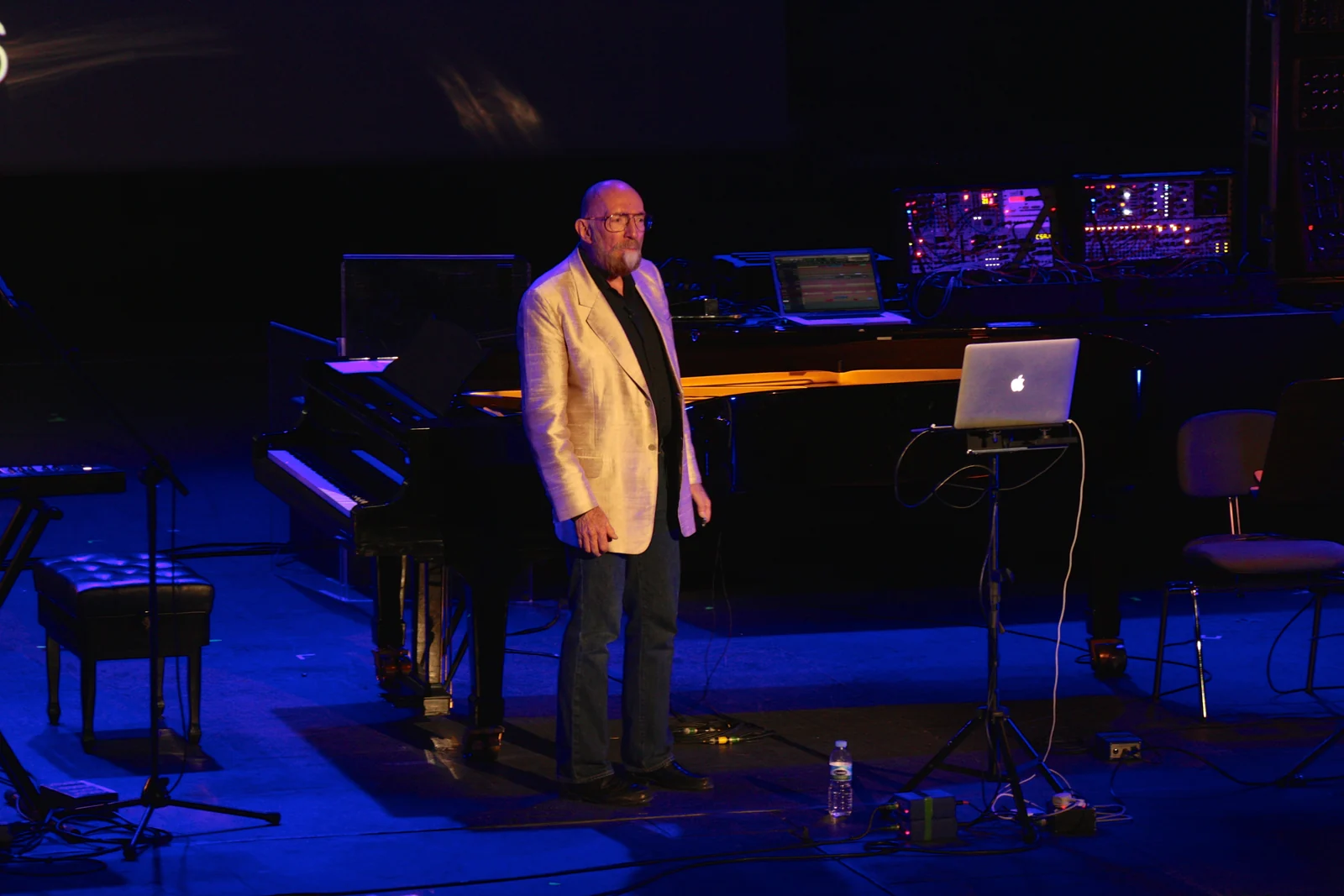
In this biography
Quick facts
- Born
- 1 June 1940
- Birthplace
- Logan, Utah, United States
- Country
- United States
- Nationality
- Not independently established
- Known for
- Developing relativistic astrophysics and contributing to LIGO and the theoretical interpretation of gravitational waves
Why this life matters
His work connects a detector’s strain measurements with the theoretical models needed to infer what distant compact objects were doing.
Timeline
Key moments
Born in Logan
Thorne was born on 1 June.
Princeton doctorate
Completed doctoral work after undergraduate study at Caltech.
Shared physics Nobel
Recognised with Rainer Weiss and Barry Barish for LIGO contributions.
Training for a field that was changing
Kip Stephen Thorne was born in Logan, Utah, in 1940. He studied at Caltech and then pursued doctoral research with John Archibald Wheeler at Princeton, receiving his doctorate in 1965. Returning to Caltech, he helped develop relativistic astrophysics at a time when discoveries such as quasars and pulsars were making general relativity relevant to new observational problems. His autobiography places the work within that changing research environment, rather than presenting black-hole theory as a subject whose eventual observational importance had always been universally accepted.
Connecting theory with a difficult experiment
Thorne became a central participant in the effort that led to LIGO, alongside experimental and organisational leaders including Rainer Weiss and Barry Barish. The project needed sensitive instruments, but also predictions about plausible sources and the information their waves could carry. His lecture credits other theorists, including Bernard Schutz, for explaining what binary signals could reveal. Those contributions were distinct from the work of building an interferometer. The productive connection was between different kinds of expertise, not a claim that theory alone had detected the waves.
Numerical relativity and the merger waveform
Thorne also encouraged work on numerical simulations of merging black holes. The final collision requires a description beyond simpler approximations useful during earlier inspiral. In his lecture he describes the development of a joint Caltech–Cornell effort with colleagues including Lee Lindblom and Saul Teukolsky. Such simulations helped connect a measured waveform with the dynamics of a source. The 2016 report of GW150914 compared the detected signal with a general-relativistic binary-merger waveform; it was not an optical photograph of the black holes.
Recognition across a much larger collaboration
Thorne shared the 2017 Nobel Prize in Physics with Weiss and Barish. The award named individuals for decisive contributions, while the detection papers belonged to the LIGO Scientific Collaboration and Virgo Collaboration. That distinction preserves both personal responsibility and collective achievement. His wider career also includes explanation of relativity to public audiences and consultation on Interstellar. The research legacy, however, is most clearly understood by following the chain from theoretical source, to predicted signal, to measured strain and a carefully inferred description of the event.
Quick answers
Frequently asked questions about Kip Thorne
- What was Kip Thorne’s role in gravitational-wave research?
- He helped connect relativistic source theory, LIGO’s scientific goals and the waveform calculations needed to interpret gravitational-wave observations.
- Did LIGO photograph the black holes in GW150914?
- No. The instruments measured strain signals, which were compared with physical models to infer a binary black-hole merger.
Keep exploring
Lives connected to this story
- Roy Kerr
Read another contribution to the mathematical description of rotating black holes, distinct from observing their merger signals.
Sources and further reading
Explore the evidence
These references support the biography and offer further reading. Official records, first-person accounts and independent reporting provide different perspectives; image records document attribution and licensing.
- 1. LIGO Scientific Collaboration and Virgo Collaboration / Physical Review LettersObservation of Gravitational Waves from a Binary Black Hole Merger
The observation date is14 September 2015; the detection paper and announcement are from February 2016. The article does not treat those dates as contradictory.
- 2. Kip S. Thorne / Nobel LectureLIGO and Gravitational Waves III
- 3. LIGO Scientific CollaborationGW150914
- 4. Nobel Prize OutreachKip Thorne — Facts
- 5. Nobel Prize OutreachKip Thorne — Biographical