In this biography
Quick facts
- Born
- Not established in the inspected records
- Birthplace
- Not independently established
- Country
- South Korea
- Nationality
- Not independently established
- Known for
- Genetic approaches to neural circuits and behaviour
- Medical training
- Seoul National University
- Doctoral field
- Genetics and cell biology
- Later institution
- KIST, 2001–2012
Why this life matters
His career helped bring genetic experiments into research on neural activity, sensory processing and social behaviour.
Timeline
Key moments
MIT and Whitehead
The programme records paired academic and institute appointments.
POSTECH
University appointments precede the move to KIST.
Observational-fear collaboration
Jeon and colleagues report mouse experiments.
Medical training and molecular genetics
Shin trained in medicine at Seoul National University and pursued genetics and cell biology at Cornell. Exact degree years are withheld because the records disagree. His early career included genetics work at Sloan-Kettering.
IBS records date his MIT and Whitehead appointments to 1985–1991, followed by a decade at POSTECH. The sequence put molecular-genetic techniques into the setting of a Korean university laboratory.
Changing the experimental question
The symposium profile describes a move from cancer research towards neuroscience. Calcium regulation became a route into questions about learning, memory and neural disorders. Genetically altered animal models allowed relationships between particular molecular components and behaviour to be investigated.
Sources for this section: [3]
Circuits and social observation
Daejong Jeon and colleagues’ 2010 paper, coauthored by Shin, studied observational fear in mice. Observers froze after watching another mouse receive shocks. Inactivating specified medial pain-system regions impaired this learning, whereas inactivating sensory thalamic nuclei did not. These were defined mouse behaviours, not a direct measurement of human empathy.
The distinction matters for explaining the contribution: a controlled behavioural response provides a tractable research problem. It does not make a human psychological concept interchangeable with the readout.
Sources for this section: [4]
Research leadership across institutions
The symposium account places him at KIST from 2001 to 2012, describes leadership of its neural-science centre and later Brain Sciences Institute, and identifies his subsequent IBS centre role. The IBS programme records the same KIST period and his earlier university appointments.
The later IBS-UST material presents a social-neuroscience group within the Center for Cognition and Sociality. The record extends his career from individual gene experiments towards a setting combining genetic, physiological and behavioural methods.
Quick answers
Frequently asked questions about Hee-Sup Shin
- Do the mouse observations establish a human treatment?
- No. A specified animal experiment and a demonstrated clinical outcome require different evidence.
Keep exploring
Lives connected to this story
- V. Narry Kim
Compare an RNA laboratory’s molecular experiments and training.
- Susumu Tonegawa
Compare another career linking genetics with brain research.
Sources and further reading
Explore the evidence
These references support the biography and offer further reading. Official records, first-person accounts and independent reporting provide different perspectives; image records document attribution and licensing.
- 1. Institute for Basic Science / 2016 admissions programmeIBS School, UST: Hee-Sup Shin profile, p10
- 2. Institute for Basic ScienceIBS-UST programme: Hee-Sup Shin selected profile
The later programme says PhD 1982; the earlier programme says 1983. The symposium profile also gives a different medical-degree year. Exact degree years are therefore withheld.
- 3. UK–Korea Neuroscience SymposiumHee-Sup Shin: thalamocortical circuits speaker profile
Selected speaker biography was read, not the whole proceedings or a recorded talk. Historical roles are dated; present-tense conference labels are not carried forward.
- 4. Jeon and colleagues / Nature NeuroscienceObservational fear learning involves affective pain system and Cav1.2 channels in ACC
The author list and selected publisher abstract were read. The full experimental paper and raw behavioural records were not inspected; no human clinical result is inferred.
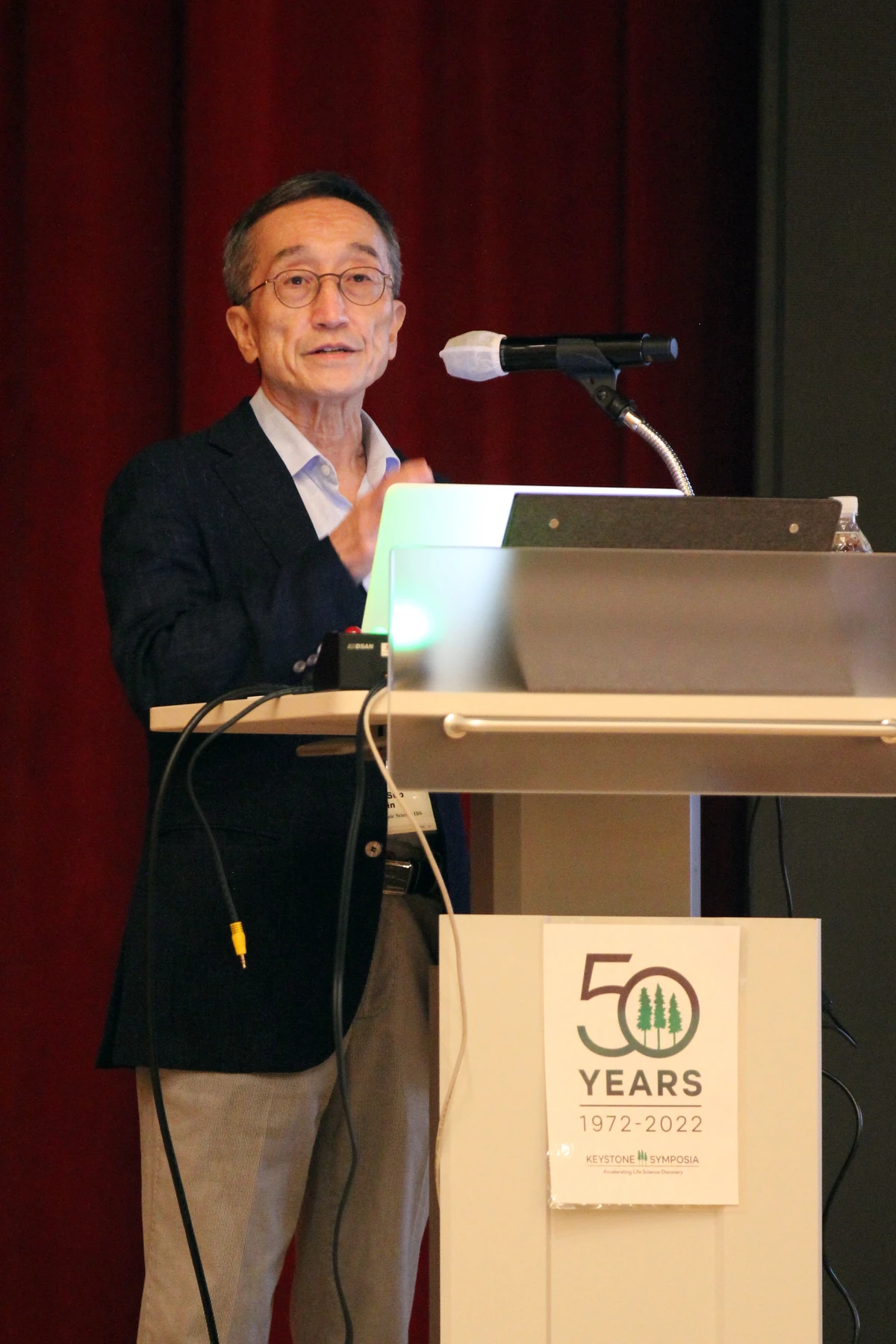
- 5. Wikimedia Commons; item-specific grant and named creatorHee-Sup Shin neuroscientist giving speech at Keystone in Korea.jpg: identity and licence record