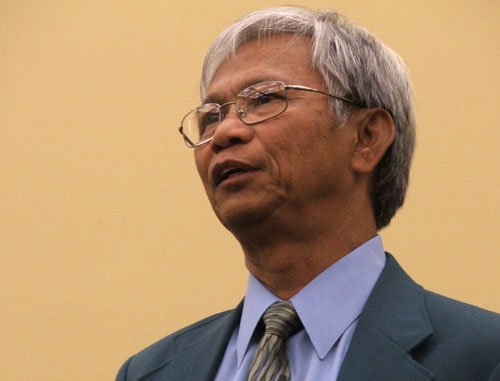
In this biography
Quick facts
- Born
- 1940
- Died
- 25 February 1996
- Birthplace
- Samrong Yong, Takéo Province, Cambodia
- Country
- Cambodia
- Nationality
- Cambodian
- Known for
- Winning an Academy Award for portraying Dith Pran in The Killing Fields
- Profession before 1975
- Physician
- Film debut
- The Killing Fields, 1984
- Academy Award
- Best Supporting Actor, 1985
- Memoir
- Haing Ngor: A Cambodian Odyssey
Why this life matters
Haing S. Ngor transformed lived experience into one of cinema’s most recognised performances about Cambodia, then used that platform for refugee and humanitarian work.
Timeline
Key moments
Survived Democratic Kampuchea
Concealed his medical training while enduring forced labour, imprisonment and profound family loss.
Resettled in the United States
Arrived as a refugee after working in a medical role in Thailand.
The Killing Fields and an Oscar
Portrayed Dith Pran without prior acting experience and won Best Supporting Actor.
Published his memoir
Recorded his life and survival in Haing Ngor: A Cambodian Odyssey.
Killed in Los Angeles
Was shot outside his home; three gang members were later convicted in the case.
A physician before he became an actor
Haing Somnang Ngor trained in medicine and worked in Phnom Penh before the Khmer Rouge takeover. Reference accounts describe obstetrics and gynaecology among his professional work. His later identification with a journalist on screen should not obscure that medical background or turn the role into his original occupation.
His early chronology is less secure than a precise birth-date label suggests. EBSCO’s reference biography gives 1940 while acknowledging alternative years; the Los Angeles Public Library prints 1947 with a question mark. This profile retains 1940 as a reported year without asserting a verified day. Agreement on his survival and career does not require pretending that all biographical dates are equally certain.
Forced labour, concealment and family loss
During Khmer Rouge rule from 1975 to 1979, Ngor concealed his education and medical identity to survive persecution. Accounts describe forced labour, hunger, imprisonment and torture. His wife died in childbirth during this period, a loss that became central to his recollections of being unable to protect those closest to him.
These experiences were his own, not scenes that should automatically be assigned to Dith Pran. After the regime’s overthrow, he reached Thailand and later resettled in the United States in 1980. The Los Angeles Public Library describes work counselling refugees in Los Angeles, connecting his life after displacement with people confronting unfamiliar institutions and the consequences of war.
Playing Dith Pran in The Killing Fields
Ngor’s film debut in The Killing Fields came in 1984. He portrayed Dith Pran, the Cambodian journalist and colleague of New York Times correspondent Sydney Schanberg. A survivor playing another survivor brought personal knowledge to the performance, but Ngor and Pran remained two different people with separate families, occupations and experiences.
The Academy’s record places his Supporting Actor win at the ceremony on 25 March 1985, honouring films released in 1984. The release year and award year are therefore both relevant. The same record lists Sam Waterston as a Leading Actor nominee, not a winner. Ngor’s achievement should not be inflated into an undated claim that no later Asian performer has won the category.
A memoir and a continuing public voice
He published Haing Ngor: A Cambodian Odyssey with journalist Roger Warner. The later edition titled Survival in the Killing Fields includes Warner’s retrospective epilogue. Its publisher records that Warner first met Ngor in a Thai refugee camp in 1980. The memoir is Ngor’s testimony, not the source biography of every character in the film.
His public work also extended beyond acting. The United States Holocaust Memorial Museum records that Ngor and Pran joined others in 1987 to call for investigation of Khmer Rouge abuses. Celebrity provided a platform for that demand, but neither the Oscar ceremony nor the film constituted an international judicial investigation or determined individual criminal responsibility.
Later work, murder and the preservation of testimony
Ngor continued performing after his debut, including in Heaven & Earth, while supporting Cambodian and refugee causes. He was killed outside his Los Angeles home in February 1996. EBSCO’s account records subsequent convictions and a robbery finding; rumours of a political killing should not be presented as established fact.
His legacy rests on several kinds of record: a film performance, autobiographical testimony and advocacy remembered by cultural and historical institutions. Each answers a different question. Watching him portray Pran can introduce viewers to Cambodian history, but studying Ngor’s life requires following his own medical career, displacement, writing and public work rather than treating a dramatic role as his complete biography.
Quick answers
Frequently asked questions about Haing S. Ngor
- Was Haing Ngor the real Dith Pran?
- No. Ngor was a physician and survivor who portrayed journalist Dith Pran. They were different men, although both survived Khmer Rouge rule.
- Did he win the Oscar in 1984 or 1985?
- The Killing Fields was released in 1984. Ngor won Supporting Actor at the Academy Awards ceremony on 25 March 1985.
- Why is his birth date qualified?
- 1940 is a commonly reported birth year, but later years have also been suggested; the Los Angeles Public Library gives 1947 with a question mark. The exact day and year are not treated as settled here.
- Is his memoir the same story as the film?
- No. His memoir with Roger Warner records Ngor’s life. The film dramatises Dith Pran and Sydney Schanberg’s experiences; the two sources should not be merged.
Keep exploring
Lives connected to this story
- Rithy Panh
Compare another Cambodian survivor whose work engages testimony and cinematic memory.
- Loung Ung
Read a separate survivor’s memoir-based public career.
- Pol Pot
Understand the regime’s leadership without substituting a film for historical evidence.
Sources and further reading
Explore the evidence
These references support the biography and offer further reading. Official records, first-person accounts and independent reporting provide different perspectives; image records document attribution and licensing.
- 1. Academy of Motion Picture Arts and SciencesOfficial record of the 1985 Academy Awards
- 2. Los Angeles Public LibrarySpotlight on actor and activist Haing Somnang Ngor
The library account gives an uncertain 1947 birth year and contains a now-outdated “only actor” superlative. Neither is silently repeated as a settled current fact.
- 3. Wikimedia CommonsPortrait and CC BY 4.0 record
- 4. Academy of Motion Picture Arts and Sciences57th Academy Awards, 25 March 1985: winners and nominees
- 5. EBSCO / Roy LiebmanHaing S. Ngor: reference biography and disputed birth chronology
The reported 1940 birth year is retained with uncertainty and the former exact birthday is removed. The reference account distinguishes subsequent murder convictions from conspiracy claims.
- 6. Hachette / Basic BooksSurvival in the Killing Fields: authorship and later edition
The publisher page describes a later memoir edition; its promotional description incorrectly calls Pran a doctor. It is used only for authorship and edition information, not to identify Pran’s profession or resolve the murder case.
- 7. United States Holocaust Memorial MuseumInternational response: film reception and the 1987 investigation demand