In this biography
Quick facts
- Born
- 15 November 1887
- Died
- 6 March 1986
- Birthplace
- Near Sun Prairie, Wisconsin, United States
- Country
- United States
- Nationality
- American
- Known for
- Enlarged flowers, New Mexico landscapes and a distinctive language of American modernism
- Full name
- Georgia Totto O’Keeffe
- Born
- 15 November 1887, near Sun Prairie, Wisconsin
- Art training
- Art Institute of Chicago, Art Students League and further study of design
- Early abstract work
- Charcoal drawings made in 1915
- New Mexico
- Extended stays from 1929; permanent home from 1949
- Died
- 6 March 1986, Santa Fe, New Mexico
Why this life matters
O’Keeffe made observation and abstraction work together, translating familiar subjects into forceful arrangements of color, scale and form. Her long career cannot be reduced to flowers or to the interpretations others imposed on them.
Timeline
Key moments
Born in Wisconsin
Georgia Totto O’Keeffe is born on 15 November near Sun Prairie, the second of seven children.
Abstract drawings reach New York
Alfred Stieglitz exhibits her drawings after Anita Pollitzer brings them to his attention.
An extended stay in northern New Mexico
O’Keeffe begins the repeated northern New Mexico visits that become central to her paintings and working life.
MoMA retrospective
The Museum of Modern Art presents a retrospective from 14 May to 25 August, covering a wider range than her flower paintings alone.
New Mexico becomes her permanent home
After years of seasonal stays and Stieglitz’s death in 1946, O’Keeffe settles permanently in New Mexico.
Death in Santa Fe
O’Keeffe dies on 6 March at age 98, following a career that continued through changing subjects, places and physical limitations.
Training, teaching and the search for another visual language
Georgia Totto O’Keeffe was born near Sun Prairie, Wisconsin, on 15 November 1887, the second of seven children. She studied at the Art Institute of Chicago and the Art Students League in New York, learning methods grounded in close observation and traditional representation. Further encounters with Arthur Wesley Dow’s ideas about composition encouraged a different emphasis: arranging lines, shapes and colors could matter as much as reproducing a subject convincingly.
Teaching supported this period of exploration in Virginia, Texas and South Carolina. In 1915 she made a series of charcoal abstractions, testing a personal vocabulary rather than simply abandoning her earlier training. These drawings gave her forms that did not depend on a conventional still life or landscape.
New York and a partnership that did not define the whole artist
O’Keeffe sent drawings to her friend Anita Pollitzer, who showed them to photographer and gallery director Alfred Stieglitz. He exhibited her work in 1916. O’Keeffe moved to New York in 1918, and the two married in 1924. Stieglitz’s galleries and recurring exhibitions provided important settings in which audiences encountered her developing art; his photographs of her also shaped her public image.
The personal and professional partnership did not determine her paintings. Her early abstractions preceded their sustained partnership. In New York and at Lake George, she continued to select subjects and develop compositions on her own terms. Drawings, architecture and botanical forms belonged to the same expanding practice, rather than to a simple progression from abstract art toward recognizable objects.
Flowers, buildings and the scale of attention
During the 1920s, O’Keeffe painted New York buildings and developed the enlarged flower images for which she became especially well known. Magnification changed a small, familiar subject into an encounter with curving edges, color and the relationships between forms. Recognition and abstraction could operate at once. The paintings did not require viewers to choose between seeing a flower and noticing the picture’s structure.
Critics often interpreted her work through gender and sexuality, readings she resisted when they reduced its possibilities. The range of her practice was visible in the Museum of Modern Art’s 1946 retrospective, organized with her close involvement. It included early works on paper, flowers and New Mexico landscapes. Running from 14 May to 25 August, it was MoMA’s first retrospective devoted to a woman artist, not the beginning of her exhibition career.
Northern New Mexico: repeated visits, then a permanent home
An extended visit to northern New Mexico in 1929 opened a sustained source of subjects. O’Keeffe returned for long stays while maintaining her New York connections. Desert hills, weathered bones, architectural details and expanses of sky entered paintings shaped by particular places, not by a generic idea of the American West. The dark terrain she called the Black Place and the patio door at Abiquiu offered markedly different structures to investigate.
She bought a home at Ghost Ranch in 1940 and another at Abiquiu in 1945. These dates distinguish acquiring working places from moving permanently: that came in 1949, after Stieglitz’s death in 1946. Her New Mexico years combined repeated observation with selective transformation. Bones or a doorway could become a means of organizing a painting without losing their connection to an encountered object.
Aerial views, later work and a long career
International travel in the 1950s and 1960s brought other vantage points. Rivers seen from aircraft and banks of clouds suggested compositions that joined recognizable experiences to broad abstract patterns. In the Sky Above Clouds paintings, repeated forms and a distant horizon expanded her interest in scale; the monumental fourth painting in the series dates to 1965.
Macular degeneration later restricted her sight. The O’Keeffe Museum dates her last unassisted oil painting to 1972, while also documenting continued work with assistants. Poor vision did not end every form of artistic activity at once. She died in Santa Fe on 6 March 1986, aged 98. Her career links charcoal experiments, urban buildings, flowers, desert places and aerial views through a persistent concern with visual form.
Quick answers
Frequently asked questions about Georgia O’Keeffe
- Was Georgia O’Keeffe an abstract painter?
- Abstraction was central to her work, beginning with the charcoal drawings of 1915. Many later paintings also depict recognizable subjects, including flowers, buildings, bones and landscapes. Observation and abstract structure often work together rather than forming separate categories.
- When did O’Keeffe move to New Mexico?
- She made an extended visit to northern New Mexico in 1929 and returned for long seasonal stays. She purchased homes at Ghost Ranch in 1940 and Abiquiu in 1945, then made New Mexico her permanent home in 1949.
- What was Alfred Stieglitz’s role in her career?
- Stieglitz exhibited O’Keeffe’s drawings in 1916 and later presented her work regularly. They married in 1924. His galleries and photographs helped shape her public reception, but her early abstractions and continuing artistic decisions were her own.
- Did loss of sight end her art immediately?
- No. Macular degeneration limited her vision, and her last unassisted oil painting dates to 1972, but she continued making work with assistants. It is inaccurate to treat that date as the end of all her artistic activity.
Keep exploring
Lives connected to this story
- Dorothea Lange
Compare a photographer’s approach to American places and people with O’Keeffe’s work in painting.
- Aaron Copland
Explore another modernist career that engaged American settings and subjects in a different medium, music.
Sources and further reading
Explore the evidence
These references support the biography and offer further reading. Official records, first-person accounts and independent reporting provide different perspectives; image records document attribution and licensing.
- 1. Georgia O’Keeffe MuseumAbout Georgia O’Keeffe
The museum distinguishes the last unassisted oil painting in 1972 from continued assisted work. It supports the human-readable birth and death dates and permanent move to New Mexico.
- 2. The Metropolitan Museum of ArtLisa Mintz Messinger: Georgia O’Keeffe (1887–1986)
Training and teaching are described without inventing an earned college degree. The essay distinguishes the 1929 extended New Mexico stay from the permanent move in 1949 and supplies the later aerial subjects.
- 3. The Museum of Modern ArtAnnemarie Iker: Georgia O’Keeffe
- 4. The Museum of Modern ArtGeorgia O’Keeffe: exhibition, 14 May–25 August 1946
The 14 May–25 August 1946 event was MoMA’s first retrospective devoted to a woman artist, not the first exhibition of any kind by a woman at the museum. The exhibition archive page was read; a complete review of the linked archival files is not claimed.
- 5. National Gallery of ArtGeorgia O’Keeffe
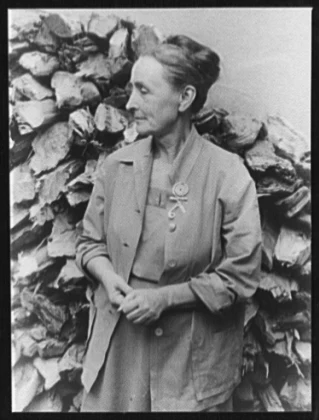
- 6. Library of CongressCarl Van Vechten: Portrait of Georgia O’Keeffe, Abiquiu, New Mexico, 16 August 1950
The exact portrait is dated 16 August 1950 and belongs to LOT 12735 no. 891. The complete supplied 319×420 intermediary-rollfilm TIFF was obtained through its matching Commons original; it is not described as a camera master and will not be enlarged.
- 7. Library of CongressCarl Van Vechten Photographs: rights and restrictions
LOC’s specific collection statement says donor restrictions expired in 1986 and records the Mauriber/Kellner authority dispute, after which the Library continues to believe the photographs are public domain. This is the stated institutional determination, not an independent worldwide legal guarantee. Integrity and photographer-credit requests are honored.