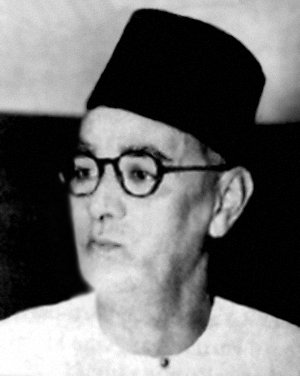
In this biography
Quick facts
- Born
- 12 February 1895
- Died
- 19 January 1962
- Birthplace
- Johor Bahru, Johor
- Country
- Malaysia
- Nationality
- Malaysian
- Known for
- Organising opposition to the Malayan Union and founding UMNO in 1946
- Full name
- Onn bin Jaafar
- UMNO office
- Founding president, 1946–1951
- State office
- Menteri Besar of Johor
- Later parties
- Independence of Malaya Party and Parti Negara
- Parliamentary seat
- Kuala Terengganu Selatan, elected 1959
Why this life matters
Onn helped turn post-war Malay associations into a national political organisation, yet his later break with UMNO revealed an early debate over whether Malayan parties should organise by community or across communities.
Timeline
Key moments
Born in Johor Bahru
Born into a prominent Johor family and later educated in Johor, England and at the Malay College Kuala Kangsar.
Worked in journalism
Wrote and edited for Malay newspapers after earlier service in the Johor administration.
Opposed the Malayan Union
Helped coordinate Malay associations against the proposed constitutional order and emerged as a leading national organiser.
Became UMNO’s founding president
The Malay congress in Johor Bahru established UMNO and chose Onn as its first president.
Led Johor’s government
Served as Menteri Besar while also building UMNO into a nationwide political organisation.
Left UMNO
Resigned after the party rejected his proposal to open membership beyond Malays and formed the Independence of Malaya Party.
Built Parti Negara and entered Parliament
Founded Parti Negara, then won Kuala Terengganu Selatan in the 1959 federal election after earlier electoral defeats.
Died in Johor Bahru
Died on 19 January, leaving a legacy tied both to UMNO’s birth and to the unresolved question of multi-ethnic party organisation.
Johor service, journalism and public argument
Onn Jaafar grew up close to the Johor court and moved between government service, military training and journalism. His administrative experience gave him direct knowledge of colonial-era government, while newspaper work developed the public voice that later made him a formidable organiser and speaker.
During the Japanese occupation he held responsibility for food control in Johor. When British rule returned after the war, the constitutional plan known as the Malayan Union created the crisis that brought him to the centre of national politics.
The Malayan Union campaign and the founding of UMNO
Onn helped bring separate Malay associations into a coordinated movement against the Malayan Union. Delegates meeting in 1946 decided to create the United Malays National Organisation, and Onn became its first president on 11 May. Under his leadership, UMNO turned resistance to the plan into a durable national organisation.
The Malayan Union was replaced by the Federation of Malaya in 1948. The new settlement restored the constitutional position of the Malay rulers and changed citizenship rules. That outcome made Onn one of the central political figures of the immediate post-war period, although the settlement’s communal structure would remain contested.
Johor leadership and an economic programme
Onn also served as Menteri Besar of Johor before choosing to concentrate on UMNO. In federal administration he chaired the Rural and Industrial Development Authority, an institution intended to strengthen Malay participation in commerce and improve rural livelihoods.
His programme therefore combined constitutional politics with education and economic advancement. UMNO’s own historical account credits him with promoting scholarships and challenging unequal treatment within the colonial public service.
The argument over an inclusive party
By 1951, Onn believed that the independence movement required a broader organisation open to people of every community. UMNO delegates rejected the proposal, and he resigned as president in August. Tunku Abdul Rahman succeeded him and later pursued inter-communal cooperation through an alliance of separate communal parties rather than a single open-membership party.
Onn tested his idea through the Independence of Malaya Party and then Parti Negara. Neither displaced the Alliance, but his departure preserved a significant alternative in the history of Malaysian party formation: a national party organised across communities rather than a coalition of community-based parties.
Parliament and historical legacy
After setbacks in the 1955 election, Onn won Kuala Terengganu Selatan in 1959 and entered the first Parliament of independent Malaya as Parti Negara’s only member. He remained an independent-minded critic until his death in January 1962.
His legacy is deliberately complicated. He is remembered as UMNO’s founder and as a defender of Malay political interests, but also as the leader who left that party because he wanted a different basis for national membership. Both parts of that story are essential to understanding his place in Malaysian political history.
Quick answers
Frequently asked questions about Onn Jaafar
- Who was Onn Jaafar?
- Onn Jaafar was a founder and first president of UMNO. Onn helped turn post-war Malay associations into a national political organisation, yet his later break with UMNO revealed an early debate over whether Malayan parties should organise by community or across communities.
- What is Onn Jaafar best known for?
- Onn Jaafar is best known for organising opposition to the Malayan Union and founding UMNO in 1946.
- When and where was Onn Jaafar born?
- Onn Jaafar was born on 12 February 1895 in Johor Bahru, Johor.
- When did Onn Jaafar die?
- Onn Jaafar died on 19 January 1962.
Sources and further reading
How this biography was checked
Core dates and offices are checked against the sources below. This profile was last reviewed on 4 October 2026.