In this biography
Quick facts
- Born
- 23 January 1947
- Birthplace
- Yogyakarta
- Country
- Indonesia
- Nationality
- Indonesian
- Known for
- Becoming Indonesia’s first woman president and building PDI-P into a major post-Suharto party
- Office
- President, 2001–2004
- Earlier office
- Vice President, 1999–2001
- Historic first
- First woman president of Indonesia
- Current party office
- PDI-P chair, 2025–2030 term
Why this life matters
Megawati connected Sukarno’s political inheritance to electoral democracy, presided over key Reformasi institutions and built Indonesia’s most durable party leadership.
Timeline
Key moments
Entered Parliament
Won election as a member of the Indonesian Democratic Party.
Won the PDI chairmanship
Was chosen to lead the Indonesian Democratic Party and became an opposition focus under Suharto.
Survived a state-backed party split
Supporters occupying PDI headquarters were forcibly removed on 27 July, deepening her status as a New Order opponent.
Led the largest party in the election
PDI-P won 33.74 per cent of the legislative vote; the MPR chose Abdurrahman Wahid as president and Megawati as vice president.
Became president
Succeeded Abdurrahman Wahid after his removal by the national legislature.
Contested the first direct presidential election
Lost Indonesia’s first direct presidential election to Susilo Bambang Yudhoyono.
Confirmed for another PDI-P term
The party’s sixth congress confirmed her as chair for 2025–2030.
Sukarno’s daughter in the New Order
Diah Permata Megawati Setiawati Sukarnoputri was born in Yogyakarta while Indonesia’s independence struggle was still under way. As the daughter of founding president Sukarno and Fatmawati, she grew up inside the presidential household before Suharto displaced her father and restricted the family’s political space.
Megawati kept a low public profile for much of the New Order. She entered the legislature through the Indonesian Democratic Party, or PDI, in 1987. Her family name mattered, but her understated style also offered a contrast to Suharto’s centralised, military-backed government.
PDI leadership and the 27 July attack
Party members selected Megawati as PDI chair in 1993 despite official resistance. The government then supported a rival faction that removed her at a separate congress. Her supporters occupied the party’s Jakarta headquarters, turning an internal dispute into a national test of political control.
On 27 July 1996, police and government-backed forces removed the occupiers. Amnesty International and Human Rights Watch documented the raid, arrests and violence that followed. Rather than ending Megawati’s career, the episode—widely remembered as Kudatuli—made her a rallying point for opposition to the New Order.
Winning votes but not the presidency in 1999
After Suharto fell in 1998, Megawati’s followers formed the Indonesian Democratic Party of Struggle, or PDI-P. In the June 1999 legislative election, the party won 35.7 million votes—33.74 per cent—and the largest bloc in the House of Representatives.
The presidency was still chosen indirectly by the People’s Consultative Assembly. A coalition instead elected Abdurrahman Wahid, while Megawati became vice president. When the Assembly removed Wahid amid a constitutional and political confrontation in July 2001, she succeeded him as Indonesia’s fifth president and its first woman head of state.
Economic stabilisation and Reformasi institutions
Megawati inherited an economy still recovering from the Asian financial crisis and a state whose rules had been rewritten after Suharto. Her economic team emphasised macroeconomic stability, bank restructuring and fiscal consolidation. Indonesia completed its IMF-supported programme in December 2003, although growth and job creation remained major public concerns.
Several institutions associated with the Reformasi settlement took legal form during her presidency. Law No. 30 of 2002 established the framework for the Corruption Eradication Commission, while Law No. 24 of 2003 created the Constitutional Court. Constitutional amendments also cleared the way for Indonesians to elect the president directly in 2004.
Terrorism, Aceh and the limits of reform
The October 2002 Bali bombings killed more than 200 people and forced the government to strengthen counter-terrorism investigations and international cooperation. The response became a major test for a young democracy trying to confront organised violence without restoring New Order methods.
Her government’s record in Aceh was more coercive. After peace talks with the Free Aceh Movement collapsed, Megawati placed the province under martial law in May 2003 and authorised a major military operation. Human Rights Watch reported abuses by both state forces and separatists, restrictions on independent reporting and large-scale civilian displacement.
The first direct presidential transfer
Megawati sought a full elected term in 2004. She reached the runoff but lost to her former coordinating security minister, Susilo Bambang Yudhoyono. Her acceptance of the result helped complete Indonesia’s first direct presidential transfer, even though her administration was criticised for slow decision-making and an uneven reform record.
The transition also separated two parts of her legacy: a relatively stable presidency during an unsettled period, and a much longer career as the organiser and ultimate authority of PDI-P.
Party leader after the palace
Megawati remained PDI-P chair after leaving office and became a decisive party gatekeeper. She backed Joko Widodo for president in 2014 and 2019, then supported Ganjar Pranowo in 2024 as relations with Jokowi fractured over the succession and the candidacy of his son Gibran Rakabuming Raka.
PDI-P’s sixth congress confirmed Megawati as chair for the 2025–2030 term. Her longevity gives the party a clear identity and organisational centre, while also sustaining debate about internal democracy, dynastic influence and leadership succession in Indonesia’s party system.
Quick answers
Frequently asked questions about Megawati Sukarnoputri
- Who is Megawati Sukarnoputri?
- Megawati Sukarnoputri is a former president of Indonesia and chair of PDI-P. Megawati connected Sukarno’s political inheritance to electoral democracy, presided over key Reformasi institutions and built Indonesia’s most durable party leadership.
- What is Megawati Sukarnoputri best known for?
- Megawati Sukarnoputri is best known for becoming Indonesia’s first woman president and building PDI-P into a major post-Suharto party.
- When and where was Megawati Sukarnoputri born?
- Megawati Sukarnoputri was born on 23 January 1947 in Yogyakarta.
Sources and further reading
Explore the evidence
These references support the biography and offer further reading. Official records, first-person accounts and independent reporting provide different perspectives; image records document attribution and licensing.
- 1. Ministry of Education and Culture of IndonesiaBalai Kirti Presidential Museum booklet
- 2. Presidential Archives Study Centre, National Archives of IndonesiaPresident Megawati Soekarnoputri
- 3. General Elections Commission of IndonesiaPemilu 1999
- 4. Amnesty InternationalArrests, torture and intimidation: The government response to its critics
- 5. Audit Board of the Republic of IndonesiaLaw No. 30 of 2002 on the Corruption Eradication Commission
- 6. Constitutional Court of the Republic of IndonesiaHistory of the Constitutional Court
- 7. International Monetary FundIndonesia’s transition from IMF financial support
- 8. National Counterterrorism Agency of IndonesiaPresidential Instruction on the 2002 Bali bombing response
- 9. Human Rights WatchAceh Under Martial Law: Human Rights Under Fire
- 10. ANTARAPDI-P confirms Megawati for the 2025–2030 term
- 11. Wikimedia CommonsPresident Megawati Sukarnoputri — image and public-domain record
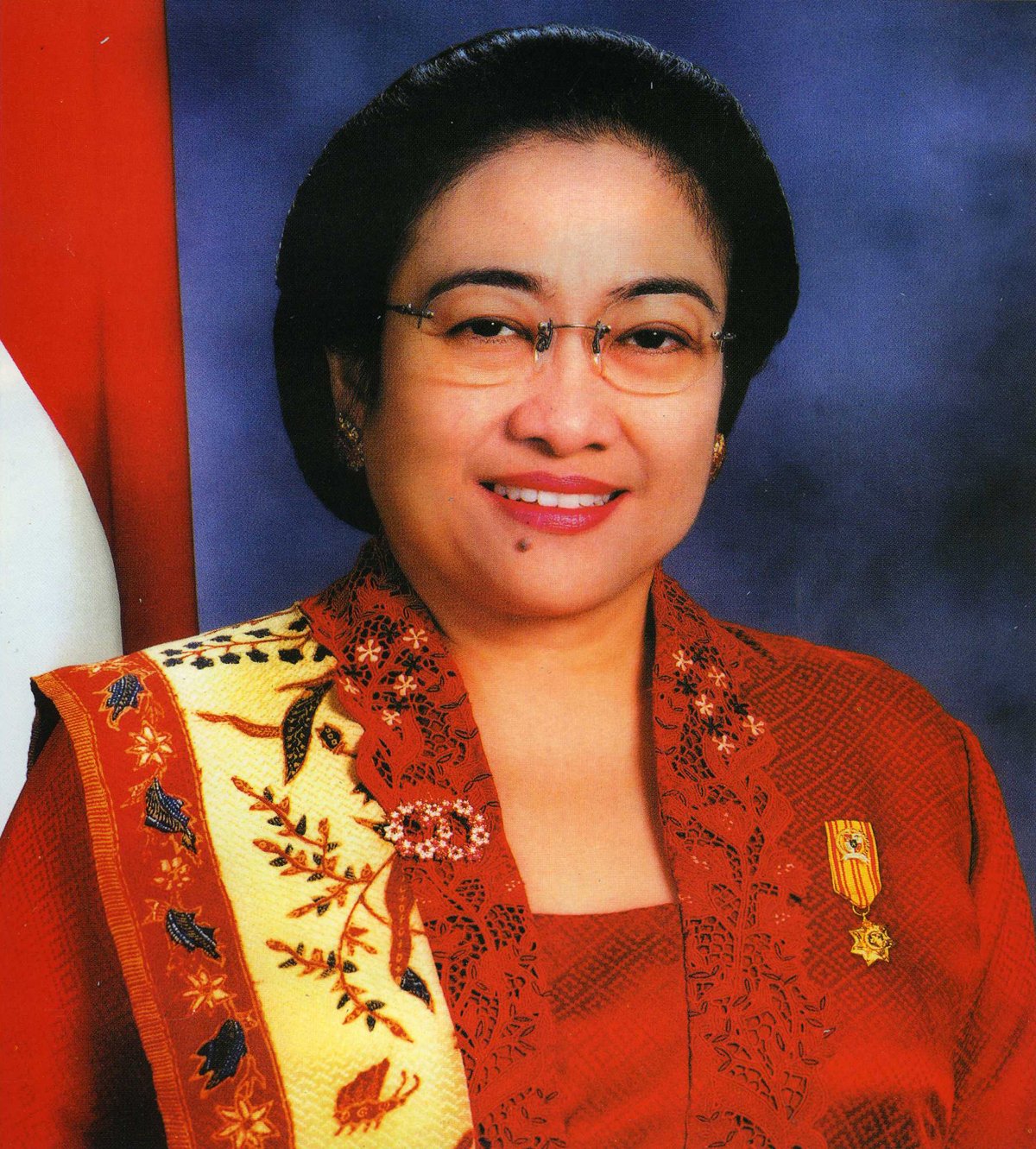
Commons identifies the National Information Agency as the creator of this 2001 official portrait and links an Indonesian government-hosted original. The file’s Article 43 public-domain statement concerns Indonesia; it should not be described as universal clearance.