In this biography
Quick facts
- Born
- 13 May 1957
- Birthplace
- Sampang, Madura, East Java
- Country
- Indonesia
- Nationality
- Indonesian
- Known for
- Leading Indonesia’s Constitutional Court and running for vice president with Ganjar Pranowo in 2024
- Judicial office
- Chief justice of the Constitutional Court, 2008–2013
- Cabinet role
- Coordinating political, legal and security minister, 2019–2024
- Legislature
- Member of the DPR, 2004–2008
- 2024 result
- 27,040,878 votes with Ganjar Pranowo
Why this life matters
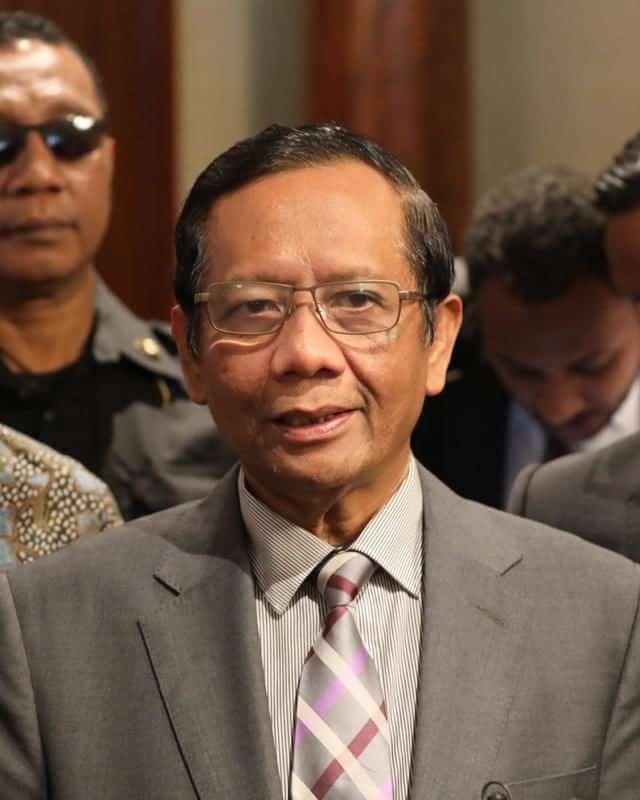
Mahfud MD carried constitutional scholarship into all three branches of Indonesia’s post-Suharto state, giving his public career unusual breadth across judicial review, legislation and executive coordination.
Timeline
Key moments
Joined the law faculty at UII
Began an academic career in constitutional law at the Islamic University of Indonesia.
Served in President Wahid’s cabinet
Held the defence and justice portfolios during the unsettled early Reformasi transition.
Entered the national legislature
Became a DPR member before moving to the Constitutional Court in 2008.
Became Constitutional Court chief justice
Led the young court through major judicial-review and election-dispute cases.
Returned to cabinet
Joko Widodo appointed him coordinating minister for political, legal and security affairs.
Ran for vice president
Resigned from cabinet during the campaign and finished third with Ganjar Pranowo.
Pesantren roots and constitutional scholarship
Mohammad Mahfud Mahmodin, publicly known as Mahfud MD, was born in Sampang on the island of Madura in 1957. Religious schooling and pesantren education accompanied his formal studies before he trained in law at the Islamic University of Indonesia in Yogyakarta. He later pursued political-science graduate study at Gadjah Mada University, bringing legal doctrine and the study of political power into the same academic career.
Mahfud joined UII’s law faculty and became known for writing and teaching on constitutional law, democracy and the relationship between legislation and political interests. That expertise mattered during Reformasi, when amendments to the 1945 Constitution redistributed authority, created new checks on government and opened questions about how courts should protect democratic rules without replacing elected institutions.
Experience across cabinet and parliament
President Abdurrahman Wahid appointed Mahfud defence minister in 2000 and later minister of justice and human rights in 2001. These were brief appointments during a confrontation between the presidency, parliament and other state institutions. They nevertheless moved a university scholar directly into debates over civilian control, legal reform and executive authority in the first years after Suharto.
Mahfud later joined the National Awakening Party and served in the House of Representatives from 2004 to 2008. His movement from academia to cabinet and legislature gave him practical experience of how constitutional principles are negotiated through coalitions, statutes and institutional rivalry. In 2008 the legislature selected him as a Constitutional Court justice, opening the most influential phase of his legal career.
Chief justice of a young constitutional court
Mahfud became chief justice soon after joining the Court and led it until 2013. The institution reviewed legislation, settled disputes among state bodies and decided contested election results. He argued publicly for substantive justice: courts should consider constitutional purpose and fairness rather than treat procedure as an end in itself. That language helped make complex judgments part of national political discussion.
His tenure also demonstrated the power and vulnerability of a court created by Reformasi. Decisions could alter statutes and certify electoral outcomes, placing judges close to partisan conflict. Mahfud left the bench before a later corruption scandal involving his successor damaged the institution’s reputation, and he continued to defend judicial independence while criticising weaknesses in law enforcement and political accountability.
Coordinating minister and 2024 candidate
Joko Widodo appointed Mahfud coordinating minister for political, legal and security affairs in 2019. The role required coordination across police, defence, legal and administrative bodies during disputes involving corruption, security, rights and elections. Because the portfolio touched many contested cases, Mahfud’s public statements attracted both support for directness and criticism over the government’s broader record.
Ganjar Pranowo chose Mahfud as his running mate for the 2024 presidential election. Mahfud resigned from cabinet during the campaign, saying he wanted to avoid a conflict of interest. The ticket received 27,040,878 votes, or 16.47 per cent, and finished third. Its challenge to the result was later rejected by the Constitutional Court, closing a campaign in which a former chief justice asked his old institution to review the conduct of a national election.
Quick answers
Frequently asked questions about Mahfud MD
- Who is Mahfud MD?
- Mahfud MD is a constitutional-law scholar, former chief justice and minister. Mahfud MD carried constitutional scholarship into all three branches of Indonesia’s post-Suharto state, giving his public career unusual breadth across judicial review, legislation and executive coordination.
- What is Mahfud MD best known for?
- Mahfud MD is best known for leading Indonesia’s Constitutional Court and running for vice president with Ganjar Pranowo in 2024.
- When and where was Mahfud MD born?
- Mahfud MD was born on 13 May 1957 in Sampang, Madura, East Java.
Sources and further reading
How this biography was checked
Core dates and offices are checked against the sources below. This profile was last reviewed on 3 October 2026.
- Constitutional Court of the Republic of IndonesiaProfile of Prof. Dr. Moh. Mahfud MD
- Constitutional Court of the Republic of IndonesiaProfessional curriculum vitae of Mahfud MD
- Constitutional Court of the Republic of IndonesiaHistory of the Constitutional Court
- General Elections Commission of IndonesiaKPU Decision No. 360 of 2024 — national election results
- Wikimedia CommonsGovernment photograph and public-domain record