In this biography
Quick facts
- Born
- 1965
- Birthplace
- Pretoria area, South Africa
- Country
- South Africa
- Nationality
- Not independently established
- Known for
- When You Come Back, Mamelodi-rooted music and performances linking artistic work with social commitment
- Born
- 1965, Pretoria area; raised in Mamelodi
- Debut album
- When You Come Back, 1992
- Public performance
- Nelson Mandela’s inauguration, 1994
- International label
- ATO Records, from 2003
- National honour
- Order of Ikhamanga in Silver, 2013
- Later recording
- Shebeen Queen, 2020
Why this life matters
His voice and guitar connect the experience of Mamelodi with exile, return, memory and the unfinished social questions of democratic South Africa.
Timeline
Key moments
A musical upbringing
Mamelodi and his grandmother’s shebeen form an early musical environment.
Artists and writers
Ancestors of Africa precedes participation in the Congress of South African Writers.
From performance to debut
The Zabalaza Festival and recording work lead to When You Come Back.
A national stage
He performs at Mandela’s inauguration and releases Wisdom of Forgiveness.
Wider circulation
ATO releases help bring his recordings to North American audiences.
Memory and continuing performance
Shebeen Queen precedes the documented Baxter Theatre performance in October 2025.
Mamelodi supplied a musical education before a recording contract
Mahlasela was born in the Pretoria area in 1965 and grew up in Mamelodi. The Presidency identifies Lady Selbourne as his birthplace; another biography says Mamelodi. The broader location is secure, but those different township descriptions should not be silently combined into a falsely precise fact.
His grandmother’s shebeen brought people together through singing as well as social life. He made an early guitar from everyday materials and later developed his technique. The importance of that setting was not simply poverty overcome: it was a working musical community whose sounds and relationships remained part of his art.
Political engagement grew through encounters with other artists
He joined Ancestors of Africa in 1981 and the Congress of South African Writers in 1988. The national citation describes a creative friendship with Lesego Rampolokeng and influences including Miriam Makeba, Phillip Tabane and Victor Jara. Poetry, music and political discussion developed in connected settings.
Police harassment formed part of that experience. Writing songs with social meaning was not an activity outside apartheid’s restrictions. Yet reducing the repertoire to a list of political messages would miss the musical choices, friendships and emotional range through which those experiences reached listeners.
When You Come Back carried an older song into a new moment
The debut album appeared in 1992. Its title song imagined the return of people driven into exile, drawing on concerns that predated the album’s release. In a 2012 interview he also described finding personal meaning in it over time, rather than assigning it one permanently fixed political explanation.
He performed at Mandela’s inauguration in 1994 and released Wisdom of Forgiveness that year. Silang Mabele followed in 1997. The inauguration was an important stage in the career, not the beginning of his musical activity or the final answer to the problems his songs addressed.
International records and collaborations expanded the audience
His official biography dates his ATO relationship to 2003, following the interest of Dave Matthews. North American releases and touring introduced more listeners to a career already established in South Africa. A compilation issued abroad should not be confused with the first domestic album.
He also appears among the musicians in Lee Hirsch’s documentary Amandla! A Revolution in Four-Part Harmony. The film brings several performers into one historical argument about music and apartheid. That shared appearance does not make their styles, political experiences or contributions interchangeable.
Later work returned to the community without retreating from public life
ATO’s 2020 Shebeen Queen release presents a live celebration of township songs and honours his grandmother Ida. In the accompanying account, Mahlasela explains the wish to preserve music heard in her home. Memory becomes a recording project, not merely a biographical anecdote.
GroundUp’s October 2025 interview and Baxter Theatre report document a continuing practice of combining songs and stories. The national honours record places his Ikhamanga Silver award in 2013, after a SAMA lifetime award in 2012. These are separate honours in different years, not competing dates for the same award.
Quick answers
Frequently asked questions about Vusi Mahlasela
- When was his debut album released?
- When You Come Back was released in 1992.
- Was Mamelodi his birthplace or upbringing?
- He grew up there. Sources differ on the precise birthplace; the Presidency identifies Lady Selbourne in Pretoria.
- Did he perform at Mandela’s inauguration?
- Yes, in 1994.
- Were the SAMA lifetime award and national order simultaneous?
- No. The cited national record dates them to 2012 and 2013 respectively.
Keep exploring
Lives connected to this story
- Miriam Makeba
Explore one of the musical influences named in his national citation.
- Sibongile Khumalo
Compare another performer featured in Amandla!, with a separate artistic and educational career.
- Yvonne Chaka Chaka
Compare different South African routes from popular performance to public engagement.
- Nelson Mandela
Place the 1994 inauguration appearance within the political transition.
Sources and further reading
Explore the evidence
These references support the biography and offer further reading. Official records, first-person accounts and independent reporting provide different perspectives; image records document attribution and licensing.
- 1. The Presidency, South Africa2013 National Orders booklet — selected Vusi citation, printed pages 16–17
Only proceedings, award list and printed pages 16–17 used, not the complete report. The precise township conflict is disclosed.
- 2. South African History OnlineVusi Mahlasela — selected early career and recording chronology
- 3. Vusi MahlaselaOfficial biography — selected recording and international-career information
Selected official biography; promotional praise, stale album totals and current residence claims are not adopted.
- 4. Lloyd Gedye / Mail & Guardian23 March 2012 — actual interview, song origins and early cassette production
Actual 2012 interview used within a shared underlying-work allowance across biography and album guide; no lyrics reproduced.
- 5. ATO RecordsShebeen Queen — 2020 release notes and the artist’s account of its purpose
- 6. Liezl Human / GroundUp21 October 2025 — interview and report of the 16 October Baxter performance
Written report read; no full embedded-video viewing claimed.
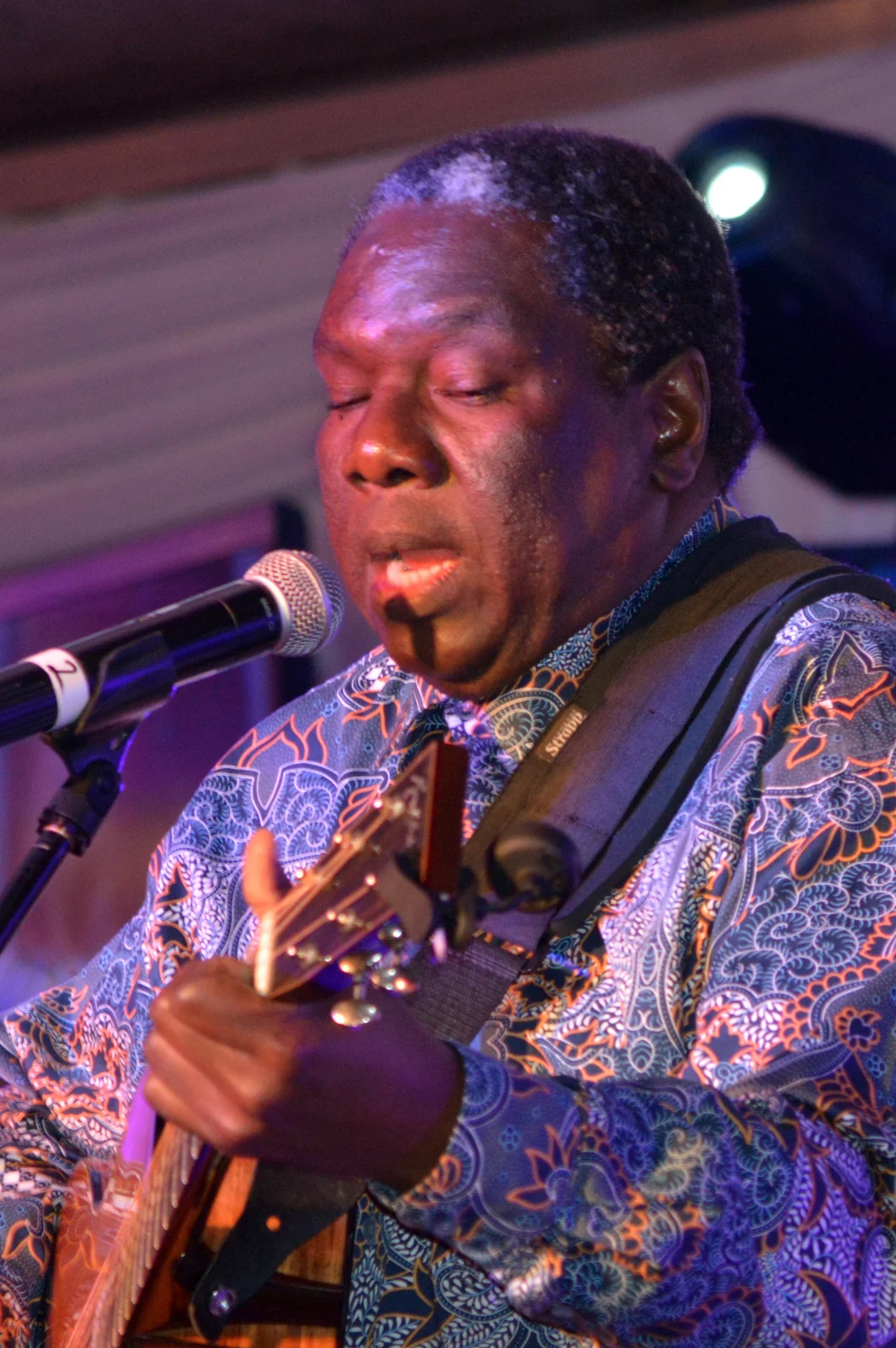
- 7. Morné van Rooyen / Wikimedia CommonsExact 2015 own-work photograph and CC BY-SA 4.0 grant
First/current records show the same sole own-work JPEG and CC BY-SA 4.0 grant. Published source-side processing is disclosed; this is a contextual 2015 photograph.
- 8. New Zealand International Film Festival2003 programme record for the 2002 Amandla! documentary — named participants
- 9. American Film InstituteAmandla! — credits and release record