In this biography
Quick facts
- Born
- 8 March 1953
- Birthplace
- Bombay, Bombay State, India (now Mumbai, Maharashtra)
- Country
- India
- Nationality
- Indian
- Known for
- Leading Rajasthan’s governments in 2003–2008 and 2013–2018
- Education
- Economics and political science, Sophia College, Bombay University
- Parliamentary base
- Jhalawar; first elected to Lok Sabha in 1989
- State constituency
- Jhalrapatan during her chief-ministerial era
- Chief minister
- 2003–2008 and 2013–2018
Why this life matters
Raje helped establish a durable personal and organisational base for the BJP in Rajasthan. Her career combines a historic breakthrough for women in state leadership with questions about inherited advantage, public accountability and the balance between regional leaders and national party control.
Timeline
Key moments
Born in Bombay
Born on 8 March into the Scindia family.
Rajasthan Assembly
Enters the state legislature before moving into national parliamentary politics.
Lok Sabha and Union ministry
Wins Jhalawar and is repeatedly re-elected; becomes minister of state for external affairs in 1998.
First chief-ministerial term
Leads the BJP to a majority and takes the oath on 8 December.
Opposition and return
Loses government in 2008 and returns after the BJP’s 2013 victory.
Controversy and defeat
Faces scrutiny over support for Lalit Modi; Congress returns to government in 2018.
A different BJP chief minister
The BJP returns to government but selects Bhajan Lal Sharma for the top office.
Family connections preceded an independent electoral career
Raje was born in Bombay on 8 March 1953 to the Scindia family. Her mother, Vijayaraje Scindia, was a major political figure. Raje studied economics and political science at Sophia College and married Hemant Singh of Dholpur, connecting her life with Rajasthan.
Family position supplied resources and recognition, but the offices she later held required party decisions and elections. The parliamentary biographical record identifies her state Assembly service from 1985 and election to Lok Sabha from Jhalawar in 1989. These stages preceded the chief-ministerial role that later dominated her public image.
Parliament and the Union ministry expanded her experience
Repeated Lok Sabha victories made Jhalawar her parliamentary base. In 1998 she became minister of state for external affairs in Vajpayee’s government. She subsequently moved from national office into leadership of the BJP’s Rajasthan campaign.
That move required a statewide political organisation beyond one parliamentary constituency. Her relationship with former chief minister Bhairon Singh Shekhawat and her campaign activity helped establish her as the party’s principal state leader. Personal prominence was therefore combined with an existing party network rather than replacing it.
The 2003 majority made her Rajasthan’s first woman chief minister
The BJP won 120 of Rajasthan’s 200 Assembly seats in 2003. Raje took the oath on 8 December and became the first woman to head the state government. The victory displaced Ashok Gehlot’s Congress administration and gave the BJP a majority of its own.
The gender milestone was significant, but it was an achievement inside representative party politics rather than a direct statewide presidential-style election. Voters chose Assembly members; party leadership and the resulting majority determined who could form the government. Her tenure then had to be assessed through administration as well as the symbolism of her appointment.
A second term brought authority and a serious accountability dispute
Congress returned to office in 2008, and Raje led the BJP back to a much larger victory in 2013. Her second chief-ministerial term strengthened her position as a regional leader. The repeated changes of government also showed the limits of assuming that a strong personal campaign guaranteed continuing support.
In 2015 her support for Lalit Modi’s UK immigration case became a major controversy. Reporting recorded her aides’ acknowledgement that she had signed a testimony while disputing descriptions of it as an affidavit addressed to a court. The issue raised questions about judgment, confidentiality and assistance to a controversial associate; it is not presented here as a finding of criminal guilt.
Later transitions showed the limits of regional dominance
Congress formed Rajasthan’s government again after the 2018 election. When the BJP returned to power in 2023, it selected Bhajan Lal Sharma rather than Raje as chief minister. She nevertheless remained an elected state politician; the Assembly’s women-members record lists her Jhalrapatan membership in the sixteenth Assembly.
The distinction between retaining a constituency and leading a government is central to her later career. Raje’s influence cannot be reduced either to royal ancestry or to two periods in executive office. It also rests on party organisation, regional relationships and an electoral base that endured beyond the chief-ministership.
Quick answers
Frequently asked questions about Vasundhara Raje
- Was Raje Rajasthan’s first woman chief minister?
- Yes. She took the oath on 8 December 2003 and served again after the 2013 election.
- Are Jhalawar and Jhalrapatan the same constituency?
- No. Jhalawar was her Lok Sabha constituency; Jhalrapatan is the state Assembly constituency associated with her chief-ministerial and later state career.
- Did the BJP’s 2023 victory make her chief minister again?
- No. The party selected Bhajan Lal Sharma, while Raje remained an Assembly member.
Keep exploring
Lives connected to this story
- Atal Bihari Vajpayee
Read about the prime minister whose Union government included Raje before her state leadership.
- Mayawati
Compare another woman chief minister’s different social base and electoral strategy.
- Smriti Irani
Compare electoral breakthrough, ministerial responsibility and later defeat in a different setting.
Sources and further reading
Explore the evidence
These references support the biography and offer further reading. Official records, first-person accounts and independent reporting provide different perspectives; image records document attribution and licensing.
- 1. Lok Sabha biographical sketch / IndiaPress reproductionVasundhara Raje: 12th Lok Sabha biographical sketch
A reproduction of the historical Lok Sabha sketch, used for birth, study and early offices; independently corroborated where available. Historical contact details are not republished.
- 2. Rajasthan Legislative AssemblyWomen members: Vasundhara Raje’s constituencies and Assembly terms
- 3. Rajasthan Legislative Assembly MuseumVasundhara Raje: first woman chief minister
- 4. Election Commission of IndiaRajasthan 2003: official statistical-report record
Official report record verified; the 120-seat election result is corroborated by reporting rather than confused with later Assembly composition tables.
- 5. Press Trust of India / The Times of IndiaRaje becomes Rajasthan’s first woman chief minister, 8 December 2003
- 6. The Indian ExpressRaje returns to power: career and 2003 majority, 2013
- 7. The Indian ExpressRajasthan election results and changes of government since 1998, 2023
- 8. The Indian ExpressRaje’s aides acknowledge signed testimony and dispute its character, June 2015
- 9. The Indian ExpressBhajan Lal Sharma selected as Rajasthan chief minister, December 2023
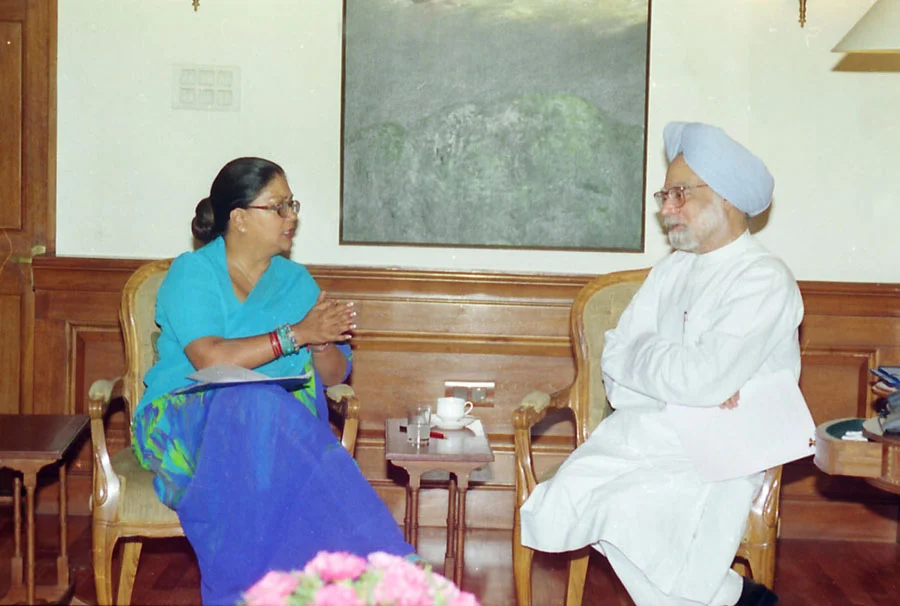
- 10. Government of India / PIB / Wikimedia CommonsRaje meets Manmohan Singh, 25 June 2004: PIB 1204, complete photograph
- 11. Press Information Bureau, IndiaCopyright policy: accurate reproduction, source credit and third-party exclusion
- 12. Government of IndiaGovernment Open Data Licence–India