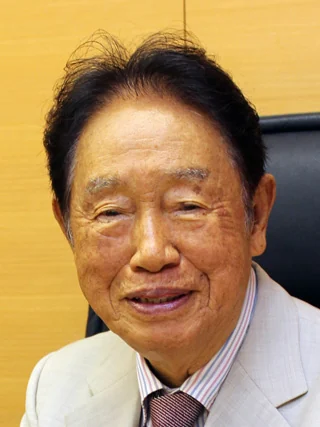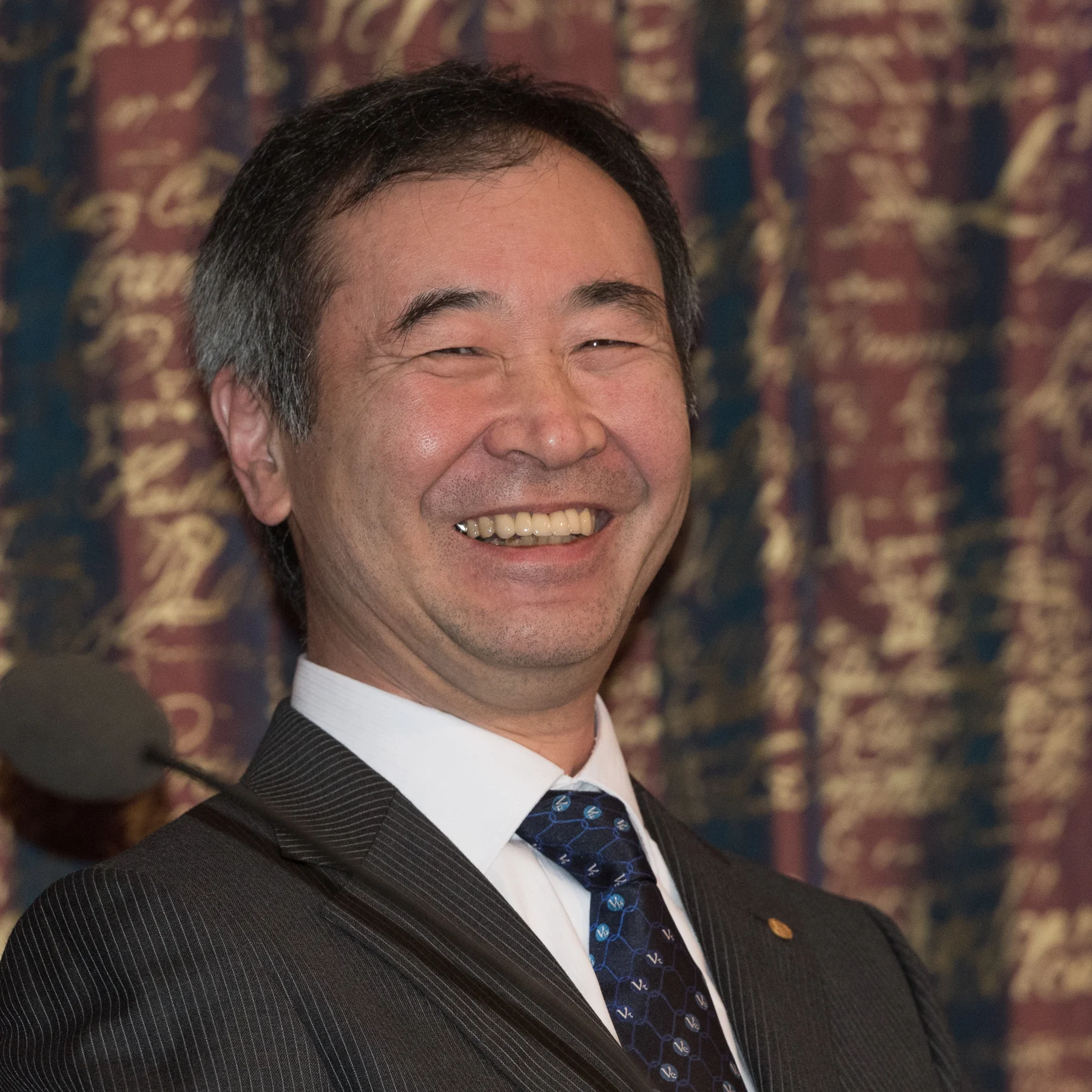
In this biography
Quick facts
- Born
- 9 March 1959
- Birthplace
- Higashimatsuyama, Saitama Prefecture, Japan
- Country
- Japan
- Nationality
- Not independently established
- Known for
- Atmospheric neutrino research with Kamiokande and Super-Kamiokande
- Undergraduate degree
- Saitama University,1981
- Doctorate
- University of Tokyo,March 1986
- ICRR director
- 2008–2022
- Nobel Prize
- Physics,2015; shared with Arthur McDonald
Why this life matters
His contribution was to sustained experimental inference within a large team, rather than an isolated observation of every individual neutrino changing identity.
Timeline
Key moments
Birth
Born in Higashimatsuyama.
Graduate research
Joined Koshiba’s group and the developing Kamiokande experiment.
Detector and doctorate
Took part in construction and analysis; completed a proton-decay thesis inMarch 1986.
ICRR appointment
Joined the Institute for Cosmic Ray Research.
New experiment begins
Super-Kamiokande began taking data on 1 April.
Oscillation evidence
Presented the collaboration’s atmospheric-neutrino results.
Institute leadership
Served as ICRR director.
Nobel recognition
Shared the Physics prize with Arthur McDonald.
A student learned through building an experiment
Born on 9 March 1959 in Higashimatsuyama, Kajita studied physics at Saitama University while continuing his interest in Japanese archery. He entered graduate work at the University of Tokyo in 1981 under Masatoshi Koshiba. Fellow student Katsushi Arisaka encouraged him to join Kamiokande, then being prepared to search for nucleon decay. Photomultiplier production, underground construction and the eventual analysis formed one connected education. In his autobiography, Kajita says experiencing that whole process helped him decide to become a professional physicist. The experiment required practical work before a discovery could become a paper.
A proton-decay thesis did not claim a discovery
Kamiokande began taking data in 1983. Kajita completed his doctorate inMarch 1986 on a search for nucleon decays into an antineutrino and mesons; it found no evidence for proton decay. That negative result belongs to the history of the work rather than being rewritten as a neutrino-oscillation doctorate. His autobiographical account describes uncertainty about employment after graduation and a research-associate position arranged by Koshiba. During that period he investigated a deficit in atmospheric muon-neutrino events. A detector designed around one question could produce evidence relevant to another, provided the background and identification problems were studied.
A larger detector became an international project
Kajita moved to the Institute for Cosmic Ray Research in 1988. Super-Kamiokande gained approval in 1991 and researchers from the United States joined in 1992, extending a collaboration already involving several Japanese institutions. Construction at the site proceeded during 1995–1996, and observations began on 1 April 1996. Kajita worked on atmospheric-neutrino analysis with Ed Kearns and other colleagues. Two initially independent analysis groups compared their results before combining their efforts. Their agreement was one check within a broader experimental process, not a replacement for detector calibration or theoretical uncertainties.
Sources for this section: [1]
Direction helped distinguish a physical effect from a simple shortfall
The 1998 collaboration paper analysed a 535-day exposure. It compared electron-like and muon-like events with simulated expectations and investigated their directions. Muon-like events showed a substantial upward–downward asymmetry, while the corresponding electron-like comparison behaved differently. Travel through Earth supplied a longer path than arrival from overhead. The combination was consistent with oscillation and difficult to explain through the investigated uncertainties alone. The paper did not determine an absolute neutrino mass for each particle or directly identify every missing event as a detected tau neutrino. It explicitly discussed remaining alternatives within the sample.
Sources for this section: [6]
The Nobel award recognised complementary experiments
Kajita shared the 2015 Nobel Prize in Physics with Arthur McDonald for the discovery of neutrino oscillations. Their work involved different experimental collaborations and neutrino sources. The award record is not the author list of the 1998 Super-Kamiokande paper, which credits a large international group. The distinction allows Kajita’s scientific leadership to be recognised without erasing the engineers, analysts, technicians and partner institutions behind the measurements. A later lecture explains how the result developed; the original paper preserves what the collaboration could claim from that particular data set.
Research leadership had its own chronology
He became an ICRR professor in 1999 and director in 2008, serving in the latter role until 2022 according to the experiment’s current institutional timeline. His research interests also extended to underground gravitational-wave work. Care with appointment dates matters because a short Nobel facts page gives a 1983 doctorate and 2015 directorship that conflict with his own account and the university CV. The 1986 degree and 2008 appointment are supported by those more detailed records. Biography is improved by resolving a specific discrepancy from evidence, rather than assuming that every field on a prestigious website is equally accurate.
Quick answers
Frequently asked questions about Takaaki Kajita
- Did Kajita’s 1986 thesis discover proton decay?
- No. It searched for nucleon decay and reported no evidence. The later atmospheric-neutrino result addressed a different problem.
- Did he work alone on the 1998 result?
- No. The paper is a Super-Kamiokande Collaboration publication, involving many institutions and contributors.
Keep exploring
Lives connected to this story
- Hideki Yukawa
Compare a theoretical prediction and its later experimental interpretation with Kajita’s detector-based evidence.
- Sin-Itiro Tomonaga
Follow a different Japanese physics career centred on theoretical work and distinct research problems.
- Satoshi Ōmura
Compare the different division of labour behind another2015Nobel-recognised research programme.
- Masatoshi Koshiba
Read Koshiba’s earlier detector programme and the collaborative SN1987A record.
Sources and further reading
Explore the evidence
These references support the biography and offer further reading. Official records, first-person accounts and independent reporting provide different perspectives; image records document attribution and licensing.
- 1. Takaaki Kajita; Nobel FoundationTakaaki Kajita: autobiographical account, 2015
- 2. University of TokyoTakaaki Kajita: CV dated 1 October 2015
The university CV dated1 October 2015 supports the 1986 doctorate and 2008 ICRR directorship. It is a dated career record, not proof that every listed appointment remains current.
- 3. Super-Kamiokande collaboration, University of TokyoTakaaki Kajita’s Nobel Prize: career timeline
- 4. Nobel FoundationTakaaki Kajita: prize facts
Used for the 2015 award, birth date and prize share. Its 1983 doctorate and 2015 directorship statements conflict with the detailed autobiography and university record and are rejected.
- 5. Takaaki Kajita; Nobel FoundationDiscovery of Atmospheric Neutrino Oscillations, Nobel Lecture, 8 December 2015
- 6. Super-Kamiokande CollaborationEvidence for Oscillation of Atmospheric Neutrinos, 1998, arXiv v2 dated31August1998
Read selected original arXiv v2 pages, including the author list, event definitions, TableI, asymmetry definition and conclusion. Oscillation evidence is not an absolute-mass measurement or unique identification of the missing flavour.