In this biography
Quick facts
- Born
- 25 June 1954
- Birthplace
- Bronx, New York City, United States
- Country
- United States
- Nationality
- American
- Known for
- Becoming the Supreme Court’s first Latina justice in 2009 after service on federal trial and appeals courts
- Birth
- 25 June 1954, Bronx, New York City
- Education
- Princeton University, 1976; Yale Law School, 1979
- Legal practice
- New York County prosecutor, 1979–1984; Pavia & Harcourt, 1984–1992
- Federal trial court
- Southern District of New York, 1992–1998
- Federal appeals court
- Second Circuit, 1998–2009
- Supreme Court
- Confirmed on 6 August 2009; took the oath on 8 August
Why this life matters
Sotomayor expanded representation on the Supreme Court and brought extensive trial and appellate experience to its work, while making education and civic participation part of her public life.
Timeline
Key moments
Born in the Bronx
Grew up in New York City in a family with Puerto Rican roots.
Completed university and law school
Graduated from Princeton with highest honors in history and earned her law degree at Yale, where she edited the Yale Law Journal.
Worked as a prosecutor and commercial lawyer
Served in the New York County district attorney’s office before becoming an associate and partner at Pavia & Harcourt.
Joined two levels of the federal judiciary
Became a Southern District of New York judge in 1992, then joined the Second Circuit in 1998.
Joined the Supreme Court
Obama announced her selection on 26 May; formal nomination followed on 1 June, Senate confirmation on 6 August and the oath on 8 August.
Combined judging with public education
Wrote the Court’s J. D. B. opinion in 2011 and discussed legal process, personal experience and children’s education during later university visits.
Bronx roots and education opened unfamiliar institutions
Sonia Sotomayor was born in the Bronx on 25 June 1954 to Puerto Rican parents. She grew up in a tenement and the Bronxdale Houses public housing development. Her childhood included diabetes and the loss of her father. These experiences became part of the personal history she later shared publicly, alongside the importance of education, family support and learning to navigate institutions unfamiliar to her community.
At Princeton, which she entered in 1972, she studied history and participated in Latino student organizing. She also organized Spanish-speaking student volunteers to assist patients at Trenton Psychiatric Hospital. She graduated with highest honors in 1976 and received the Pyne Prize. Yale Law School followed; she edited the Yale Law Journal and earned her law degree in 1979.
Prosecution and commercial practice preceded the bench
After law school, Sotomayor joined the New York County district attorney’s office, serving as an assistant district attorney from 1979 to 1984. In a later Yale conversation, she recalled Robert Morgenthau’s promise of responsibility and practical training as an important reason for choosing the job. The position placed her in criminal litigation before she became a judge responsible for deciding disputes rather than presenting one side’s case.
She moved to Pavia & Harcourt in 1984, handling international commercial litigation as an associate and then partner until 1992. Her career therefore included both public prosecution and private civil practice. These were different professional settings, involving different clients and responsibilities. Together they formed the practical legal background she brought to her first federal appointment, rather than a direct move from university into judging.
Three presidents nominated her to three judicial positions
President George H. W. Bush nominated Sotomayor to the Southern District of New York in 1991. Senate confirmation and her commission followed in August 1992. President Bill Clinton nominated her to the Second Circuit in 1997; she was confirmed in October 1998. Her service thus moved from a federal trial court to an appellate court before she was considered for the Supreme Court.
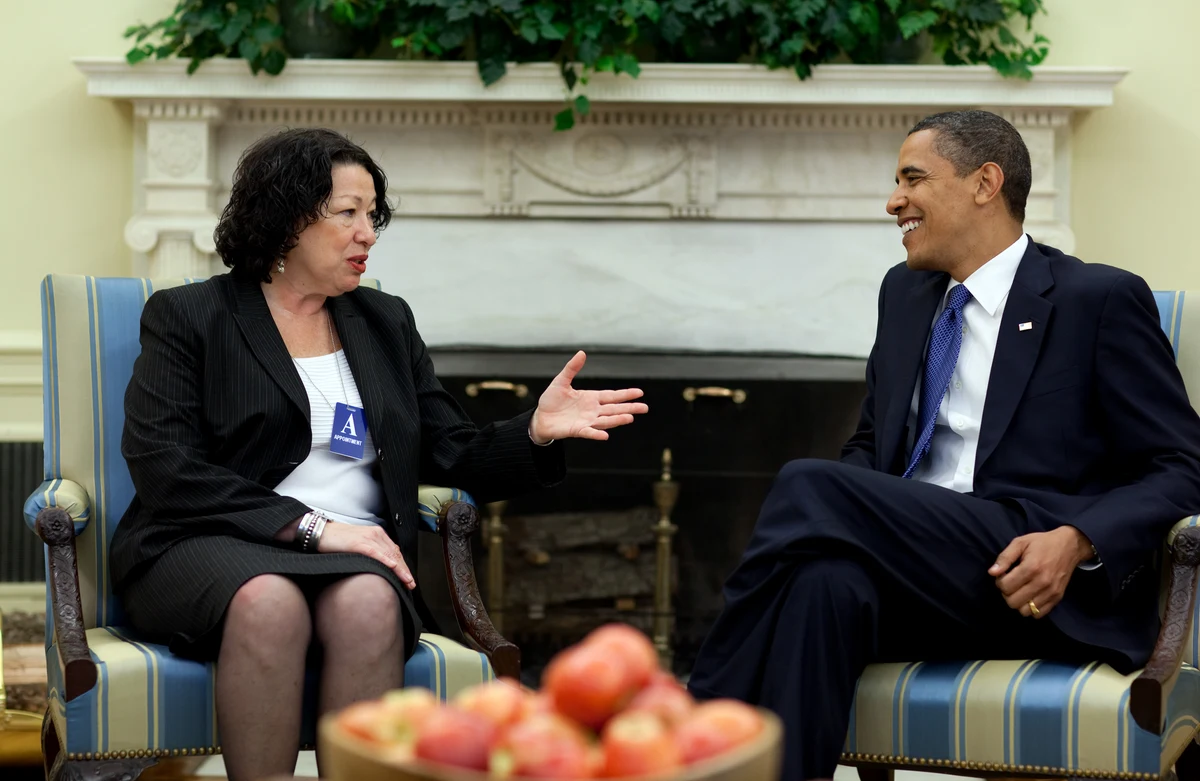
President Barack Obama announced her selection for David Souter’s Supreme Court seat on 26 May 2009. The formal nomination reached the Senate on 1 June. Senators confirmed her by 68 votes to 31 on 6 August, and she took the oath on 8 August. She became the Court’s first Latina justice and its third woman. The appointment was a milestone in representation as well as a new judicial responsibility.
A juvenile-interrogation case illustrates a specific judicial contribution
In J. D. B. v. North Carolina, decided in June 2011, Sotomayor wrote the Supreme Court’s majority opinion concerning a thirteen-year-old questioned by police at school. The issue was whether a child’s age could inform the assessment of custody for Miranda purposes. Her opinion explained why circumstances that might not constrain an adult could affect a reasonable child’s understanding of being free to leave.
The holding required consideration of age when officers knew it or it was objectively apparent. It did not declare every school interview custodial, or decide that this particular child necessarily had been in custody. The Court returned that question to the state courts under the corrected analysis. This distinction between a governing rule and its application shows why an opinion’s actual holding matters more than a sweeping summary.
Public education became another strand of her work
Sotomayor has also used books and public conversations to connect personal experience with education and civic responsibility. During a 2014 Yale visit, she discussed her memoir, My Beloved World, and encouraged involvement in community institutions. Her discussion of judging emphasized fair process and attention to legal reasoning. These public exchanges offered readers and students a different encounter with a justice from the formality of a courtroom.
At Yale in 2019, she discussed her children’s book Just Ask and its encouragement of understanding among children with different conditions and experiences. She connected its purpose to living with diabetes since childhood. Meetings with students and conversations about belonging extended a theme visible in her Princeton years: gaining access to an institution could also create opportunities to help others participate in it.
Quick answers
Frequently asked questions about Sonia Sotomayor
- When did Sonia Sotomayor join the Supreme Court?
- The Senate confirmed her on 6 August 2009, and she took the oath on 8 August. Obama’s public announcement on 26 May and formal nomination on 1 June were earlier stages of that process.
- What work did she do before becoming a justice?
- She was a New York County prosecutor, a commercial litigator at Pavia & Harcourt, a Southern District of New York judge and a Second Circuit judge before joining the Supreme Court.
- What was historically significant about her appointment?
- In 2009 she became the Supreme Court’s first Latina justice and third woman. Her family’s Puerto Rican roots and Bronx upbringing are important parts of her publicly documented life story.
- What did her opinion in J. D. B. decide?
- The 2011 opinion required a child’s known or objectively apparent age to be considered in the Miranda custody analysis. It remanded for the state courts to apply that analysis; it did not make every interview of a child custodial.
Keep exploring
Lives connected to this story
- Shirley Chisholm
Compare distinct careers that expanded representation in Congress and on the Supreme Court, without treating their institutions or roles as interchangeable.
- Susan B. Anthony
Read about an earlier struggle over women’s civic participation and the courtroom, set in a very different legal and political era.
Sources and further reading
Explore the evidence
These references support the biography and offer further reading. Official records, first-person accounts and independent reporting provide different perspectives; image records document attribution and licensing.
- 1. Supreme Court of the United StatesBiographies: Sonia Sotomayor
- 2. Federal Judicial CenterBiographical Directory: Sotomayor, Sonia
Uses the formal nomination date, 1 June 2009, separately from the public announcement on 26 May recorded by the Court. Confirmation, commission and oath are not collapsed into one event.
- 3. United States SenateRoll call vote 262: confirmation of Sonia Sotomayor, 6 August 2009
- 4. National ArchivesFrom the Bronx to the Bench: Sonia Sotomayor’s Trailblazing Journey to the Supreme Court
Used selectively for family background, the appointment milestone and the exact White House image caption. Does not repeat the uncorroborated 1983 independent-practice statement, delayed baseball season described as on time, or May 22 date in a birthday-photo caption.
- 5. Princeton UniversityPrinceton establishes Sonia Sotomayor 1976 Scholarship Fund
- 6. Yale Law SchoolJustice Sotomayor ’79 Shares Insights on Life and the Law During Alumni Weekend
- 7. Yale Law SchoolJustice Sonia Sotomayor ’79 Delivers the James A. Thomas Lecture
- 8. U.S. Supreme Court, via Cornell Legal Information InstituteJ. D. B. v. North Carolina: opinion of the Court, 16 June 2011
Historical summary of the 2011 majority opinion, not present legal advice. Known or objectively apparent age and remand are retained; no claim that childhood alone establishes custody.
- 9. U.S. Supreme Court Reporter of Decisions, via Cornell Legal Information InstituteJ. D. B. v. North Carolina: syllabus
- 10. Obama White House ArchivedP052109PS-1106: Obama meets Sotomayor, 21 May 2009
Exact White House-supplied full original, P052109PS-1106, photographed by official staff photographer Pete Souza on 21 May 2009. The Supreme Court collection portrait was screened out because its collection policy expressly requires publication approval.
- 11. Obama White House ArchivesPete Souza: Director and Chief Official White House Photographer
- 12. Obama White House ArchivesCopyright Policy