In this biography
Quick facts
- Born
- 22 May 1954
- Birthplace
- Ikata, Ehime Prefecture, Japan
- Country
- Japan
- Nationality
- Not independently established
- Known for
- Efficient blue light-emitting diodes based on gallium nitride materials
- Birth
- 22 May 1954, Ikata
- Nichia
- Joined 1979; left 1999
- Doctorate
- Tokushima,1994
- Nobel share
- One third of the 2014 Physics Prize
Why this life matters
His career connects hands-on equipment development, materials research and the broader collaborative history of efficient lighting.
Timeline
Key moments
Birth
Born in the coastal community of Ikata.
University study
Entered electrical engineering at Tokushima.
Nichia
Joined the chemical company after postgraduate study.
Bright blue LEDs
Developed devices before Nichia’s November 1993 announcement.
Doctorate
Received a doctorate from Tokushima.
Move to California
Left Nichia in 1999; UCSB records joining its faculty in 2000.
Nobel Prize
Shared the award with Isamu Akasaki and Hiroshi Amano.
Tokushima provided an education in making devices
Nakamura was born on 22 May 1954 in the Ikata area of Shikoku. He entered Tokushima University in 1973 and studied electrical engineering. The Nobel biographical account describes an attraction to theory alongside laboratory work that demanded practical skills in building and modifying equipment. His master’s research under Osamu Tada became part of that training. The later blue-LED story is therefore not simply one of an idea arriving fully formed. It depended on learning how to make apparatus perform, recognise a failed experiment and change a process in response to what the material actually did.
Nichia’s existing business was not yet the blue LED
He joined Nichia in 1979, when the company’s work included phosphors used in televisions and fluorescent lighting. The corporate laboratory became the setting for his semiconductor research. The Nobel account explains that he had to acquire knowledge of materials and develop equipment rather than inherit a complete production method. That account is a participant-centred history with vivid recollections; it is not an independent audit of every corporate decision. For the biography, its most useful details are the experimental setting and the work on growth processes, rather than a claim that perseverance alone explains a technical result.
Gallium nitride required solutions at several stages
The Royal Swedish Academy’s 2014 explanation places the invention within work by Isamu Akasaki, Hiroshi Amano and Nakamura on gallium nitride materials. Producing efficient blue emission required more than recognising which colour was missing. Researchers needed suitable material quality and electronic structures that could emit light effectively. Nakamura’s work on growth methods contributed to that progress. His account dates important device development to 1992 and Nichia’s public announcement to 29 November 1993. These milestones are different from the later 1994 doctorate. They should not be combined into a single invention day or used to erase the other laureates’ research.
Blue emission expanded the possibilities for white lighting
Blue LEDs mattered because they supplied a route to efficient white light sources when combined appropriately with other light or wavelength-converting materials. The prize’s public explanation presents that practical importance, while the technical history remains a sequence of material and device problems. The Nobel recognition does not mean that Nakamura alone invented every white lamp, phosphor, driver circuit or later manufacturing improvement. It identifies a crucial contribution to efficient blue light emission. A useful biography keeps that achievement precise while recognising the wider engineering needed to turn a semiconductor device into lighting that people can use.
California marked a new institutional setting
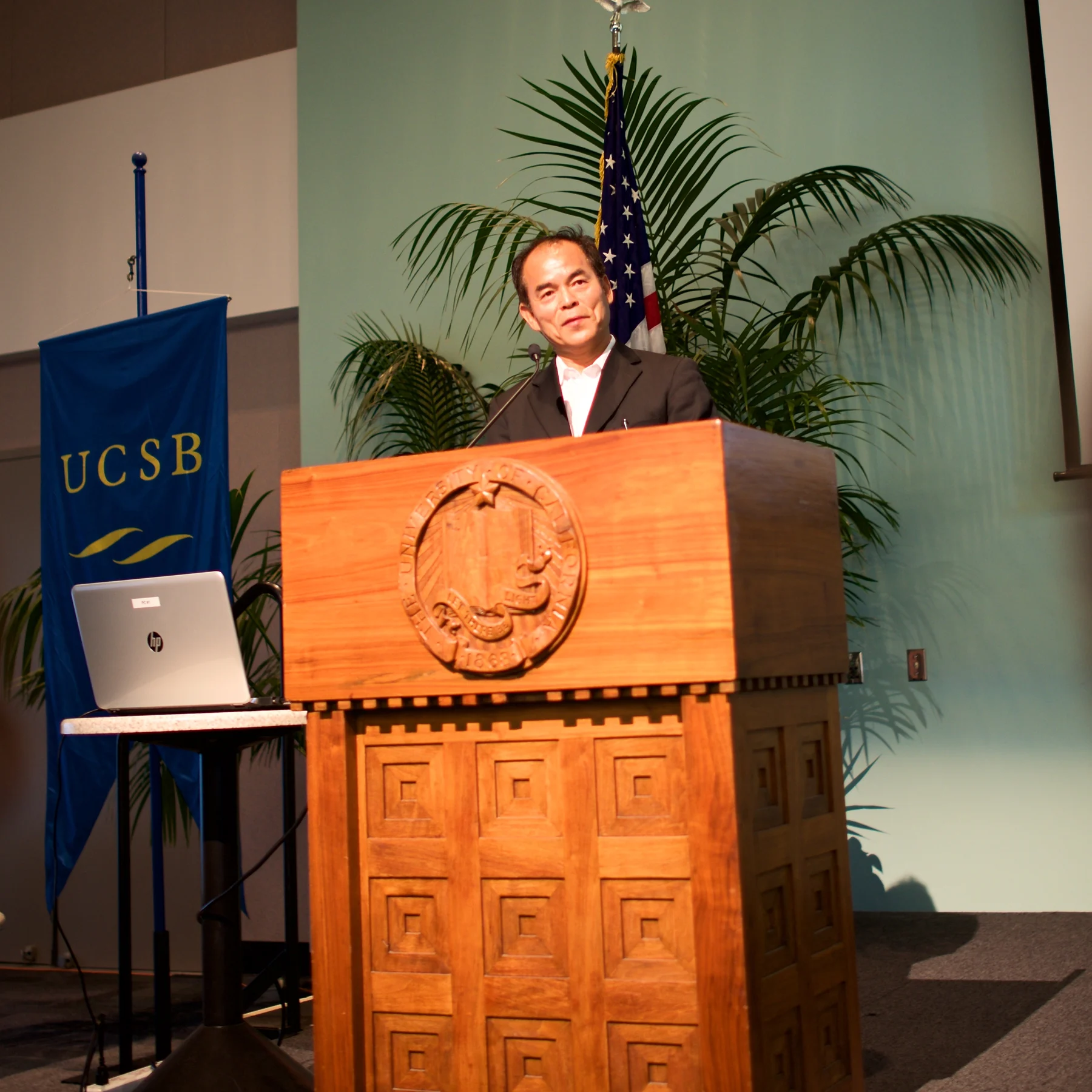
The Nobel facts record says he left Nichia in 1999. UCSB’s own profile states that he joined its faculty in 2000. Those are compatible stages of a move rather than a reason to assign both actions to the same day. At Santa Barbara he worked in materials and electrical and computer engineering, within a setting that included colleagues such as James Speck, Umesh Mishra and Steven DenBaars. The university profile connects his work to its lighting and energy-electronics research. Its titles and descriptions are institutional information; dated entry and research themes are more secure historical anchors than treating an old award-era patent count as a current total.
Quick answers
Frequently asked questions about Shuji Nakamura
- Did Nakamura join UCSB in1999 or2000?
- The sources identify separate steps: he left Nichia in1999, while UCSB records his faculty arrival in2000.
- Was the blue-LED Nobel Prize awarded to him alone?
- No. He shared the2014 prize equally with Isamu Akasaki and Hiroshi Amano.
Keep exploring
Lives connected to this story
- Leo Esaki
Compare another semiconductor discovery and the distinction between an effect, a measurement and a device.
- Osamu Shimomura
Read about a different source of useful light: a protein developed into a biological marker.
- Isamu Akasaki
Compare the Nagoya/Meijo programme and its materials work.
- Hiroshi Amano
Read the participant account of buffer-layer growth and p-type GaN.
- Kenichi Iga
Compare another semiconductor-light research programme.
Sources and further reading
Explore the evidence
These references support the biography and offer further reading. Official records, first-person accounts and independent reporting provide different perspectives; image records document attribution and licensing.
- 1. Nobel FoundationShuji Nakamura: biographical account,2014
Actual biographical text acquired; education, Nichia, equipment,1992 device/1993 announcementand 1999 departure passages read. Recollections not independently audited; old patent/publication counts and laboratory safety anecdotes not republished.
- 2. Nobel FoundationShuji Nakamura: prize facts
Exactbirthdate,1994 doctorate andone-thirdawardshare verified;Ikata locality preferred to narrower Oku spelling in narrative.
- 3. University of California, Santa BarbaraShuji Nakamura: faculty and alumni profile
Actual university profile read; joinedfaculty 2000 used distinctly from 1999 Nichia departure. No assertion that every displayedtitlehasnewOctober 2026 appointmentverification.
- 4. Royal Swedish Academy of SciencesThe Nobel Prize in Physics 2014: efficient blue light-emitting diodes
Publicawardexplanationread; three laureates’ contributions and white-light significance, notfulltechnicalpaperreplication.