
In this biography
Quick facts
- Born
- 29 March 1918
- Died
- 5 April 1992
- Birthplace
- Kingfisher, Oklahoma, United States
- Country
- United States
- Nationality
- American
- Known for
- Building Walmart’s discount-store business with his brother Bud Walton and developing Sam’s Club
- Birth
- 29 March 1918 in Kingfisher, Oklahoma
- Education
- University of Missouri, business degree, 1940
- Early store
- Ben Franklin franchise in Newport, Arkansas, 1945
- First Walmart
- Rogers, Arkansas, 2 July 1962
- Leadership succession
- David Glass became chief executive in 1988; Walton remained chair
- National honor
- Presidential Medal of Freedom, 17 March 1992
Why this life matters
His career helped reshape American retailing by connecting low-price selling with large-scale logistics, while the company continued to evolve under later managers.
Timeline
Key moments
Oklahoma birth and Missouri education
Born in Kingfisher and graduated from the University of Missouri in 1940 before joining J. C. Penney.
Variety-store experience
Operated a Newport Ben Franklin store, then established Walton’s 5&10 in Bentonville.
First Walmart opened
Opened the Rogers discount store on 2 July, building the business with his brother Bud and other partners.
Corporate and financing milestones
Incorporation in 1969, public trading in 1970 and a New York Stock Exchange listing in 1972 were separate events.
New formats and leadership
Sam’s Club opened in 1983; the first Supercenter and David Glass’s CEO appointment followed in 1988.
Final recognition
Received the Medal of Freedom on 17 March and died in Little Rock on 5 April.
Learning to sell before Walmart
Samuel Moore Walton was born in Kingfisher, Oklahoma, on 29 March 1918. Newspaper routes and other jobs gave him early experience of earning money and organizing work. He graduated from the University of Missouri with a business degree in 1940 and became a management trainee at J. C. Penney in Des Moines, Iowa.
His route to owning stores was interrupted by the Second World War. Walton entered the Army in 1942 and married Helen Robson the following year. After his military service ended in 1945, retailing became the family’s principal enterprise. He had already encountered the practical business of serving customers, handling merchandise and managing a shop before the Walmart name appeared.
Variety stores and a move to Bentonville
In 1945, Walton acquired a Ben Franklin franchise in Newport, Arkansas. He experimented with prices, merchandise and ways to encourage customers to buy more. Lower margins on individual items could produce a better overall result if enough additional goods were sold, but that approach still depended on purchasing costs and the volume a store could actually achieve.
The Newport lease was not renewed, forcing a change of location despite the store’s growth. In 1950, the Waltons moved to Bentonville and opened Walton’s 5&10. This was a variety store, not the first Walmart. The years spent operating such shops gave Walton a base of experience, managers and regional knowledge from which the later discount business developed.
Discount retailing in small-town markets
The first Walmart opened in Rogers, Arkansas, on 2 July 1962. Walton built the enterprise with his brother James, known as Bud, and a growing group of managers and employees. Small-town customers were central to the early strategy. Harvard Business School’s historical profile identifies this attention to markets often overlooked by larger retailers as an important feature of his approach.
The business combined a broad range of merchandise with discount pricing. Keeping shelves supplied and purchasing on favorable terms mattered as much as announcing a low price. An expanding chain could negotiate and move goods differently from a single shop, but it also required coordination across many locations. Walton’s contribution lay in developing that retail organization, not inventing discount selling itself.
Systems, capital and different store formats
Walmart incorporated in 1969, became publicly traded in 1970 and obtained a New York Stock Exchange listing in 1972. These were distinct stages in building a larger company. Distribution facilities and communication systems supported the growing store network; the organization increasingly needed reliable information about merchandise, sales and replenishment rather than a founder’s visits alone.
The company’s historical timeline dates computerized checkout systems and the first Sam’s Club to 1983. The membership warehouse format served a different shopping pattern from a conventional discount store. In 1988, Walmart opened its first Supercenter, combining general merchandise with a supermarket. The same year David Glass became chief executive, while Walton continued as chairman. Expansion was increasingly the work of an established management organization.
Recognition and a company beyond its founder
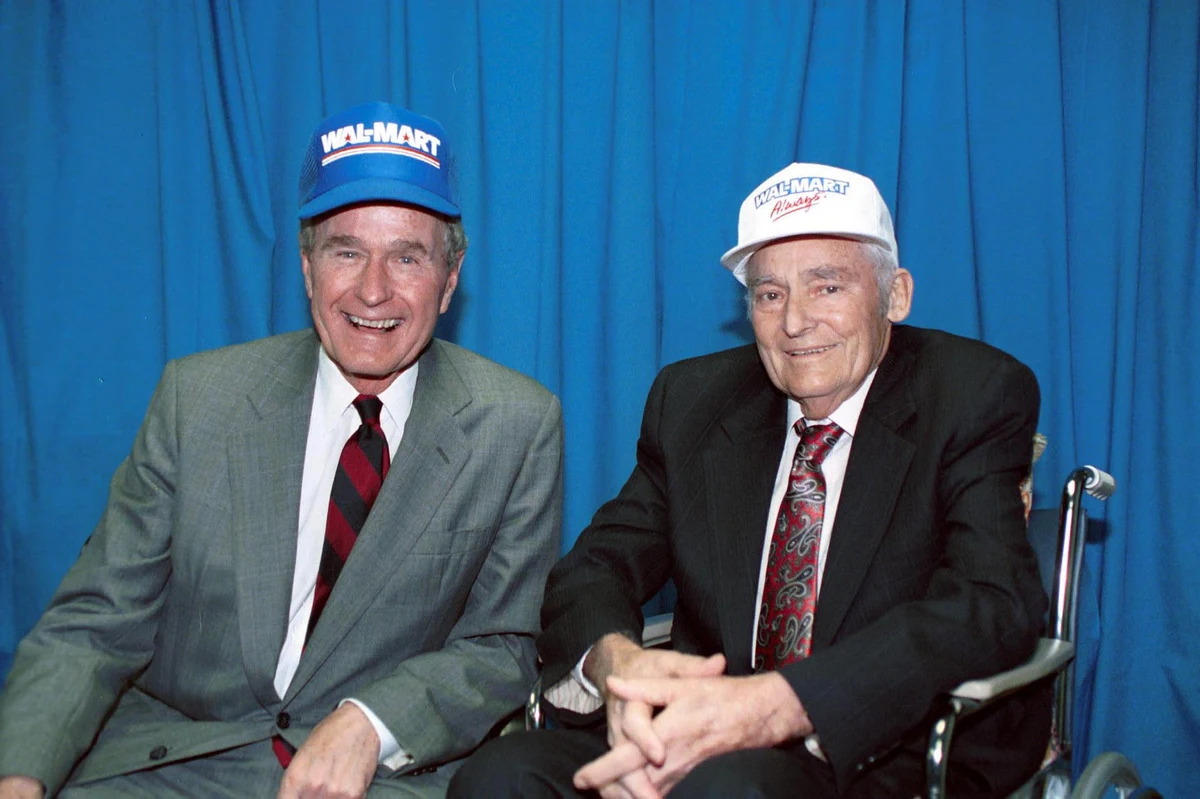
President George H. W. Bush presented Walton with the Presidential Medal of Freedom in Bentonville on 17 March 1992. The ceremony celebrated his business career and charitable activities. It was also a public presentation of his image as a familiar, small-town entrepreneur, even though the company he chaired had become a large national organization.
Walton died in Little Rock on 5 April 1992. His family’s later educational giving included the 1998 gift that established his name at the University of Arkansas business college, a contribution made after his death. His retail legacy continued under successors. Later debates about Walmart’s effects on workers, suppliers and smaller retailers belong to that longer company history and should not be confused with events he personally directed.
Quick answers
Frequently asked questions about Sam Walton
- Was Walmart founded in 1950 or 1962?
- Walton opened his Bentonville variety store in 1950. The first Walmart discount store opened in Rogers, Arkansas, on 2 July 1962. They were different businesses in the development of his retail career.
- Did Sam Walton build Walmart alone?
- No. His brother Bud was a co-founder, and the chain grew through the work of managers, employees, suppliers and other partners. Walton supplied leadership and a retail strategy rather than doing every operating task himself.
- Was Walton still CEO when he died?
- David Glass became chief executive in 1988. Walton remained chairman until his death in 1992, so the executive and board roles should be distinguished.
- When did he receive the Medal of Freedom?
- President George H. W. Bush presented it in Bentonville on 17 March 1992, shortly before Walton’s death on 5 April.
Keep exploring
Lives connected to this story
- Jeff Bezos
Compare store-based discount retailing with an online retailer’s purchasing, distribution and growth challenges.
- Warren Buffett
Compare the founder or long-serving leader’s role with the responsibilities of later chief executives and boards.
Sources and further reading
Explore the evidence
These references support the biography and offer further reading. Official records, first-person accounts and independent reporting provide different perspectives; image records document attribution and licensing.
- 1. CALS Encyclopedia of ArkansasSam Walton — historical biography
- 2. WalmartSam Walton — corporate retrospective
- 3. WalmartCompany historical timeline
Corporate timeline supports distinct 1962 opening/1969 incorporation/1970 public trading/1972 listing, 1983 Sam’s Club and 1988 CEO succession. Promotional leadership and present-day scale claims are not adopted as independent conclusions.
- 4. Harvard Business SchoolSamuel M. Walton — Great American Business Leaders
- 5. George Bush / American Presidency Project, UC Santa BarbaraMedal of Freedom ceremony remarks, 17 March 1992
- 6. University of ArkansasSam Walton’s legacy and the 1998 family gift
- 7. CALS Encyclopedia of ArkansasWalmart Inc. — historical operations and later company history
Used for historical operations and the distinction between Walton’s life and subsequent company controversies; later allegations or cases are not presented as acts he personally directed.
- 8. David Valdez / George H.W.Bush Presidential LibraryFull Bentonville visit portrait, 17 March 1992
Full published two-person portrait matched to official White House roll P30100, labelled David Valdez. It shows the Bentonville visit, not the literal medal presentation. The precise negative number among near-identical portraits is not asserted; Sam-only crops excluded.
