In this biography
Quick facts
- Born
- 22 February 1922
- Died
- 23 July 2016
- Birthplace
- Central India, British India (now Madhya Pradesh, India)
- Country
- India
- Nationality
- Indian
- Known for
- Landscape abstraction, the bindu motif and a career linking India and France
- Training
- Nagpur School of Art, Sir J. J. School of Art and art study in Paris
- Collective
- Founding member, Progressive Artists’ Group, 1947
- Paris move
- 1950, with a French government scholarship
- Recurring motif
- Bindu: point, seed or drop; developed across many paintings
Why this life matters
His changing treatment of colour, landscape and the bindu helped define a cosmopolitan Indian modernism through several decades of artistic exchange.
Timeline
Key moments
Born in central India
Born on 22 February in central India, now in Madhya Pradesh.
Art education
Studied in Nagpur, then developed his practice and further training in Bombay.
Progressive Artists’ Group
Co-founded the Bombay group with fellow artists including Souza, Husain, Ara, Gade and Bakre.
Paris and recognition
Moved to France in 1950 and received the Prix de la Critique in 1956.
Marriage and return visits
Married artist Janine Mongillat and visited India with her.
Bindu and geometric order
The point or circle became a systematic feature of his painting, alongside colour, landscape memory and geometry.
Foundation and later India years
Created the Raza Foundation in 2001; returned to live in India around 2010–2011 and received the Padma Vibhushan in 2013.
Death in New Delhi
Died on 23 July, aged 94.
Growing up around forests and drawing
Sayed Haider Raza was born on 22 February 1922 in central India, now in Madhya Pradesh. His father worked as a forest ranger. The landscape of his childhood became an enduring resource for his art, though the later paintings are imaginative constructions rather than literal maps of a village.
He finished school in Damoh and studied at the Nagpur School of Art before moving to Bombay for further work and training at Sir J. J. School of Art. Drawing and painting developed alongside the practical demands of earning a living. The catalogue chronology records design employment and evening study, making his formation a combination of formal education, work and contact with other artists.
Bombay and an artist collective
Raza became a founding member of the Progressive Artists’ Group in 1947. His fellow founders included F. N. Souza, M. F. Husain, K. H. Ara, H. A. Gade and S. K. Bakre. Their experiments took shape around independence and partition. It was a collective of distinct practices rather than a single style or a programme in which every member painted alike.
The Pompidou curators place the group within a cosmopolitan generation attentive both to European avant-gardes and to classical Indian art. Raza’s early landscapes and city views belong in that setting. Modernism did not require him to choose a pure national tradition or to abandon local experience; encounters with different visual languages helped generate new possibilities of form.
Paris as a place to work and learn
In 1950 a French government scholarship took Raza to Paris. Study, travel and the experience of French towns changed the structure and colour of his painting. He developed relationships with artists, critics and galleries, including Lara Vincy. The Prix de la Critique in 1956 marked recognition in France, but it was one event in a long process of making a working life abroad.
He married the French artist Janine Mongillat in 1959. Their shared life included visits to India and sustained artistic work in France. Mongillat was an artist in her own right, not simply a biographical explanation for his residence. Raza maintained Indian friendships and interests across these decades; his long Paris career should not be treated as a period of cultural absence.
From landscape to a more concentrated geometry
Raza’s work moved through representational landscape, more gestural abstraction and increasingly ordered geometric arrangements. The 1962 encounter with American abstraction was one part of that development. The Pompidou essay also connects his paintings with Indian miniature composition, ragamala painting and his attachment to land. These sources operated together rather than forming a simple succession of foreign and Indian phases.
The bindu became a recurring centre of attention. A 1980 Untitled painting documented by Christie’s shows the transition towards it; a different work called Bindu in the Pompidou collection is dated November 1986. One motif therefore cannot identify one unique painting or date. Individual objects require their own titles, materials, dimensions and records.
A point with several kinds of meaning
Bindu can mean a point, seed or drop. Raza connected it with concentration, potential and the relationships among colour, line and space. The motif invites spiritual readings, but it is also a formal device. Its placement can organise a canvas, concentrate attention and create tension with surrounding shapes. Those functions matter when looking at a painting rather than merely recognising an emblem.
Tuli’s archive reproduces Raza’s response to an invitation to a neo-tantric exhibition: he resisted the inference that circles, squares or titles automatically made his work tantric. His stated concern was with the life and logic of pictorial form. That qualification protects his artistic agency from an easy category, while leaving room to examine the cultural and philosophical associations he deliberately explored.
Later India years and support for other artists
Raza created the Raza Foundation in 2001 to support arts and culture in India. It began with awards in visual art and poetry and later extended its activities across other forms. This institutional work carried forward his concern for younger practitioners. Public recognition included the Padma Shri in 1981, Padma Bhushan in 2007 and Padma Vibhushan in 2013.
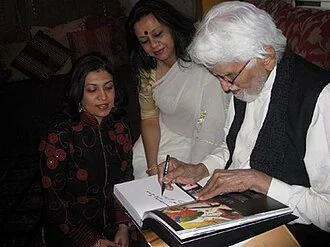
After Mongillat’s death in 2002, he eventually returned to live in India around 2010–2011. He died in New Delhi on 23 July 2016. His changing work and continuing archive resist reduction to a market price or a single black circle. The photograph here records a later encounter with people and a book at the Delhi Art Summit, keeping the social setting around the artist visible.
Quick answers
Frequently asked questions about S. H. Raza
- What do S. H. Raza’s initials stand for?
- Sayed Haider Raza; Syed is another common spelling of the first name.
- Was Bindu one painting?
- No. Bindu is a recurring motif and appears in multiple titles. A documented 1980 Untitled painting and the Pompidou’s November 1986 Bindu are different objects.
- Did living in France make Raza a French artist only?
- His career had deep connections to both India and France. He was an Indian painter who worked in Paris for decades, maintained Indian relationships and eventually returned to India.
- Why is the portrait shown with other people?
- It is Chetan Nikam’s complete 2011 Delhi Art Summit photograph. Retaining the supplied frame preserves the people, book and setting rather than isolating Raza’s face.
Keep exploring
Lives connected to this story
- Mulk Raj Anand
Explore the writer and Marg editor associated with the public discussion of modern Indian art.
- Rabindranath Tagore
Compare an earlier painter and writer whose practice also crossed artistic media and national borders.
- Amrita Sher-Gil
Compare artistic education and sustained movement between India and France.
Sources and further reading
Explore the evidence
These references support the biography and offer further reading. Official records, first-person accounts and independent reporting provide different perspectives; image records document attribution and licensing.
- 1. The Raza FoundationSayed Haider Raza: indexed biography and institutional work
Relevant indexed Foundation biography read; direct request timed out. Used for education, marriage, nationality, Foundation and dates, without market-price claims or contradictory fellowship chronology.
- 2. Raza Catalogue RaisonnéBiography: selected documented chronology
Read selected early, Paris, marriage and later-life entries. Records vary between Babaria and Kakaiya and in district labels; the profile uses the supported broader region and modern state without merging village names into an invented locality. Its 2011 return differs from the Foundation’s 2010 decision; text gives around 2010–2011.
- 3. Centre PompidouS. H. Raza, 1922–2016: 2023 retrospective
- 4. Catherine David and Diane Toubert / Centre PompidouSayed Haider Raza, les lieux de l’abstraction
- 5. Christie’sUntitled, painted 1980, lot 4777623
- 6. Centre PompidouBindu, November 1986, indexed collection record
Read indexed museum object metadata: Bindu, November 1986, acrylic diptych, 200.5 × 99.5 cm. Direct page showed maintenance. It is not labelled as the 1980 work.
- 7. Tuli Research Centre for India StudiesRaza: recorded statements on form and neo-tantric classification
- 8. The Raza FoundationCatalogue raisonné: documentation and published volumes
- 9. Wikimedia Commons / Chetan NikamExact Delhi Art Summit photograph and licence record
Exact own-work CC BY-SA 4.0 photograph, full group frame and inscribed book retained; no artwork is misidentified as a Bindu reproduction.