In this biography
Quick facts
- Born
- 4 February 1913
- Died
- 24 October 2005
- Birthplace
- Tuskegee, Alabama, United States
- Country
- United States
- Nationality
- American
- Known for
- Her 1955 bus protest, the Montgomery boycott and decades of civil rights work in Detroit
- Birth
- 4 February 1913, Tuskegee, Alabama
- Early organizing
- Became Montgomery NAACP secretary in 1943
- Bus protest
- Arrested in Montgomery on 1 December 1955
- Detroit work
- Served in John Conyers’s district office, 1965–1988
- Youth institution
- Co-founded the Rosa and Raymond Parks Institute with Elaine Steele in 1987
- Death
- 24 October 2005, Detroit, Michigan
Why this life matters
Parks connected resistance to segregation with sustained organizing, voter registration, economic justice and youth education; her life extended far beyond the single act for which she became famous.
Timeline
Key moments
Born in Alabama
Born Rosa Louise McCauley in Tuskegee and grew up amid segregation in Alabama.
Built an organizing life
Married Raymond Parks in 1932, became Montgomery NAACP secretary in 1943 and youth adviser in 1949.
Refused to surrender her bus seat
Was arrested after resisting the driver’s demand that she vacate her seat for a white passenger.
Sustained protest and faced its costs
Worked for the boycott, lost her department-store job, traveled to raise funds and moved with family to Detroit in 1957.
Combined congressional and community work
Worked in John Conyers’s Detroit office while participating in wider civil rights campaigns; co-founded a youth institute in 1987.
Received national honors
Received the Presidential Medal of Freedom and Congressional Gold Medal; after her death on 24 October 2005, she lay in honor in the U.S. Capitol.
Alabama family life shaped resistance to segregation
Rosa Louise McCauley was born in Tuskegee, Alabama, on 4 February 1913. She grew up in Pine Level with her mother, brother and maternal grandparents, in a society structured by segregation and racial intimidation. Her later recollections described family vigilance against Ku Klux Klan violence. The everyday work of learning, sewing and helping at home existed alongside the danger of white supremacist attacks.
She attended the Montgomery Industrial School and completed her high school education in 1933. In 1932 she married Raymond Parks, a barber already engaged in racial justice work. They supported the defense of the Scottsboro defendants. Their partnership connected employment and family responsibilities with political activity long before the bus protest made Rosa nationally famous.
NAACP work included voting and opposition to racial violence
Parks became secretary of the Montgomery NAACP in 1943 and its youth adviser in 1949. With E. D. Nixon and other organizers, she worked on voter registration and cases of racial discrimination and violence. This required collecting information, maintaining networks and pressing officials who were often unwilling to protect Black citizens. Her activism was practiced organizational work rather than a sudden discovery of injustice.
In 1944 she investigated the assault of Recy Taylor and helped mobilize a campaign demanding accountability. The failure to secure justice showed the limits confronting Black women and local activists. Parks also attended an interracial desegregation workshop at Highlander Folk School in 1955. These experiences placed her within a wider movement and helped sustain her determination to challenge unequal treatment.
Her bus refusal became part of a collective struggle
On 1 December 1955, Parks boarded a Montgomery bus after work. She sat behind the seats permanently reserved for white passengers. When the driver demanded that four Black passengers vacate their row, she refused and was arrested. She was not Montgomery’s first bus resister. Her standing in the community and existing networks helped turn this arrest into a rallying point.
The boycott that began on 5 December depended on organizers, churches, drivers, riders and thousands of residents who sustained alternative transportation. Parks served as a carpool dispatcher and traveled to raise money and awareness. She lost her department-store job in January 1956. The successful federal challenge, Browder v. Gayle, was separate from her criminal appeal; bus desegregation followed in December 1956, without ending the family’s hardships.
Detroit became a new center of work, not a retirement
Parks, Raymond and her mother moved to Detroit in 1957. A period working at Hampton Institute in Virginia followed before she returned to Detroit in 1958. Public acclaim had not produced immediate financial security. Her papers document the economic and health consequences that the Montgomery struggle imposed on the family. Moving north also brought encounters with discrimination in housing, schools, jobs and policing.
From 1965 to 1988, she worked in Congressman John Conyers’s Detroit district office. She also supported prisoners, the Friends of SNCC, women’s rights and opposition to the Vietnam War. National participation continued through the March on Washington, the Selma-to-Montgomery campaign and the Poor People’s Campaign. Her Detroit years reveal an organizer addressing northern inequality as well as southern segregation.
Youth education and public honors followed decades of organizing
In 1987, Parks and Elaine Steele established the Rosa and Raymond Parks Institute for Self Development. Its youth education work connected civil rights history to the choices facing another generation. Parks also published books, including Rosa Parks: My Story with Jim Haskins in 1992. These projects gave her ways to explain a life that public memory often reduced to one bus ride.
She received the Presidential Medal of Freedom in 1996 and the Congressional Gold Medal in 1999. After her death in Detroit on 24 October 2005, she lay in honor in the Capitol Rotunda. Those tributes recognized a national symbol; her papers reveal the sustained labor behind it. Parks’s significance lies in personal courage joined to organization, solidarity and an enduring insistence on equal rights.
Quick answers
Frequently asked questions about Rosa Parks
- Was Rosa Parks already an activist before her bus arrest?
- Yes. She became Montgomery NAACP secretary in 1943, worked on voter registration and racial violence cases, and served as a youth adviser. Her organizing experience preceded the December 1955 protest by years.
- Where was Parks sitting on the bus?
- She sat in the first row behind the seats permanently reserved for white passengers. The driver ordered her and three other Black passengers to vacate their row; she refused and was arrested.
- Did Parks’s criminal case end bus segregation?
- Her appeal was distinct from Browder v. Gayle, the federal civil case that struck down bus segregation. The boycott and legal campaign were related parts of a larger struggle, not a single lawsuit brought by Parks.
- What did Rosa Parks do after Montgomery?
- She continued organizing in Detroit, worked in John Conyers’s district office from 1965 to 1988 and participated in national campaigns. In 1987 she co-founded a youth-development institute with Elaine Steele.
Keep exploring
Lives connected to this story
- John Lewis
Follow a later organizer’s campaign for voting rights, including the Selma movement in which Parks also participated.
- Fannie Lou Hamer
Explore how another grassroots organizer connected voting rights with economic security and community power.
- Lyndon B. Johnson
Read about the president who signed the 1965 voting-rights law after sustained organizing and the Selma campaign.
Sources and further reading
Explore the evidence
These references support the biography and offer further reading. Official records, first-person accounts and independent reporting provide different perspectives; image records document attribution and licensing.
- 1. Library of CongressRosa Parks (1913–2005): Timeline
- 2. Library of CongressRosa Parks: Early Life and Activism
- 3. Library of CongressEarly Childhood Experiences: autobiographical sketch context
- 4. National Park ServicePlaces of Rosa Parks
- 5. National ArchivesAn Act of Courage: The Arrest Records of Rosa Parks
Arrest explanation distinguishes her seat from the permanently white section and her criminal appeal from Browder. The lesson's June4 district-decision date conflicts with other institutional June5 chronologies; that exact side date is not used.
- 6. Library of Congress; Jeanne TheoharisBeyond the Bus: Rosa Parks’s Lifelong Struggle for Justice
Read through indexed article text; its reference to November12,1956 speech notes celebrating a Supreme Court ruling is not adopted as the ruling date. Uses the well-supported dispatching, travel, job-loss and financial-cost discussion.
- 7. Library of CongressRosa Parks: Detroit 1957 and Beyond
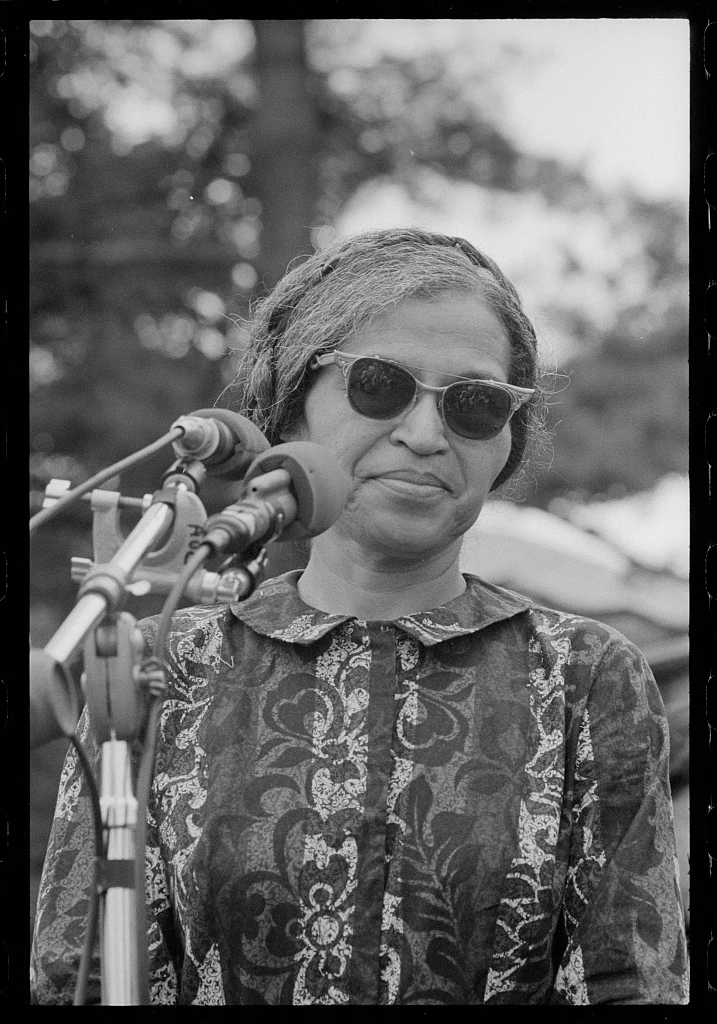
- 8. Library of CongressPoor People’s March photograph, 19 June 1968; 2017650273
Exact indexed item identifies the later1968 rally photo; specific staff-photographer donation policy supplies the rights basis. Direct master access blocked; full native717x1024 official-Flickr mirror preserved, not enlarged or called the highest master.
- 9. Library of CongressU.S. News & World Report Collection: specific rights dedication
- 10. Library of Congress on FlickrPoor Peoples March: official institutional image mirror