In this biography
Quick facts
- Born
- 1 March 1913 or 1914 (birth year disputed)
- Died
- 16 April 1994
- Birthplace
- Oklahoma City, Oklahoma, United States
- Country
- United States
- Nationality
- American
- Known for
- Invisible Man, Shadow and Act, and writing about music and American identity
- Full name
- Ralph Waldo Ellison
- Birth date
- 1 March 1913 or 1914; year disputed
- Education
- Studied music at Tuskegee Institute, 1933–1936; left without a degree
- First novel
- Invisible Man, published in 1952
- Literary award
- 1953 National Book Award for Fiction
- Died
- 16 April 1994, New York City
Why this life matters
Ellison challenged narrow definitions of Black experience and American culture. His fiction and criticism investigated how individuals are misrecognized by racial assumptions, political institutions and inherited stories about the nation.
Timeline
Key moments
Born in Oklahoma City
Ellison is born on 1 March; institutional sources disagree over whether the year was 1913 or 1914.
Musical study at Tuskegee
He studies at Tuskegee Institute before leaving without a degree and moving to New York.
Federal Writers’ Project work
Ellison gathers life histories and folklore while developing as a writer in New York.
Invisible Man is published
His novel brings an unnamed Black narrator’s experiences into an experimental work of American fiction.
National Book Award
Invisible Man wins the National Book Award for Fiction, a year after its publication.
Death and an unfinished project
Ellison dies in New York on 16 April, leaving extensive drafts for a second novel that editors later bring into print.
Oklahoma City, music and an unfinished course of study
Ralph Waldo Ellison grew up in Oklahoma City, where music and modern urban culture helped shape his ambitions. His birthday was 1 March, although institutional sources disagree between 1913 and 1914 for the year. The Oklahoma Historical Society emphasizes the city’s jazz environment and his early interest in several art forms. He attended the Frederick Douglass School before entering Tuskegee Institute in Alabama in 1933.
At Tuskegee, music was his principal field, but reading widened his intellectual interests. T. S. Eliot and other modernist writers offered examples of what literary form might accomplish. He left in 1936 without completing a degree and went to New York. That move redirected rather than erased his musical education: attention to rhythm, variation and performance remained important to his later writing.
New York, folklore and the work of listening
In New York, Ellison encountered writers including Langston Hughes and Richard Wright. Wright encouraged his literary work, while friendships and debates placed him within a demanding artistic community. After an interval away following his mother’s death, Ellison returned to New York in 1938. Employment with the Federal Writers’ Project supported him through 1942 as he collected life histories and folklore and published shorter writing.
This work required listening to how people shaped experiences through speech. Its importance was not simply a stock of anecdotes to transfer into fiction. Ellison became interested in the forms, humor and possibilities of vernacular culture, alongside the books he read. He served in the Merchant Marine from 1943 to 1945 and married Fanny McConnell in 1946, before the success that would transform his professional circumstances.
A 1952 novel and a 1953 award
Invisible Man appeared in 1952 and won the National Book Award for Fiction in 1953. Its unnamed Black narrator moves through Southern and Northern settings, confronting institutions and people who assign him identities that do not encompass his experience. Invisibility concerns recognition and power, rather than a scientific power to disappear. The novel’s changes of register, satire and retrospective storytelling are as important as its sequence of encounters.
Ellison drew on Black cultural traditions and a broad literary inheritance, resisting the idea that these were incompatible sources. The book’s success established him nationally, but responses were not unanimous: some Black critics questioned its politics. Those disagreements belong to its history. The National Book Foundation identifies it as the only novel Ellison published during his lifetime, not the only kind of writing he produced.
Essays, teaching and arguments about American culture
Shadow and Act in 1964 and Going to the Territory in 1986 collected essays on literature, music and American culture. These volumes extended questions also present in the fiction: who can define a person, how traditions interact and what democratic ideals demand of a divided society. Jazz, blues and folklore were resources for thought, not evidence that Black cultural life belonged outside a wider American inheritance.
Ellison also taught and lectured widely, including appointments at Bard and New York University. He served as the Library of Congress’s Honorary Consultant in American Letters from 1966 to 1972. The public intellectual and teacher continued working alongside the novelist. His reputation therefore rests on a major novel, but his career also includes sustained criticism and participation in educational and cultural institutions.
Unfinished manuscripts and a posthumous literary history
Ellison spent decades working on a second novel without bringing it to a finished publication. When he died in New York on 16 April 1994, extensive drafts and notes remained. Their survival made editorial decisions central to the work’s later history. With Fanny Ellison’s support, literary executor John F. Callahan shaped material into Juneteenth, published in 1999.
Callahan and Adam Bradley subsequently produced the expanded Three Days Before the Shooting ... in 2010. These books represent different editorial presentations of unfinished material, not two completed novels Ellison released himself. Read alongside the essays, they enlarge the record of his experiments without changing Invisible Man’s place as his completed lifetime novel. His legacy involves both the work he made public and the archival labor through which later readers encounter his continuing ambitions.
Quick answers
Frequently asked questions about Ralph Ellison
- Why are two birth years given for Ralph Ellison?
- The Ralph Ellison Foundation and Oklahoma Historical Society give 1 March 1913, while Library of Congress biographies give 1 March 1914. The Foundation acknowledges the scholarly disagreement. This profile preserves the uncertainty rather than presenting one year as conclusively established.
- Did Ellison earn a degree at Tuskegee?
- No completed Tuskegee degree is claimed. He studied music there from 1933 to 1936 and left without a degree before moving to New York.
- When did Invisible Man win the National Book Award?
- It won the National Book Award for Fiction in 1953. The novel was published in 1952; the publication year and award year are separate.
- Did Ellison finish Juneteenth before his death?
- No. John F. Callahan edited material from Ellison’s unfinished second-novel project into Juneteenth in 1999. Callahan and Adam Bradley published a larger presentation as Three Days Before the Shooting ... in 2010.
Keep exploring
Lives connected to this story
- Langston Hughes
Read about a writer Ellison encountered in New York and another approach to the relationship between literary form, music and Black cultural life.
- James Baldwin
Compare another novelist and essayist’s arguments about race, individual experience and American identity.
Sources and further reading
Explore the evidence
These references support the biography and offer further reading. Official records, first-person accounts and independent reporting provide different perspectives; image records document attribution and licensing.
- 1. Oklahoma Historical SocietyGordon O. Taylor: Ellison, Ralph Waldo
Supports Tuskegee study without a degree, Federal Writers’ Project dates, Merchant Marine service, death and the distinction between a literary reputation and unanimity of critical response.
- 2. Ralph Ellison FoundationMeet Ralph Ellison: chronology and disputed birth year
The Foundation’s indexed chronology gives 1 March 1913 and expressly acknowledges the 1914 alternative. The full page timed out; the indexed date/dispute passage was read. Oklahoma Historical Society’s complete relevant biography and LOC’s contrary dating were read directly. No exact birth-year certainty is asserted.
- 3. Library of CongressRalph Ellison Rare Book Collection: A Resource Guide
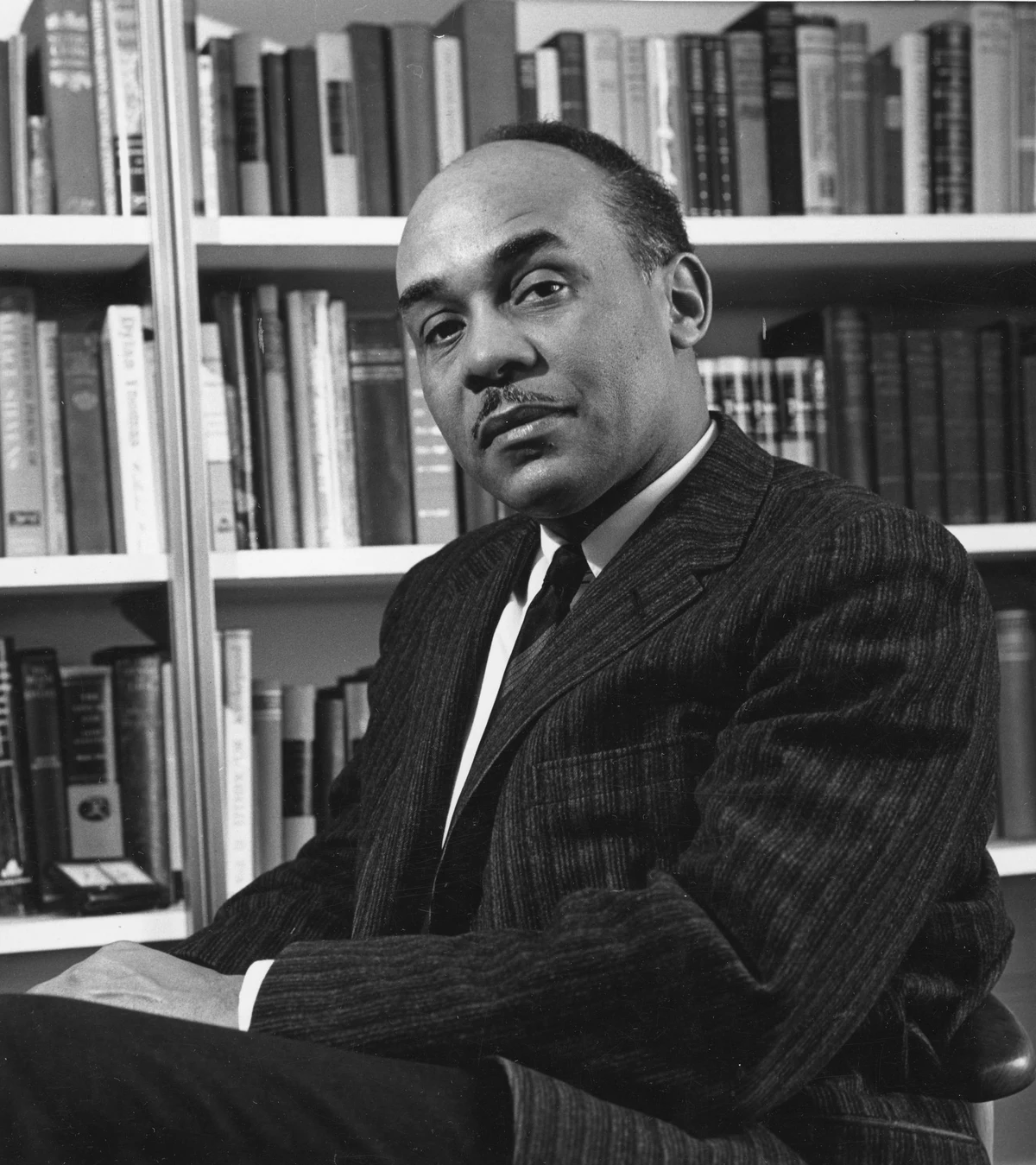
The exact USIA staff photograph is NARA 306-PSA-61-8989. LOC captions say 1960; the older LOC/Commons description says 1961. Credit uses circa 1960–1961, not a more precise invented date or named photographer.
- 4. Library of Congress, American Folklife CenterStephen Winick: Ralph Ellison, Invisible Folklorist
- 5. National Book FoundationInvisible Man: Winner, National Book Awards 1953 for Fiction
- 6. Penguin Random HouseInvisible Man: Reader’s Guide
- 7. Library of Congress GazetteBarbara Bair: Juneteenth Novel Crafted from Library’s Ellison Papers, page 7
Barbara Bair’s article on page 7 was read for the unfinished manuscript and the separate 1999 and 2010 editorial publications. No complete reading of the novels or the entire eight-page Gazette issue is claimed.