In this biography
Quick facts
- Born
- 24 January 1960
- Birthplace
- Meerut, India
- Country
- Singapore
- Nationality
- Singaporean
- Known for
- DBS’s digital strategy, regional banking and the transition to board leadership
- DBS CEO tenure
- November 2009–28 March 2025
- Earlier employer
- Citi, in several Asian leadership roles
- Management qualification
- Post Graduate Diploma in Management, IIM Ahmedabad
- DBS successor
- Tan Su Shan
- Keppel board
- Deputy chairman from July 2025; chairman from April 2026
Why this life matters
His record brings together banking strategy and technology reliability: digital expansion, serious service disruptions and the difference between running a bank and overseeing a board.
Timeline
Key moments
Born in Meerut
The McKinsey interview’s biographical panel gives 24 January 1960.
Began a Citi career
His later roles included country and regional banking responsibilities.
Appointed to lead DBS
The September announcement preceded his November start.
Digital strategy
His 2017 interview described the board’s 2013 decision and a broader change in bank operations.
Technology disruptions and regulatory action
DBS disclosed additional capital requirements and a pause on non-essential IT changes.
DBS retirement and Keppel appointment
Retired on 28 March; joined Keppel’s board on 1 July.
Keppel chairman
Succeeded Danny Teoh with effect from 17 April.
From India to regional banking
Piyush Gupta was born in Meerut, India, on 24 January 1960. He studied economics at St. Stephen’s College, University of Delhi, and completed management studies at the Indian Institute of Management Ahmedabad. Keppel’s appointment record identifies the latter qualification as a Post Graduate Diploma in Management, a more precise label than simply converting every management programme into an MBA.
He began his Citi career in 1982. Over the following decades, his responsibilities included country leadership in Singapore, Indonesia and Malaysia and a wider regional role. DBS’s September 2009 appointment announcement emphasised that combination of operational and strategic experience. He started as DBS chief executive in November, after a career in an international bank rather than as the founder of DBS.
What DBS’s digital transformation meant
In a 2017 McKinsey interview, Gupta explained that DBS’s board had decided in 2013 to make digital change central to the bank’s future. His account went beyond adding mobile applications. It involved reworking internal processes and technology, understanding how customers used services and changing the habits of a large established organisation.
That account explains the strategy from the chief executive’s perspective. Banking services increasingly reached customers through phones and connected systems, making technology part of everyday delivery rather than a separate support function. The same dependence also made reliable operations important: a convenient digital product would still fail its users when the underlying service was unavailable.
Service disruptions and the limits of a success story
Repeated disruptions in 2023 exposed that operational risk. DBS’s financial statements report that MAS imposed an additional capital requirement after the March and May outages. In November, the regulator imposed a six-month pause on non-essential IT changes. These were measures directed at the bank and its operations, not a personal criminal conviction of Gupta.
The bank described a technology-resilience roadmap covering change management, system resilience, incident management and governance. The distinction matters when assessing his tenure: the digital strategy and the reliability failures belong in the same account. A published remediation plan establishes what the bank proposed to change, not that every weakness had already been resolved when the plan was announced.
Sources for this section: [3]
Tan Su Shan’s succession and the move to Keppel
Gupta retired as DBS chief executive and executive director on 28 March 2025, when Tan Su Shan took over. The subsequent governance report records the completed transition, rather than only a prospective retirement announcement. His departure ended an executive tenure that had begun in November 2009.
Keppel appointed him deputy chairman and a non-executive independent director from 1 July 2025. He then succeeded Danny Teoh as non-executive chairman with effect from 17 April 2026; the company’s later board register confirms the chairman title. This is a board-oversight role, not Keppel’s chief executive position. The distinction prevents his former DBS title from being carried forward into a different company or treated as a current bank appointment.
Quick answers
Frequently asked questions about Piyush Gupta
- Is Piyush Gupta still DBS chief executive?
- No. He retired on 28 March 2025 and was succeeded by Tan Su Shan.
- When did Piyush Gupta become Keppel chairman?
- His non-executive chairmanship took effect on 17 April 2026, after he joined the board as deputy chairman in July 2025.
- Did Piyush Gupta found DBS?
- No. DBS recruited him as chief executive in 2009 after his Citi career.
- Why are DBS’s 2023 disruptions part of his biography?
- They occurred during his CEO tenure and led to bank-level regulatory measures. They are relevant operational history, not evidence of a personal criminal conviction.
Keep exploring
Lives connected to this story
- Ho Ching
Compare the distinct responsibilities of a bank CEO and the former leader of Singapore’s investment company Temasek.
- Ng Kok Song
Explore investment management and public institutions alongside, but separate from, commercial bank leadership.
- Mochtar Riady
Compare a professional banking executive with an Indonesian entrepreneur whose career combined banking and conglomerate-building.
- Wee Cho Yaw
Compare different Singapore bank leadership careers and use dated institutional roles.
Sources and further reading
Explore the evidence
These references support the biography and offer further reading. Official records, first-person accounts and independent reporting provide different perspectives; image records document attribution and licensing.
- 1. McKinsey Quarterly · original interview20 March 2017: personal background and digital strategy
The interview supplies the exact birthday and birthplace and attributes the digital rationale to Gupta. Its “2009–present” CEO label describes March 2017, not October 2026. The PGDM qualification uses Keppel’s more precise wording.
- 2. DBS · appointment announcement1 September 2009: recruitment from Citi
- 3. DBS · audited annual-report financial statements2023 significant events: digital disruption and regulatory action
The statements disclose bank-level operational measures. No personal fine, criminal charge, completed remediation or causal link to his later retirement is inferred.
- 4. DBS · 2025 annual reportCompleted CEO and director transition on 28 March 2025
- 5. Keppel · company announcementDeputy chairman appointment effective 1 July 2025
- 6. Keppel · company announcementChairman succession effective 17 April 2026
- 7. Keppel · current board registerPiyush Gupta: non-executive chairman
Checked 19 October 2026 against the dated succession announcement; the current chairmanship is distinct from his former DBS executive role.
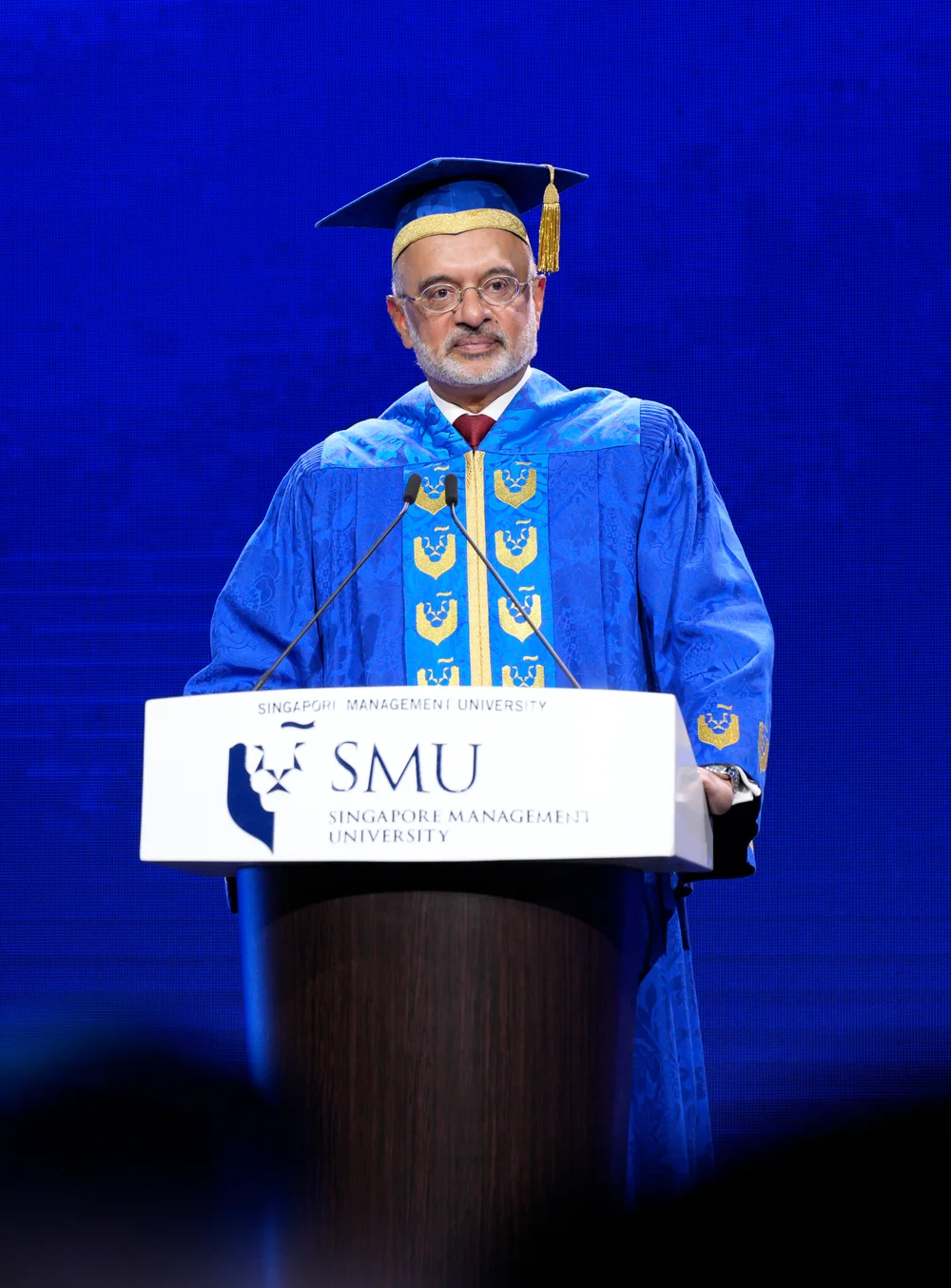
- 8. Wikimedia Commons · Chensiyuan2023 SMU commencement photograph and CC BY-SA 4.0 licence
Chensiyuan’s own-work photograph, 25 July 2023, CC BY-SA 4.0. The full supplied frame, including lectern and academic dress, is retained; no face-only crop or enlargement.