In this biography
Quick facts
- Born
- 1961
- Birthplace
- Montréal, Québec, Canada
- Country
- Canada
- Nationality
- Not independently established
- Known for
- Quebecor’s communications expansion, the Videotron acquisition, Québec politics and cultural patronage
- Education
- Philosophy at UQAM; law at Université de Montréal
- Quebecor leadership
- President and CEO, 1999–2013; returned in February 2017
- Political service
- Saint-Jérôme MNA, 2014–2016; PQ leader, 2015–2016
- Personal acquisition
- Montreal Alouettes, March 2023
Why this life matters
His life connects inherited corporate control, strategic change and Québec public life, showing why ownership, executive management and political responsibility must be considered separately.
Timeline
Key moments
Montréal and education
Grows up in Montréal and studies philosophy and law.
The family business
Joins Quebecor, works in printing and other subsidiaries, and becomes CEO in 1999.
Videotron and broadcasting
Quebecor Media’s takeover is followed by separate cable and television regulatory decisions.
Growth and conflict
Communications expansion accompanies printing setbacks and disputed labour relations.
Elected politics
Represents Saint-Jérôme, leads the PQ and resigns on 2 May 2016.
Executive return and new commitments
Returns to Quebecor, later adds Videotron responsibilities and personally acquires the Alouettes.
A Montréal upbringing preceded philosophy and law
Pierre Karl Péladeau was born in Montréal in 1961 to entrepreneur Pierre Péladeau and Raymonde Chopin. He attended the city’s Sainte-Marcelline and Stanislas colleges before studying philosophy at the Université du Québec à Montréal and law at the Université de Montréal. His parliamentary biography records membership in the Québec bar from 1988 to 2001.
The family name already belonged to an established publishing enterprise. His father founded Quebecor in 1965, after launching Le Journal de Montréal the previous year. Pierre Karl would inherit an important position within that organization, but he did not found either the newspaper or Quebecor. His later decisions changed an existing business built by others.
Printing provided experience before he took the chief executive role
Péladeau entered Quebecor in 1985 and worked across its subsidiaries. His responsibilities included the development of Quebecor’s printing operations and leadership of a group containing publishing, distribution and retail activities. International printing was part of his executive formation, rather than simply a legacy he received without operational experience.
After his father’s death in 1997, he became Quebecor’s president and chief executive in 1999. Expansion did not produce uniformly successful outcomes. Quebecor Printing’s combination with World Color Press created a large international printer, but Quebecor World later entered bankruptcy in 2008. That company’s difficulties form part of the wider corporate history alongside the communications businesses that became more important.
The Videotron transaction redirected the business without creating it
The 2000 takeover of Groupe Vidéotron by Quebecor Media, backed by the Caisse de dépôt et placement du Québec, brought cable distribution and broadcasting interests into the group. André Chagnon, not Péladeau, had founded Videotron. The transaction connected Quebecor’s existing content businesses with a substantial distribution network.
Commercial acquisition and permission to control regulated operations were separate steps. The CRTC approved cable control in May 2001 and issued a conditional television decision concerning TVA in July. Telecommunications later occupied a much larger place in Quebecor’s activities. The Caisse’s financing and the work of subsidiary managers were material contributions, not incidental details in a single-executive success story.
Labour relations exposed the costs and disputes around restructuring
His leadership also attracted sustained union criticism. Le Journal de Montréal’s long lockout became a particularly visible dispute. In 2014, the FTQ criticized his use of lockouts as he moved towards party leadership. Péladeau defended those decisions as necessary to preserve the newspaper founded by his father; that defence was reported in a Quebecor-owned publication.
A 2015 Canadian Press interview described a change in his position on the balance of bargaining power after leaving the chief executive role. He said reopening the labour code was not a priority. These disagreements concern employment and corporate power, and cannot be replaced by a list of acquisitions or philanthropic commitments.
A short political career raised questions about media ownership
After leaving executive office in 2013, Péladeau entered electoral politics. He won Saint-Jérôme for the Parti Québécois in April 2014, became party leader on 15 May 2015 and served as leader of the official opposition. His public support for Québec independence made his political programme explicit.
His continuing controlling shareholding in Quebecor drew criticism about possible conflicts between political activity and ownership of influential media. That criticism is not itself a finding that every newsroom acted on his instructions. On 2 May 2016, he resigned both the leadership and his legislative seat, citing family reasons. The parliamentary record fixes those dates independently of later speculation about a return to politics.
His return combined corporate management with personal commitments
Péladeau returned as Quebecor’s president and chief executive in February 2017. Videotron’s current official biography also records his appointment there in June 2021 and as acting president of TVA Group in October 2021. It dates the Freedom Mobile acquisition’s completion to April 2023, extending the group’s wireless operations beyond Québec.
Other commitments have a different ownership basis. The CFL confirmed that he personally acquired the Montreal Alouettes in March 2023. His cultural activities include the Éléphant cinema-preservation project and the family’s Chopin-Péladeau foundation. These pursuits broaden his public life without erasing the contested record of an executive who also became an elected politician.
Quick answers
Frequently asked questions about Pierre Karl Péladeau
- Did Pierre Karl Péladeau found Quebecor or Videotron?
- No. His father Pierre Péladeau founded Quebecor, and André Chagnon founded Videotron. Pierre Karl later led Quebecor and its acquisition strategy.
- When did he leave politics?
- He resigned as PQ leader, opposition leader and Saint-Jérôme MNA on 2 May 2016, citing family reasons.
- Did he return to Quebecor?
- Yes. He returned as president and chief executive in February 2017. The current official biography also records later Videotron and TVA appointments.
- Did Quebecor buy the Montreal Alouettes?
- The CFL’s completed-transaction announcement of 10 March 2023 explicitly identifies Péladeau’s acquisition as personal, not a purchase by Quebecor.
Keep exploring
Lives connected to this story
- Brian Mulroney
Compare a different move from corporate leadership into elected politics, with public-office responsibilities distinct from running a business.
Sources and further reading
Explore the evidence
These references support the biography and offer further reading. Official records, first-person accounts and independent reporting provide different perspectives; image records document attribution and licensing.
- 1. Assemblée nationale du QuébecPierre Karl Péladeau: official biography, updated January 2024
The parliamentary biography establishes 1961 and Montréal, not an exact birthday. Its philosophy graduation year conflicts with a 2013 government appointment note; the biography retains the qualification without a year. Nationality is omitted rather than inferred from Canadian associations.
- 2. VideotronPierre Karl Péladeau: executive biography and dated later appointments; accessed 23 October 2026
Current appointments were checked as of 23 October 2026. Corporate claims about competitive benefits or cultural leadership are not adopted as independent evaluations.
- 3. CORIMPierre Karl Péladeau: education, printing career and return to Quebecor
- 4. Ross Marowits / The Canadian Press via CityNews10 March 2014: Quebecor’s transformation, inheritance and printing setbacks
- 5. Lynn Desjardins / Radio Canada International2 May 2016: political resignation and media-ownership controversy
Ownership-related criticism is attributed; no unestablished newsroom instruction or ethics finding is inferred. Conflicting accounts of blind-trust implementation are not resolved by repeating one categorical claim.
- 6. Alexandre Robillard / La Presse Canadienne via Métro4 February 2015: Péladeau’s changing position on labour-code reform
- 7. Geneviève Lajoie / Le Journal de Montréal11 November 2014: union criticism and Péladeau’s defence of lockouts, reported by a Quebecor publication
This account records union criticism and Péladeau’s public reply, but the publication belongs to Quebecor. The separate Canadian Press interview and RCI report supply independent context.
- 8. TVA Nouvelles3 December 2015: labour debate recalls the Journal de Montréal’s 25-month lockout
- 9. Canadian Football League10 March 2023: completed personal acquisition of the Montreal Alouettes
- 10. The Canadian Press via CityNews10 March 2023: Péladeau unveiled as Alouettes owner
- 11. VideotronCorporate history: André Chagnon’s 1964 founding and later changes
- 12. CRTCDecision 2001-283, 23 May 2001: cable control, QMI ownership and effective control; French decision read
- 13. CRTCDecision 2001-384, 5 July 2001: conditional TVA approval and newsroom safeguards
- 14. Julien Arsenault / The Canadian Press via CityNews8 May 2018: proposed buyout explains the Caisse’s original partnership and later stake
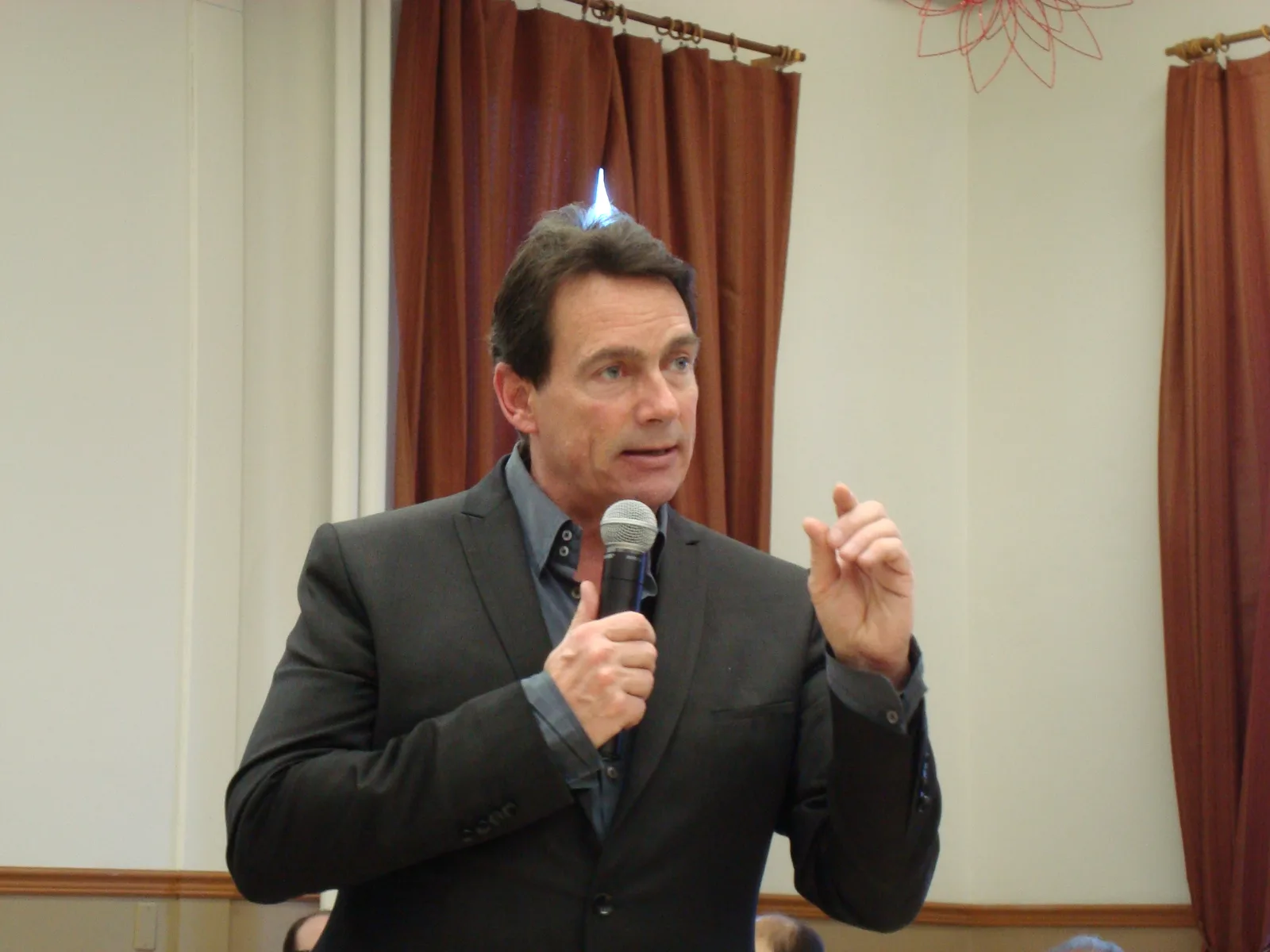
- 15. Samounet / Wikimedia CommonsPierre Karl Péladeau.JPG: own-work speech photograph, 7 December 2014, sole full-frame version
Samounet’s sole 7 December 2014 political-speech photograph is used in full frame under the copyright-holder’s explicit CC BY-SA 4.0 grant. It does not depict the 2000 acquisition.
- 16. Creative CommonsAttribution-ShareAlike 4.0 International: commercial reuse, credit and ShareAlike conditions