In this biography
Quick facts
- Born
- 5 January 1938
- Died
- 28 May 2025
- Birthplace
- Limuru area, Kenya
- Country
- Kenya
- Nationality
- Not independently established
- Known for
- Weep Not, Child, A Grain of Wheat, Devil on the Cross and arguments for writing and translation in African languages
- Makerere education
- Makerere University College of East Africa, 1959–1964
- Leeds study
- Postgraduate study in English from 1964; honorary LittD, 2004
- First published novel
- Weep Not, Child, 1964
- Language and publication
- Caitaani Mũtharaba-inĩ, 1980; author’s English translation, Devil on the Cross, 1982
Why this life matters
He challenged readers and institutions to ask whose languages carry literature and knowledge, while developing a body of work across fiction, performance, criticism and memoir.
Timeline
Key moments
Born in Kenya
Born on 5 January.
Makerere years
Develops as a writer while studying at Makerere University College.
Early novels and Leeds
Weep Not, Child appears in 1964, The River Between in 1965 and A Grain of Wheat in 1967.
Collaborative theatre
Works on plays with Micere Githae Mugo, Ngũgĩ wa Mirii and the Kamiriithu community.
Detention without trial
Writes the Gĩkũyũ novel later published as Caitaani Mũtharaba-inĩ while detained at Kamĩtĩ.
Novel and translation
The Gĩkũyũ publication is followed by his English translation, Devil on the Cross.
Decolonising the Mind
Publishes essays about language, culture and power.
UC Irvine
Joins the university as a distinguished professor.
Death
Dies on 28 May, aged 87.
A writer emerging at Makerere
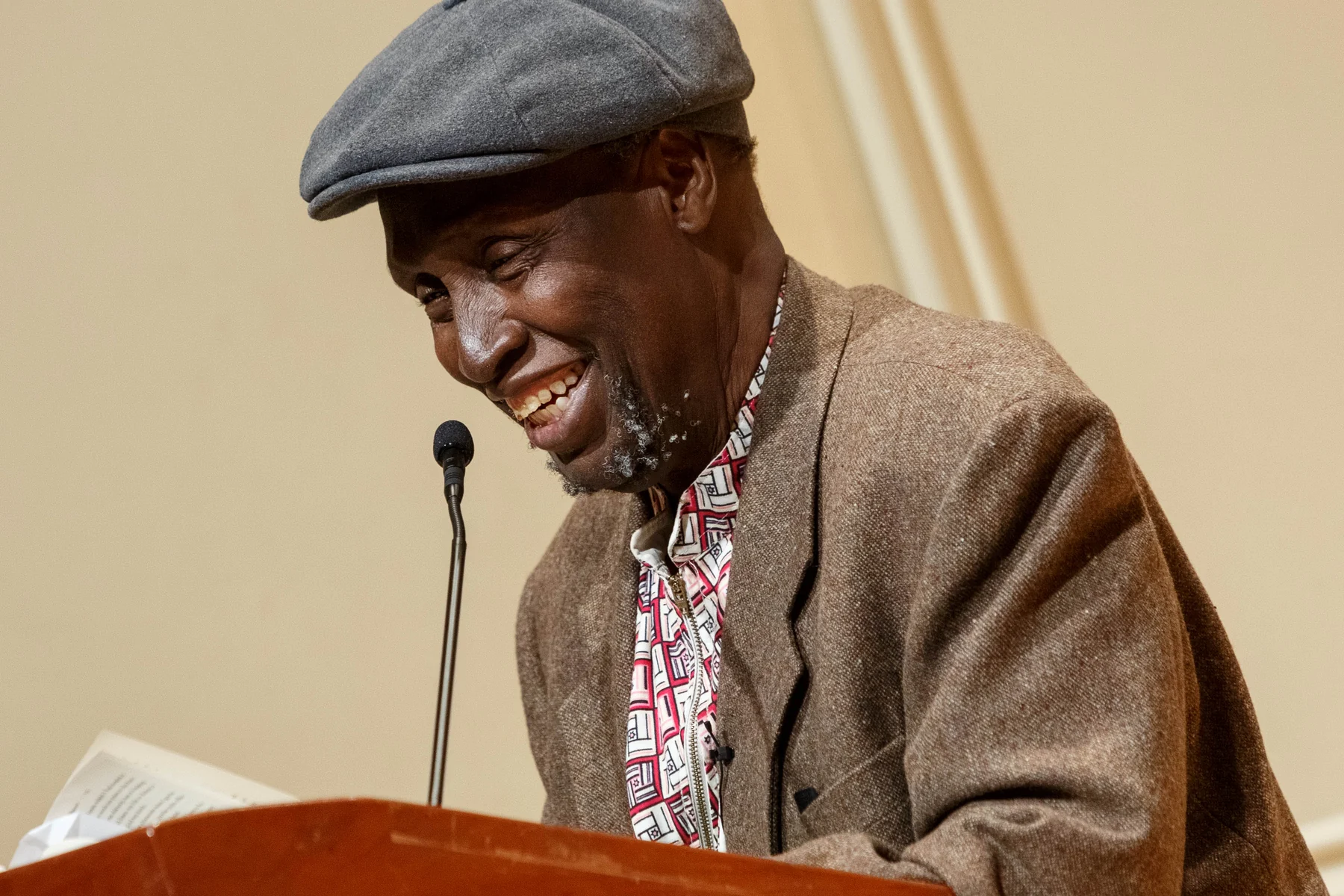
Ngũgĩ wa Thiong’o was born in Kenya on 5 January 1938 and first published under the name James Ngugi. His childhood belonged to a society under British colonial rule; colonial violence and the struggle over Kenya’s future later became central concerns of his fiction and memoirs. His public name changed as his understanding of language, culture and authorship developed.
He attended Makerere University College of East Africa from 1959 to 1964. Makerere’s commemorations locate the beginnings of his writing career in those years: he wrote early novels and produced The Black Hermit as a student. The college provided teachers, fellow writers and opportunities for performance. His emergence was part of an active literary community as well as an individual achievement.
Early novels and postgraduate study
Weep Not, Child appeared in 1964, followed by The River Between in 1965 and A Grain of Wheat in 1967. The sequence of publication differs from the order in which he developed the manuscripts. These English-language books brought him an international readership through the African Writers Series while examining the pressures on communities undergoing colonial rule and political change.
He began postgraduate study at Leeds in 1964. The university associates that period with the writing of A Grain of Wheat, which follows a community through the Mau Mau war and the approach of independence. Later recognition included Leeds’s honorary Doctor of Letters in 2004. That honorary distinction should remain separate from his earlier postgraduate study.
Theatre with other writers and communities
Ngũgĩ’s theatrical work depended on collaborators. The Trial of Dedan Kimathi was written with Micere Githae Mugo; Ngaahika Ndeenda, known in English as I Will Marry When I Want, was written with Ngũgĩ wa Mirii. At Kamiriithu, workers and other community members helped turn theatre into a public encounter with inequality and power.
That work made the choice of language a practical question. A performance could bring an argument to people who were excluded from English-language literary institutions. It also depended on performers, rehearsal space and permission to gather. His detention without trial in 1977–1978 followed the confrontation surrounding this community theatre; credit for its creation belongs to more people than its most famous writer.
A novel in prison and an argument about language
At Kamĩtĩ Maximum Security Prison he wrote on toilet paper, turning restricted material into the manuscript of a Gĩkũyũ novel. Caitaani Mũtharaba-inĩ was published in 1980. His own English translation, Devil on the Cross, followed in 1982. The composition in detention, the original-language publication and the translation are separate stages of the work’s history.
The novel uses Wariinga’s experiences to confront corruption, combining storytelling rhythms with written narrative. Ngũgĩ’s language argument also took an explicit critical form in Decolonising the Mind, published in 1986. Its essays considered literature, theatre and education within unequal relations between languages. Writing in Gĩkũyũ and translating outward were connected choices about who could create and encounter literature.
Exile, teaching and a widening body of work
Ngũgĩ spent more than two decades in exile and taught at several American universities. He joined UC Irvine in 2002, becoming a distinguished professor of English and comparative literature and directing its International Center for Writing and Translation. He continued to produce fiction, criticism and memoir alongside teaching.
Later books included Wizard of the Crow, Dreams in a Time of War and In the House of the Interpreter. The prison memoir appeared in a later form as Wrestling with the Devil in 2018. Across these different genres, his recurring questions concerned power, memory and whose experience could enter literary knowledge. The continuing work makes his prison novel one important turning point within a much longer career.
Death and a multilingual literary legacy
Ngũgĩ died on 28 May 2025 at the age of 87. He left a body of work that reached readers through original texts, translations, performances and teaching.
His influence does not require treating all African literature as one position in the language debate. His own career supplies a more precise starting point: early English novels, collaborative Gĩkũyũ theatre, prison writing, self-translation and criticism of linguistic hierarchies. Together they made language part of the substance of literature, rather than merely a transparent means of delivering it.
Quick answers
Frequently asked questions about Ngũgĩ wa Thiong’o
- Who was Ngũgĩ wa Thiong’o?
- Ngũgĩ wa Thiong’o was a novelist, playwright, essayist and university teacher. He challenged readers and institutions to ask whose languages carry literature and knowledge, while developing a body of work across fiction, performance, criticism and memoir.
- What is Ngũgĩ wa Thiong’o best known for?
- Ngũgĩ wa Thiong’o is best known for weep Not, Child, A Grain of Wheat, Devil on the Cross and arguments for writing and translation in African languages.
- When was Ngũgĩ wa Thiong’o born?
- Life dates are confirmed by the George Padmore Institute tribute. The regional birthplace is retained cautiously; no birth register was examined.
- When did Ngũgĩ wa Thiong’o die?
- Ngũgĩ wa Thiong’o died on 28 May 2025.
Keep exploring
Lives connected to this story
- Chinua Achebe
Follow the editorial adviser involved in the early African Writers Series network.
- Nadine Gordimer
Compare another writer’s encounters with political power, censorship and life in southern Africa; their histories and literary choices differ.
- Han Kang
Compare another author’s literary translation and international publishing history in a different political and language context.
- Grace Ogot
Compare another Kenyan literary career across English, an African language and public service.
- Ali Mazrui
Explore a different Kenyan thinker’s work across universities, publishing and broadcasting.
- Ayo Bamgbose
Compare literary arguments about language with Bamgbose’s linguistic research and work on education.
- Dedan Kimathi
Place literary remembrance beside the historical commander’s life and contemporary legal record.
- Micere Githae Mugo
Read the career of his collaborator on The Trial of Dedan Kimathi.
- Binyavanga Wainaina
Compare a later writer’s experiments and editorial networks.
- Mũkoma wa Ngũgĩ
Compare a distinct writer’s fiction and language advocacy, preserving separate original-story and essay credits.
Sources and further reading
Explore the evidence
These references support the biography and offer further reading. Official records, first-person accounts and independent reporting provide different perspectives; image records document attribution and licensing.
- 1. George Padmore InstituteTribute to Ngũgĩ wa Thiong’o, 2 June 2025: life dates and working relationships
Direct tribute confirms 5 January 1938–28 May 2025. No uncertain death-place claim is included: early reports differed between Atlanta, Buford and Bedford.
- 2. Makerere UniversityThe Ngũgĩ Wa Thiong’o Memoriam: 1959–1964 education
Makerere dates attendance through 1964, which differs from some 1963 graduation summaries elsewhere. Attendance is stated without inventing an exact degree-conferral date.
- 3. Makerere University, College of Humanities and Social SciencesMakerere celebrates the life and legacy of Ngũgĩ, 22 October 2025
- 4. Brendon Nicholls / University of Leeds, LUCASCommemorating Leeds alumnus, Ngũgĩ wa Thiong’o, 30 May 2025
University commemoration states study for an MA in 1964–1965, not an earned MA. No completed Leeds degree is asserted. This article and its Faculty of Arts reprint are one source, not independent corroboration.
- 5. UC Irvine, Office of the ChancellorPassing of Ngũgĩ wa Thiong’o, 29 May 2025
- 6. UC Irvine, Faculty Profile SystemNgugi wa Thiong’o: inactive historical bibliography, updated 21 June 2023
Explicitly inactive/outdated faculty record, last updated 21 June 2023; useful as a historical bibliography, never as evidence that the writer is alive or currently teaching. Some bibliography entries have edition-date variation.
- 7. Ngũgĩ wa Thiong’o’s official websiteWrestling with the Devil: author-site description of the 2018 prison memoir
Author-site synopsis examined, not the complete memoir or surviving prison manuscript. Its 2018 publication is kept separate from 1978 composition of the novel.
- 8. East African Educational Publishers / African Books CollectiveDevil on the Cross: publisher-distributor description
Distributor synopsis is used to identify Wariinga, corruption and the relation of oral and written storytelling; no independent full-novel close reading is claimed.
- 9. Daystar University LibraryDevil on the Cross: 1982 catalogue record and author-translation note
- 10. Boydell & Brewer, James Currey imprintDecolonising the Mind: 1986 publication and essay subjects