In this biography
Quick facts
- Born
- 12 December 1905
- Died
- 28 September 2004
- Birthplace
- Peshawar, North-West Frontier Province, British India (now Pakistan)
- Country
- India
- Nationality
- Indian
- Known for
- Untouchable, Coolie, Morning Face and founding the arts magazine Marg
- Debut novel
- Untouchable, published by Wishart in 1935
- Academic training
- Punjab education; philosophy doctorate in London, 1929
- Arts publishing
- Founder editor of Marg, first published in 1946
- Literary recognition
- Sahitya Akademi Award for Morning Face, 1971; Fellowship, 1989
Why this life matters
His novels made social exclusion a central subject of Indian writing in English, while his editorial work connected literature, modern art and public debate.
Timeline
Key moments
Born in Peshawar
Born on 12 December in colonial British India, in a city now in Pakistan.
Study in London
Arrived in Britain in 1925 and completed a philosophy doctorate in 1929.
Art criticism in print
Published Persian Painting before his breakthrough as a novelist.
Fiction and collective politics
Untouchable appeared; Anand helped establish the Progressive Writers’ Association in London.
Further novels
Coolie, Two Leaves and a Bud, The Village, Across the Black Waters and The Sword and the Sickle extended his fiction.
Marg begins
The arts magazine opened a long editorial project after his return to India.
Later fiction and recognition
Morning Face appeared in 1968 and won the 1971 Sahitya Akademi Award; Anand became an Akademi Fellow in 1989.
Death in Pune
Died on 28 September, aged 98.
A Punjabi childhood and a move to London
Mulk Raj Anand was born on 12 December 1905 in Peshawar, then in British India and now in Pakistan. His early education took place in cantonment schools and in Punjab. The South Asian Britain research project identifies his family as Kshatriya: that social position matters when considering his later representations of people subjected to caste exclusion. His Indian literary association should not obscure the changed borders around his birthplace.
He reached Britain in 1925 and studied philosophy at University College London, completing his doctorate in 1929. The move brought him into overlapping intellectual, literary and political networks. Education in English institutions did not simply supply a route away from India; London also became a place in which he argued about colonialism and developed a public career as a writer.
Politics and literary work in interwar Britain
Anand participated in left-wing and Indian independence circles, spoke at India League meetings and helped form the Progressive Writers’ Association in London in 1935. These commitments connected writing with arguments about economic exploitation, empire and fascism. They also placed him among writers who disagreed about the relationship between artistic freedom and political purpose; the movement was a collective undertaking rather than his personal invention.
Reviewing, editing and broadcasting provided other kinds of employment. He worked in the orbit of T. S. Eliot’s Criterion and the Woolfs’ Hogarth Press, and later contributed to the BBC Eastern Service alongside George Orwell and Una Marson. His Persian Painting had appeared in 1930. Art criticism and essays were already substantial interests before the novel made his reputation.
Untouchable and the question of representation
Published by Wishart in 1935, Untouchable follows one day in the life of Bakha, a young sweeper and latrine cleaner. Its concentration on ordinary work and humiliation makes caste hierarchy a material condition of movement, food, water and bodily contact. The novel is fiction, not Bakha’s autobiography or a transcript of all Dalit experience. Anand’s educated, higher-caste position creates questions about who can represent whom.
In his 1989 Akademi acceptance speech, Anand recalled the experience and imaginative work behind writing Bakha and described his fiction as a protest against imposed inferiority and bondage. That retrospective testimony helps explain his purpose, but does not settle every issue of narrative authority. Criticism of the novel’s mediation is part of its reading history, alongside recognition of its force as social protest.
A career extending beyond the first novel
Coolie followed in 1936 and Two Leaves and a Bud in 1937. The Village, Across the Black Waters and The Sword and the Sickle continued his exploration of people caught in unequal social and political structures. The Private Life of an Indian Prince, published in 1953, addressed another social world. Together these books prevent his career being reduced to a single representative subject.
His later autobiographical fiction included Seven Summers and Morning Face. Autobiographical material is reshaped by narrative and should not be read as an automatically literal record. Morning Face, published in 1968, received the Sahitya Akademi Award in 1971. The official award table gives that precise year and title; the honour was not awarded to Untouchable.
Marg and the public life of the arts
After the war Anand returned to India and made Bombay an important centre of his activities. Marg began publication in 1946, with Anand as founding editor. Its work covered the visual, built and performing arts. The journal’s own institutional account describes a sustained effort to document heritage and encourage public discussion about museums, monuments, planning and art education.
That programme joined preservation with modernist argument. Editing meant choosing subjects, commissioning writers and making art legible to readers, rather than merely celebrating a fixed national inheritance. Paris Musées’ serial catalogue independently confirms the 1946 publication start. Marg’s long life also shows why Anand belongs in the history of cultural institutions as well as in histories of the English-language novel.
Later years and a broad cultural legacy
Anand continued writing, teaching and participating in cultural associations through a long later career. His 1989 Sahitya Akademi Fellowship recognised a writer whose work encompassed fiction, criticism and public engagement. His acceptance speech framed literature around affection, protest and the pursuit of freedoms beyond formal political independence, making clear that his social concerns remained active rather than confined to the 1930s.
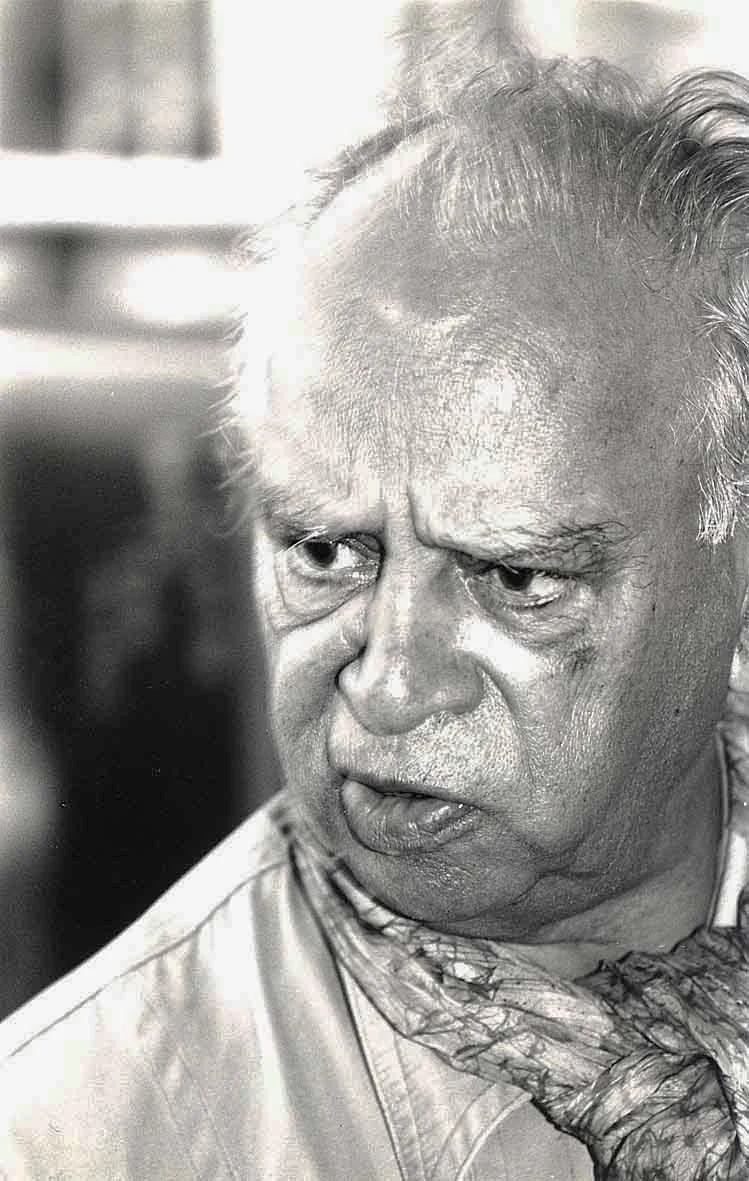
He died in Pune on 28 September 2004. His legacy includes novels that demand attention to degrading labour and caste power, but also editorial work that made art a subject of public inquiry. Reading those strands together reveals both his ambition and the tensions of speaking on behalf of others. The 1982 photograph shown here records the later author; it does not illustrate the fictional world of Bakha.
Quick answers
Frequently asked questions about Mulk Raj Anand
- Was Mulk Raj Anand born in present-day India?
- No. He was born in Peshawar in British India, a city now in Pakistan. His later career is strongly associated with Indian literature and cultural institutions.
- Is Untouchable Anand’s autobiography?
- No. It is a novel about Bakha, a fictional young sweeper. Anand used remembered experience and imaginative construction, but neither the character nor the novel is a literal autobiography.
- What was Anand’s role at Marg?
- He was its founding editor. The arts magazine began in 1946 and developed discussion of architecture, visual and performing arts, heritage and public institutions.
- Which book won him the Sahitya Akademi Award?
- Morning Face received the English-language Sahitya Akademi Award in 1971. He became an Akademi Fellow in 1989.
Keep exploring
Lives connected to this story
- Rabindranath Tagore
Compare an earlier writer’s work across literature, education and the public life of art.
- Satyajit Ray
Consider another artist’s use of specific lives and settings to examine social relations.
- Premchand
Connect socially engaged fiction across Hindi, Urdu and English and the progressive writers’ milieu.
Sources and further reading
Explore the evidence
These references support the biography and offer further reading. Official records, first-person accounts and independent reporting provide different perspectives; image records document attribution and licensing.
- 1. South Asian Britain / University of Bristol and British Library partnershipMulk Raj Anand: life, British networks and bibliography
Read the relevant biographical paragraphs and bibliography. Its 1945 return date differs from Penguin’s 1946; the narrative says after the war and uses the independently catalogued 1946 date for Marg.
- 2. Penguin Random HouseMulk Raj Anand: author biography and novels
- 3. Penguin BooksUntouchable: publisher synopsis and author note
- 4. Mulk Raj Anand / Sahitya AkademiFellowship 1989 acceptance speech: indexed passages
Read indexed passages from the 1989 first-person acceptance speech. The PDF supplied no extractable text and the second screenshot request failed; no complete speech inspection is claimed. Recollections are attributed, not treated as literal proof of each fictional event.
- 5. Sahitya AkademiAkademi Awards: English, Morning Face, 1971
- 6. MargMulk Raj Anand: founder-editor, indexed institutional profile
Direct page was a JavaScript shell; read the indexed founder-editor paragraph. The serial start is separately corroborated by Paris Musées.
- 7. Paris MuséesMārg: A Magazine of the Arts, serial catalogue
- 8. Bianca Cherechés / Indi@logsAn Exploration of the Aesthetics of Dalit Trauma in Untouchable: representation discussion
- 9. Wikimedia Commons / Amarjit Chandan ArchiveMulk Raj Anand photograph: exact rights record
Exact Commons record identifies Amarjit Chandan’s London 1982 photograph, its single supplied upload and CC BY-SA 4.0 permission. The whole frame is retained.