In this biography
Quick facts
- Born
- 14 February 1942
- Birthplace
- Boston, Massachusetts, United States
- Country
- United States
- Nationality
- American
- Known for
- Cofounding Bloomberg L.P., developing its financial-information business, serving three terms as New York City mayor and supporting public-health and education initiatives
- University education
- Johns Hopkins, electrical engineering, 1964; Harvard MBA, 1966
- Company established
- Bloomberg L.P., 1981
- Original colleagues
- Thomas Secunda, Duncan MacMillan and Charles Zegar
- New York City mayor
- 2002–2013, three terms
Why this life matters
Bloomberg connected financial data, software and news in a subscription business used by market professionals. His later career brought business-management methods into city government, alongside substantial philanthropy and contested policing policies.
Timeline
Key moments
Engineering and business education
Graduates from Johns Hopkins in electrical engineering, earns a Harvard MBA and joins Salomon Brothers.
A financial-information business
After leaving Salomon, establishes the business with Thomas Secunda, Duncan MacMillan and Charles Zegar.
News expansion
Bloomberg News extends the company beyond financial data and analytics into a larger journalism operation.
Three mayoral terms
Serves as New York City mayor, with public-health initiatives and major controversy over police stop-and-frisk practices.
Financial-aid gift
Gives Johns Hopkins $1.8 billion for financial aid, supporting need-blind admissions and loan-free aid packages.
Company leadership transition
Vlad Kliatchko is appointed Bloomberg L.P. CEO; the company's later official biography records the completed appointment.
Engineering, business school and Wall Street
Michael Bloomberg was born in Boston on 14 February 1942 and grew up in nearby Medford, Massachusetts. He graduated from Johns Hopkins University in 1964 with a degree in electrical engineering, then earned an MBA at Harvard Business School in 1966. His education combined an understanding of technical systems with formal business training.
He joined Salomon Brothers in 1966. Over time he worked in equity trading and sales and then led information systems. Those assignments exposed him to how financial professionals obtained and used information. His Salomon career ended after its acquisition in 1981. He then began a business aimed at putting financial data and analytical tools directly into customers' daily work.
Building the company with other specialists
Bloomberg established the company in 1981 with Thomas Secunda, Duncan MacMillan and Charles Zegar. Although it carried his name, it was not the invention of one person working alone. The team combined experience in financial markets, computing and the practical information needs of professional customers. Bloomberg's own background spanned both the trading desk and systems management.
The central product brought data and analytics together through a subscription service, later widely known as the Bloomberg Terminal. Instead of selling only a machine, the business supplied continually updated information and tools. Serving that market required maintaining the system and developing customer relationships. The product's usefulness depended on the work behind the screen as well as the interface a subscriber saw.
From market information into news
The company expanded beyond its original financial-information service. Bloomberg News began in 1990, adding a journalism operation to a business already selling market data and analysis. News reporting, television, radio and print later reached audiences outside the terminal's professional subscriber base. The company's identity consequently became both technological and editorial.
These activities were related but not interchangeable. A data service organizes information for customers' decisions; a newsroom also selects stories, verifies claims and explains events. Building both required journalists and editors alongside engineers, sales staff and financial specialists. Bloomberg's role was entrepreneurial and managerial, while the wider organization supplied the reporting and technical expertise. Its growth cannot be reduced to his personal authorship of every product or news report.
City government and the policing controversy
Bloomberg won New York City's 2001 mayoral election and took office on 1 January 2002. He served three terms, through 2013. His administration promoted smoking restrictions, changes in school governance, development and environmental planning. The city faced both the aftermath of the September 2001 attacks and the financial crisis that began in 2008.
His record also includes the serious civil-rights controversy over police stop-and-frisk practices. In August 2013 a federal court found the city liable for constitutional violations involving suspicionless stops and racial profiling. The litigation concerned how the practices were conducted, not a ruling that every lawful police stop was forbidden. The city appealed; the succeeding administration pursued settlement and withdrew the appeals. This was municipal liability, not a personal criminal conviction of Bloomberg.
Returning to business and planning succession
After leaving City Hall, Bloomberg returned to the company while continuing his philanthropic work. The business was no longer the small venture of 1981: its activities included a mature financial-information system and an international media operation. Leadership therefore involved managing an established organization rather than simply extending a founder's original product idea.
In 2023 Vlad Kliatchko was appointed Bloomberg L.P.'s chief executive. He had previously led product, data and engineering, served as chief product officer and headed the engineering organization. The transition brought an experienced internal technology leader into the CEO position. It also separated Michael Bloomberg's continuing association as founder from the day-to-day executive role held by Kliatchko, whom the company identified as CEO in February 2025.
Philanthropy, education and public management
Bloomberg's giving has supported education, public health, the environment, arts and government innovation. Johns Hopkins has been a major recipient. In 2018 he gave the university $1.8 billion for financial aid; the institution says that support enabled permanent need-blind admissions and removed loans from its aid packages. The gift addressed access to education, rather than creating another commercial business.
His philanthropy also supported collaboration with Harvard on city leadership. The Bloomberg Harvard City Leadership Initiative began in 2017, followed by the Bloomberg Center for Cities in 2021. These programs carried his interest in management into training and research for public institutions. They sit alongside, rather than erase, the contested aspects of his mayoralty: philanthropic spending and public accountability remain different parts of his record.
Quick answers
Frequently asked questions about Michael Bloomberg
- Did Michael Bloomberg establish his company alone?
- No. The company's history names Thomas Secunda, Duncan MacMillan and Charles Zegar alongside Bloomberg in its 1981 beginnings. The financial-information system developed through a wider technical and commercial team.
- When was he mayor of New York City?
- He took office on 1 January 2002 and served three terms through 2013. He is a former mayor, not the city's current officeholder.
- Who became Bloomberg L.P.'s CEO in 2023?
- Vlad Kliatchko was appointed CEO in 2023. Bloomberg's own February 2025 event biography confirms the appointment, distinguishing that executive role from Michael Bloomberg's founding association.
- What was the court finding on stop and frisk?
- The 2013 Floyd ruling found New York City liable for constitutional violations in how police stops and frisks were conducted, including racial profiling. It was not a personal criminal conviction of Bloomberg or a blanket prohibition on lawful police stops.
Keep exploring
Lives connected to this story
- Oprah Winfrey
Explore another business career linking ownership, media production and philanthropy.
- Michael Dell
Compare the development of another technology business that depended on customer needs and operating systems beyond its founder.
Sources and further reading
Explore the evidence
These references support the biography and offer further reading. Official records, first-person accounts and independent reporting provide different perspectives; image records document attribution and licensing.
- 1. New York City Global PartnersMichael R. Bloomberg: archived mayoral biography
An archived mayoral biography supports birth, education and historical assignments. Its old present-tense office and company totals are not treated as current, and its favorable policy-outcome claims are not adopted.
- 2. Johns Hopkins UniversityMike Bloomberg to give Johns Hopkins University Commencement address, 14 May 2021
- 3. Harvard Business SchoolMichael R. Bloomberg, MBA 1966: entrepreneurship profile
Institutional retrospective used for MBA, career, news expansion and Harvard programs. Its description of Bloomberg returning as CEO is historical, not evidence of the present officeholder.
- 4. Bloomberg L.P.Sobre a Bloomberg: company history
The official Portuguese-language company history names the three original colleagues; only the relevant historical passage is used, not its undated subscriber totals or promotional claims.
- 5. New York City Department of Citywide Administrative ServicesMayors of the City of New York: historical office dates
- 6. Mike BloombergMike's Story: personal retrospective
- 7. U.S. Court of Appeals for the Second Circuit / JustiaFloyd v. City of New York, 31 October 2014: opinion background and disposition
The reproduced court opinion's background and disposition were read, distinguishing the 2013 liability ruling from 2014 appeal and settlement procedure. No complete trial record or PDF review is claimed.
- 8. Bloomberg EventsResponsible AI event, 10 February 2025: Vlad Kliatchko biography
The dated February 2025 company event biography explicitly records Kliatchko's 2023 CEO appointment; no current board-chair title is assigned to Mark Carney.
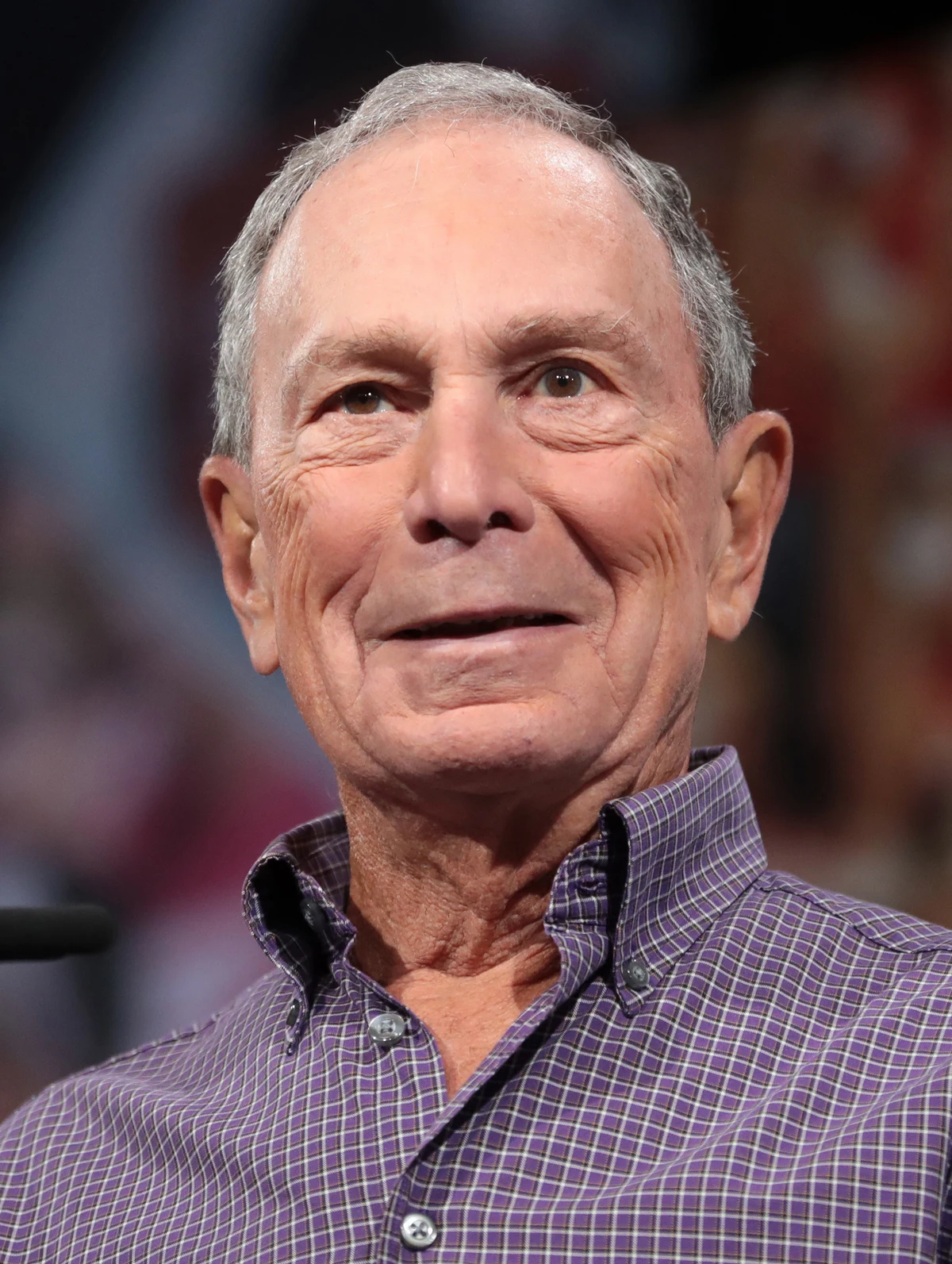
- 9. Gage Skidmore / Wikimedia CommonsMichael Bloomberg by Gage Skidmore: original photograph and upload history
The supplied file restores the initial 2047 by 2718 photographer composition after intervening third-party crops. The restored full frame, not a cropped derivative, is used under the author's CC BY-SA 3.0 grant.