In this biography
Quick facts
- Born
- 18 September 1973
- Birthplace
- Welkom, South Africa
- Country
- South Africa
- Nationality
- Not independently established
- Known for
- Building Thawte’s certificate business and supporting Ubuntu through a company and wider developer community
- Early company
- Thawte Consulting, founded in 1995
- Acquisition sequence
- Announced in 1999; completed in February 2000
- Foundation
- Shuttleworth Foundation, begun in 2001
- Software milestone
- First Ubuntu release, October 2004
Why this life matters
His career links a South African software export business with the challenge of sustaining a globally shared open-source platform commercially.
Timeline
Key moments
Born in Welkom
Later studies business science at the University of Cape Town.
Thawte
Student-era consulting develops into an Internet certificate enterprise.
A share-based sale
VeriSign announces the acquisition and subsequently completes it.
Foundation and spaceflight
Starts the foundation and later participates in a Soyuz visiting mission to the ISS.
Canonical and Ubuntu
A developer team creates a distribution backed by a commercial organisation.
Exchange-control judgment
The Constitutional Court overturns his appellate victory over an exit charge.
Continuing software leadership
Canonical’s dated account identifies him as CEO; Ubuntu also describes shared community governance.
A Cape Town education led into a specialised Internet business
Mark Richard Shuttleworth was born in Welkom on 18 September 1973. At the University of Cape Town he studied business science, combining financial interests with computing. Contemporary reporting describes technology consulting while he was still a student, rather than a fully formed global company appearing suddenly at the point of sale.
Thawte began in 1995 and narrowed its activity towards security for electronic commerce. Its Cape Town-area operation offered digital certificates used to identify websites and software publishers. This was a specialised service within an expanding Internet economy, not the invention of the Internet or a claim that certificates made every online activity safe.
Foundation work and spaceflight opened different paths
He started the Shuttleworth Foundation in 2001. Its account describes a social-investment approach supporting people working on change and an emphasis on open knowledge. A foundation’s stated model is distinct from the commercial certificate business, and from proof that every funded initiative achieved its intended result.
In April 2002 he travelled to the International Space Station on a Soyuz visiting mission. That highly visible episode expanded public interest in a businessman previously associated with Internet security. It was a separate undertaking, requiring preparation and an international spaceflight programme, not an achievement delivered by Thawte’s normal operations.
Ubuntu needed a business and a community, not a solitary inventor
In 2004 Shuttleworth gathered Debian developers around the project that became Ubuntu, with Canonical providing a commercial organisation. The first official release followed that October. Ubuntu built on existing free software and collective expertise; founding and financing the project did not mean personally creating the Linux kernel or all its components.
In a 2006 interview he emphasised sustainability rather than declaring the project finished. Ubuntu’s own later account describes commercial support alongside volunteer governance. Canonical’s February 2026 material identifies him as CEO. The company and the wider project are connected, but their contributors and responsibilities are not identical.
The exchange-control dispute ended with a different result on final appeal
Shuttleworth challenged an exit charge imposed when transferring capital from South Africa. Although he won in the Supreme Court of Appeal, the Constitutional Court reversed that result on 18 June 2015. It upheld the main appeal and dismissed his application and cross-appeal, treating the charge as regulatory rather than a tax requiring the process he argued was necessary.
The case concerned the legality of an exchange-control mechanism, not a criminal conviction. It also shows why an intermediate court victory cannot be presented as the final outcome. Across enterprise, open-source work and philanthropy, his career combines unusual personal freedom with institutions whose decisions remain subject to commercial, communal and legal scrutiny.
Quick answers
Frequently asked questions about Mark Shuttleworth
- Did the Thawte deal close in 1999?
- It was announced in 1999; VeriSign’s later note records completion on 1 February 2000.
- Did Shuttleworth invent Linux?
- No. Ubuntu drew on existing free software and a developer community, with Canonical supplying a commercial organisation.
- Is the foundation the same as Canonical?
- No. The foundation’s social-investment work and the software company have separate purposes and histories.
- Did his exchange-control victory survive final appeal?
- No. The Constitutional Court reversed the appellate result in June 2015 and dismissed his application.
Keep exploring
Lives connected to this story
- Nicky Oppenheimer
Compare a founder’s technology-company sale with a family’s exit from an established industrial shareholding.
Sources and further reading
Explore the evidence
These references support the biography and offer further reading. Official records, first-person accounts and independent reporting provide different perspectives; image records document attribution and licensing.
- 1. Czech Academy of Sciences Library, SPACE.40Indexed named astronaut record: Mark Richard Shuttleworth, birth date and Welkom; direct page unavailable
Named institutional record read through its indexed entry; direct page unavailable. Degree year is not asserted where selected accounts differ.
- 2. IOL / Business Report22 December 1999: Welkom, university subjects, consulting and Cape Town operating base; erroneous Linux-as-language description excluded
- 3. Nicola Davies / News2415 March 2002: selected student-enterprise and certificate-business account; wealth and exact graduation year excluded
- 4. Microsoft10 May 1999: actual separate VeriSign and Thawte certificate offerings for Office/VBA code signing
- 5. Steven Liversedge / InternetNews23 December 1999: announced stock deal, international customers and founder’s proposed transition
- 6. VeriSign1999 annual filing, indexed subsequent-event passage: proposed $575 million share consideration and conditions
- 7. VeriSign2001 annual report, indexed printed page 85 acquisition note: 1 February 2000, shares and purchase accounting
Selected indexed acquisition note, not the entire annual report. Stock transaction value and later accounting allocation are distinct measures.
- 8. Shuttleworth FoundationActual about page: 2001 beginning and open-philanthropy model, not evaluated social-impact results
- 9. NASAISS guide, indexed Soyuz mission table: TM-34 launch with Shuttleworth in April 2002; spacecraft duration not treated as his stay
- 10. Ubuntu / CanonicalProject history and governance: 2004 developer team, first release, commercial support and volunteer responsibilities
- 11. Tony Mobily / Free Software Magazine20 February 2006 interview: technical recollection and sustainability goal, not the interviewer’s exaggerated first-provider claim
- 12. Canonical6 February 2026 named CEO reference in hiring account, not endorsement of every hiring practice
- 13. Constitutional Court of South Africa / SAFLII2015 ZACC17, actual indexed order, summary and selected background paragraphs; no full docket claimed read
Actual indexed order, summary and selected background read despite direct access 403; intermediate appellate victory not mistaken for final outcome.
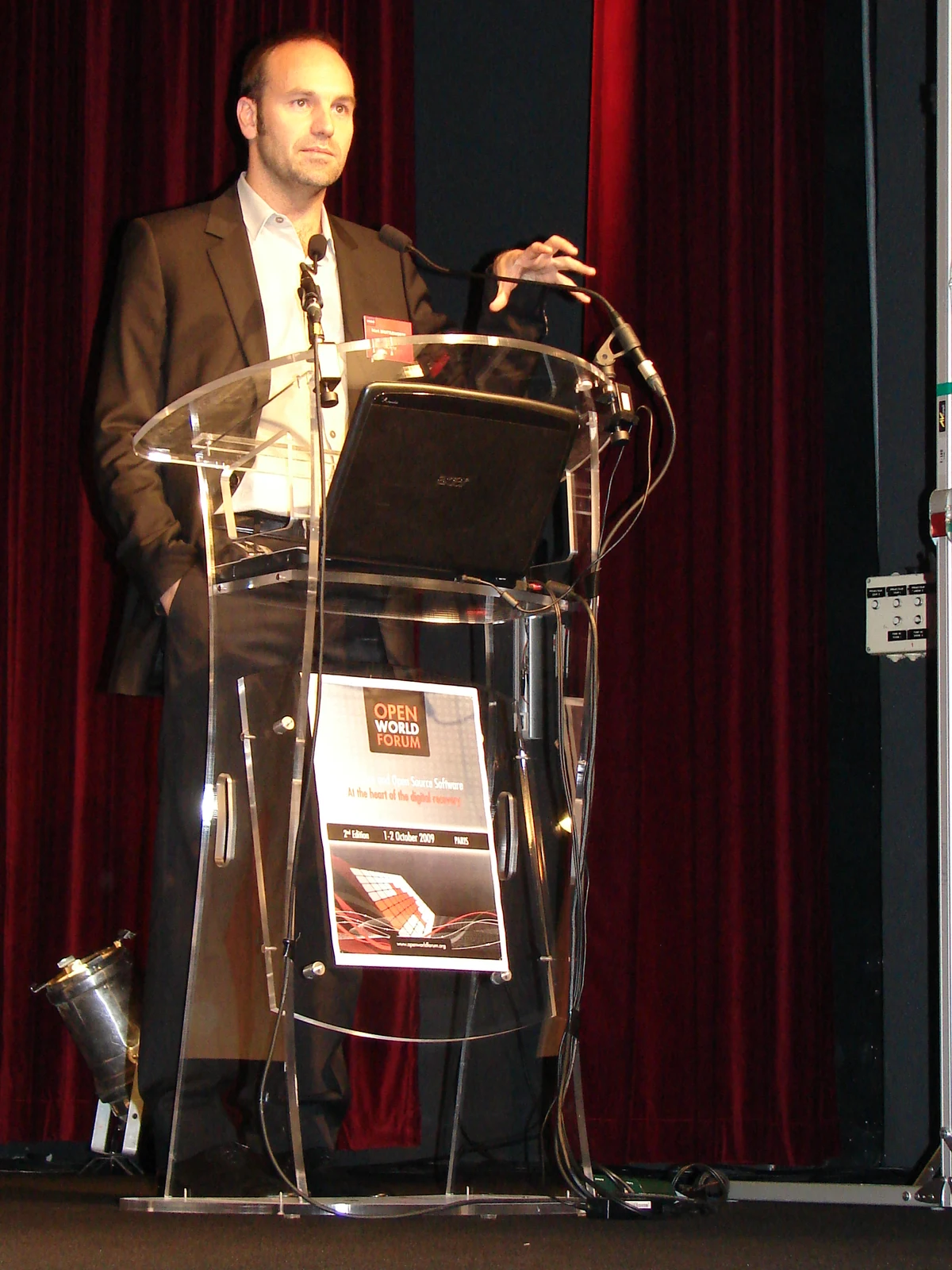
- 14. Eurobas / Wikimedia CommonsOwn-work full Open World Forum photograph and explicit copyright-holder commercial-compatible grant
Exact Eurobas own-work declaration and complete sole binary version. Original camera clock conflicts with dated caption/poster; no resolved exact capture time or unavailable first text-revision ID invented.
- 15. Creative CommonsAttribution-ShareAlike 3.0 Unported