
In this biography
Quick facts
- Born
- 1936
- Died
- 30 September 2026
- Birthplace
- Paoli, Indiana, United States
- Country
- United States
- Nationality
- Not independently established
- Known for
- Leadership of Apollo onboard flight-software work and systems-engineering methods
- Earned degree
- BA mathematics, Earlham, 1958
- Apollo work
- MIT Instrumentation Laboratory software leadership
- Companies
- Higher Order Software; Hamilton Technologies
- Medal of Freedom
- 2016
Why this life matters
Margaret Hamilton led an MIT Instrumentation Laboratory software division working on Apollo flight systems. Her career made the organisation, checking and reliability of software visible as engineering work, alongside the contributions of a large mission team.
Timeline
Key moments
Birth
Born in Paoli, Indiana; year retained without an unverified full birth date.
Earlham degree
Completed mathematics with a philosophy minor.
Apollo 11
Her software team contributed to the mission systems.
Higher Order Software
Founded an engineering company.
Hamilton Technologies
Established another systems-methodology company.
Medal of Freedom
Received the presidential honour on 22 November.
Honorary doctorate
Earlham awarded an honorary Doctor of Science.
Death
Died on 30 September.
Mathematics at Earlham and a move into computing
Margaret Hamilton was born in 1936 in Paoli, Indiana. Earlham College records her 1958 bachelor’s degree in mathematics with a philosophy minor. The honorary Doctor of Science it awarded in May 2025 was a later honour, not an earned research doctorate. After moving to Massachusetts, she entered computing through scientific work at MIT. Her early experience included weather research associated with Edward Lorenz and the SAGE air-defence project. Those settings brought programming into contact with physical systems, operational requirements and the consequences of mistakes.
Apollo software was a team responsibility
At MIT’s Instrumentation Laboratory, Hamilton led a division responsible for work on the Apollo command and lunar modules’ onboard software. NASA’s account places that effort within the laboratory’s Apollo guidance contract, awarded in 1961. Mission software had to work with navigation instruments, the computer, astronauts and ground controllers. Hamilton’s leadership is a substantial contribution without making her the sole author of the programs. Requirements, coding, checking and operation involved many people, and the finished flight system cannot be assigned to one celebrated photograph.
Reliability mattered during a changing mission
Software in a crewed spacecraft had to handle competing work and unexpected conditions. NASA’s history of the Apollo 11 landing describes the 1202 and 1201 program alarms and the controllers’ decision to continue. These alarms are part of a broader engineering history involving computer resources, executive behaviour, flight procedures and ground judgement. They do not establish that Hamilton personally wrote every recovery mechanism or alone saved the landing. Her career helps explain why designing, testing and managing software became recognised as engineering responsibilities with operational consequences.
What the familiar photograph actually shows
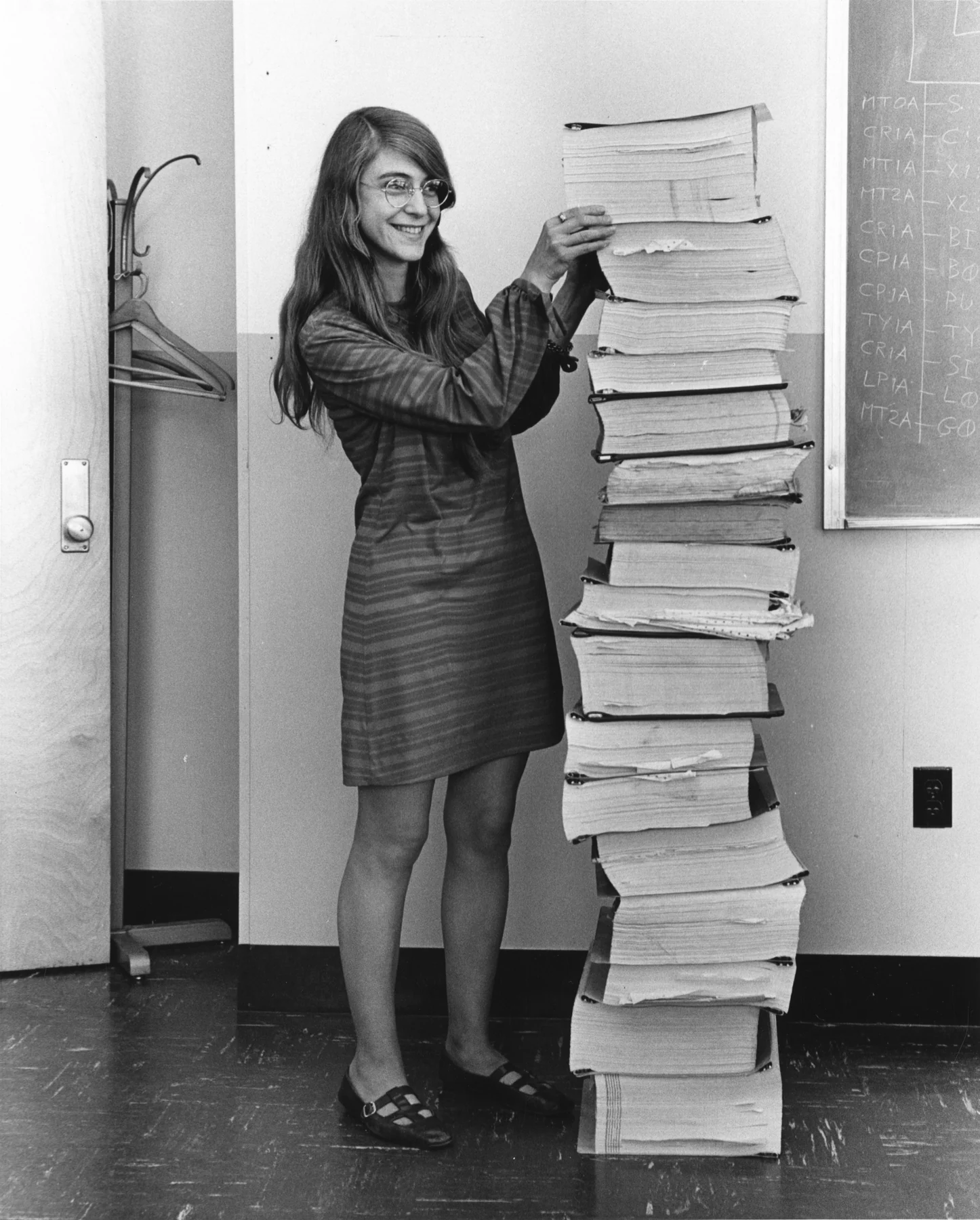
A 1969 photograph shows Hamilton beside a tall stack of software listings. NASA identifies the listings as work by her and the command- and lunar-module team, rather than a pile written entirely by one person. It also identifies the photographer as an MIT staff member who later worked for Draper. That provenance matters: an image displayed on a NASA page is not automatically a photograph made by a federal employee. The portrait used here follows the separate public reuse record supplied with the Draper version.
Sources for this section: [3]
Companies, methods and national recognition
Hamilton carried her systems interests into entrepreneurship. MIT’s memorial dates Higher Order Software to 1976 and Hamilton Technologies to 1986. The latter developed a methodology associated with Universal Systems Language. Statements about such methods need to be kept distinct from an independently demonstrated guarantee that all software errors can be eliminated. On 22 November 2016 she received the Presidential Medal of Freedom. The White House’s science-and-technology account placed her alongside other recipients while identifying her own Apollo software contribution.
A completed life and a continuing engineering lesson
Hamilton died on 30 September 2026 at the age of ninety, as reported by MIT and Earlham in October. Her biography therefore uses a completed life span, rather than carrying forward an outdated living-person introduction. The strongest lesson of her work is practical: software must be designed as part of the system it controls, with checking, priorities and responsibility made explicit. That interpretation keeps the engineering work visible while preserving the team credit, degree distinctions and historical dates supported by the institutional records.
Quick answers
Frequently asked questions about Margaret Hamilton
- Who was Margaret Hamilton?
- Margaret Hamilton was a software engineer, Apollo team leader and entrepreneur. Margaret Hamilton led an MIT Instrumentation Laboratory software division working on Apollo flight systems. Her career made the organisation, checking and reliability of software visible as engineering work, alongside the contributions of a large mission team.
- What is Margaret Hamilton best known for?
- Margaret Hamilton is best known for leadership of Apollo onboard flight-software work and systems-engineering methods.
- When and where was Margaret Hamilton born?
- Margaret Hamilton was born in 1936 in Paoli, Indiana, United States.
- When did Margaret Hamilton die?
- Margaret Hamilton died on 30 September 2026.
Keep exploring
Lives connected to this story
- Frances Allen
Compare systems reliability with a different research programme in program analysis.
- Grace Hopper
Explore another computing pioneer’s language and software work without assigning either woman the other’s contributions.
Sources and further reading
Explore the evidence
These references support the biography and offer further reading. Official records, first-person accounts and independent reporting provide different perspectives; image records document attribution and licensing.