In this biography
Quick facts
- Born
- Not independently verified
- Birthplace
- Not independently established
- Country
- Myanmar
- Nationality
- Burmese
- Known for
- Cultural and culinary writing, the memoir Nor Iron Bars a Cage and English translation
- Birth details
- Not independently established in the checked sources
- Creative background
- Painting, followed by cultural writing and translation
- Political involvement
- Joined the 1988 movement and assisted Aung San Suu Kyi
- Imprisonment
- July 1989–1992, according to her 2008 interview
- Memoir
- Nor Iron Bars a Cage (2013)
- Translation
- A Man Like Him, by Journal Kyaw Ma Ma Lay; English edition, 2008
Why this life matters
Her books connect cultural observation with personal memory and translation, while her political testimony offers a distinct, sometimes contested perspective rather than one voice for all Myanmar experiences.
Timeline
Key moments
Democracy movement
Joins the movement and assists Aung San Suu Kyi.
Imprisonment
Her testimony dates detention from July 1989 and release to 1992.
Personal assistance and disagreement
Describes helping with personal errands after Suu Kyi’s release, followed by political differences.
Cultural nonfiction
Institutional biography lists Myanmar Architecture: Cities of Gold (2005) and Defiled on the Ayeyarwaddy (2010).
English translation
Cornell’s edition of Journal Kyaw Ma Ma Lay’s A Man Like Him appears.
Memoir and cookbook
Nor Iron Bars a Cage and Ginger Salad and Water Wafers document different aspects of her experience and interests.
Painting and the move into cultural writing
Ma Thanegi’s creative background includes painting as well as writing. In a 2008 interview she recalled entering the democracy movement as an artist who had previously taken little interest in politics. Later institutional and publisher biographies describe a body of English-language work concerned with Myanmar’s art, architecture, journeys and everyday customs.
Her books therefore cannot be reduced to political commentary alone. The Guggenheim contributor biography identifies Myanmar Architecture: Cities of Gold, published in 2005, and Defiled on the Ayeyarwaddy, published in 2010. These are cultural and travel-related works, distinct from both her prison memoir and the books she translated for other authors.
The 1988 movement, imprisonment and political differences
She joined the 1988 democracy movement and helped Aung San Suu Kyi with calls, meeting notes and travel. In her account, this was personal assistance rather than a claim to have held every organisational role within the National League for Democracy. Her imprisonment began in July 1989; she was released in 1992.
She also described helping with personal errands after Suu Kyi’s 1995 release from house arrest, before disagreements over political strategy and sanctions became public. Her opposition to economic isolation is her stated position, not an established verdict on the effects of every sanction. Likewise, her recollections of women’s prison conditions should not be generalised to all prisoners or used to dismiss other testimony.
Food, travel and collaborative bookmaking
Ginger Salad and Water Wafers, published by ThingsAsian Press in 2013, presents 101 recipes and a glossary of ingredients. It connects cooking with social experience: the publisher describes recipes she had enjoyed with friends, rather than presenting Myanmar cuisine as an abstract list of national dishes.
The division of work is explicit. Ma Thanegi wrote the text, while Tiffany Wan supplied the photographs. Reported conversations about food and friendship also place the writing within a lived cultural environment. A cookbook, a travel narrative and a book about architecture offer different ways of observing a country; they are not interchangeable titles for one autobiography.
Prison memoir and the work of translation
Nor Iron Bars a Cage appeared in 2013. A contemporary newspaper review describes its attention to the women who shared her prison life, bringing collective routines and individual relationships into an account based on her own experience. The memoir’s publication came long after the detention it describes.
Her translation work serves another purpose: making an earlier Burmese writer available to English-language readers. Cornell’s 2008 edition of A Man Like Him names Journal Kyaw Ma Ma Lay as author and Ma Thanegi as translator. It concerns the journalist Journal Kyaw U Chit Maung, not Thanegi’s own life. That distinction preserves both the original writer’s authorship and the translator’s contribution.
Quick answers
Frequently asked questions about Ma Thanegi
- What does Ma Thanegi write about?
- Her work covers Myanmar’s food, travel, art, architecture and everyday culture, as well as her experience of imprisonment.
- Did Ma Thanegi work for Aung San Suu Kyi?
- Yes. Her 2008 interview describes personal-assistant work before her July 1989 imprisonment and personal errands after Suu Kyi’s release in 1995.
- What is Ma Thanegi’s prison memoir?
- Nor Iron Bars a Cage, published in 2013, draws on her imprisonment and the women who shared it.
- Did Ma Thanegi write A Man Like Him?
- She translated the English edition published in 2008. Its original author is Journal Kyaw Ma Ma Lay; the subject is journalist Journal Kyaw U Chit Maung.
Keep exploring
Lives connected to this story
- Ma Thida
Compare a different Myanmar writer’s separate prison experience and literary work; the two authors are not namesakes to merge.
- Journal Kyaw Ma Ma Lay
Read about the original author of A Man Like Him, whose work Ma Thanegi translated into English.
- Kin Maung Yin
Explore the separate career of a Burmese painter known for modernist experimentation.
Sources and further reading
Explore the evidence
These references support the biography and offer further reading. Official records, first-person accounts and independent reporting provide different perspectives; image records document attribution and licensing.
- 1. New Mandala · Stanley Weiss interview, 2 March 2008Firsthand political involvement, personal assistance, detention and disagreements
Personal recollections and sanctions arguments are attributed to Ma Thanegi. Neither her prison experience nor her political views are treated as representative of all prisoners or all opposition groups.
- 2. AFAR · reported interview, 20 September 2012Painting, food writing, imprisonment and cultural conversation
Historical ages do not establish an exact birthday. No unverified birth date, birthplace, academic qualification or current age is inferred.
- 3. Guggenheim · contributor biographyCultural nonfiction and the separate 2005/2010 books
The contributor biography was available as indexed institutional text; direct opening returned the JavaScript application shell. Historical residence/editorial roles are not asserted as current appointments.
- 4. ThingsAsian Press · publisher catalogue2013 cookbook, 101 recipes and Tiffany Wan’s photography credit
- 5. Cornell University Press / JSTOR · 2008 editionA Man Like Him: original author and English translator
Journal Kyaw Ma Ma Lay is the original author, Ma Thanegi the translator, and Journal Kyaw U Chit Maung the biographical subject. These three people are not conflated.
- 6. Myanmar Times · 4 October 2013 edition, page 46Contemporary review of Nor Iron Bars a Cage; preserved newspaper PDF
- 7. Wikimedia Commons · original photograph and rights recordIdentified full supplied frame, creator and reuse terms
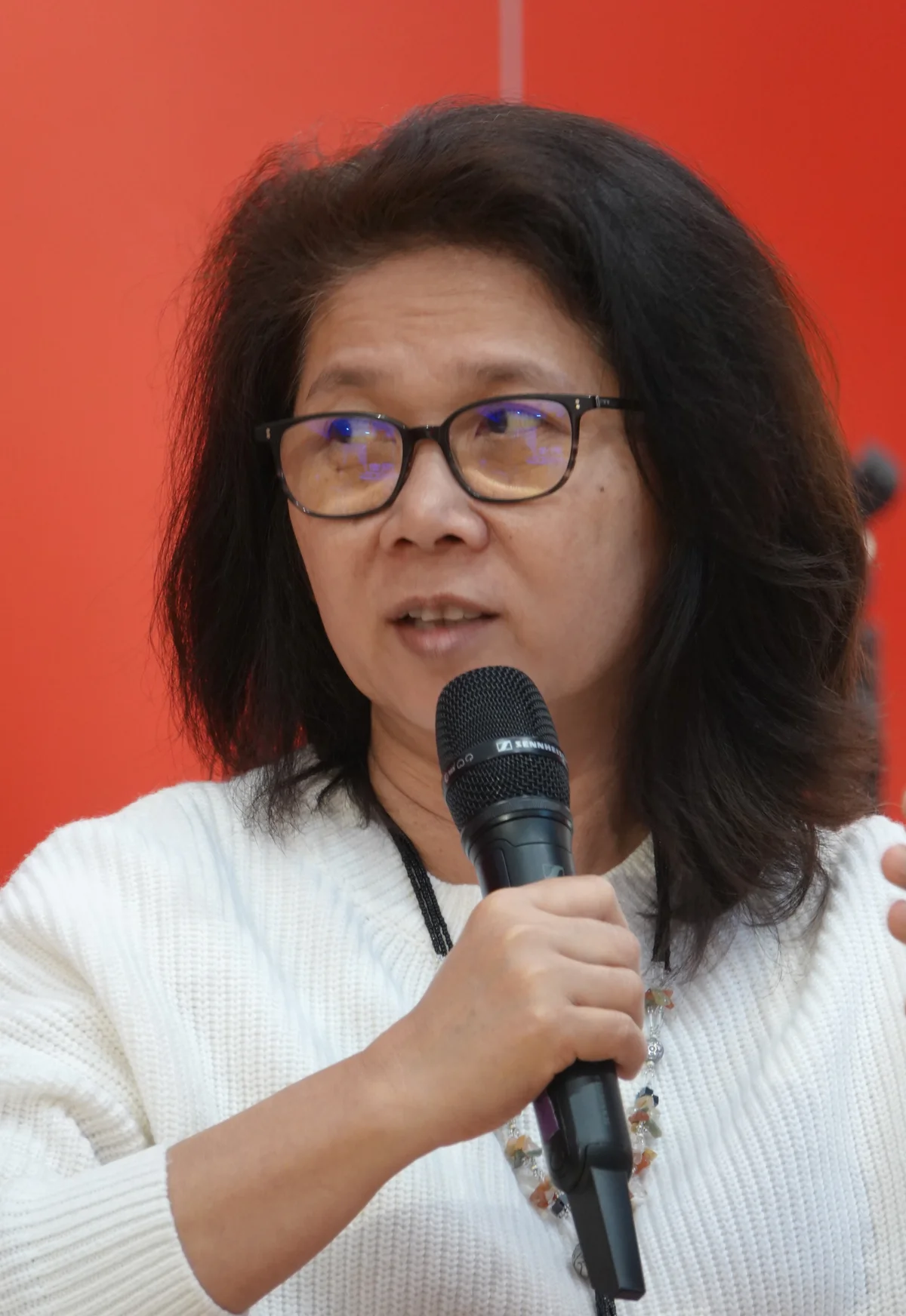
The festival description and Nikon metadata both name photographer Anggara Mahendra. Raw pixels are 4928 × 3264 with EXIF orientation 8; rotating to the intended portrait view preserves the complete 3264 × 4928 display frame. The correct source is the official Ubud Writers Festival Flickr record, not a guessed account path.