In this biography
Quick facts
- Born
- 15 March 1944
- Died
- 28 June 2024
- Birthplace
- Kampot Province, Cambodia
- Country
- Cambodia
- Nationality
- Cambodian
- Known for
- Mastery and transmission of Cambodia’s sung storytelling tradition and the 2017 Fukuoka Arts and Culture Prize
- Birth
- 15 March 1944, Kampot Province
- Musical teacher
- His uncle; lessons began in 1957
- Ministry service
- Performer, 1991–2007
- Living Arts teaching
- 2003–2012
- International award
- Fukuoka Arts and Culture Prize, 2017
- Death
- 28 June 2024
Why this life matters
His career connects cultural survival and rebuilding with chapei’s continuing ability to address public affairs and reach new musical audiences.
Timeline
Key moments
Birth
Born on 15 March in Kampot Province.
Apprenticeship and performance
Began lessons with his uncle in 1957; first village performance recorded in 1959.
Culture ministry work
Performed as a civil servant with the Ministry of Culture and Fine Arts.
Training musicians
Taught through Cambodian Living Arts.
Tradition recognised
Chapei Dang Veng entered UNESCO’s Urgent Safeguarding List, not as a personal award.
Fukuoka prize
Received the Arts and Culture Prize.
Time to Rise
Appeared with VannDa on the song.
Death
Died on 28 June, confirmed by the prize organisation’s obituary.
Early life and a musical apprenticeship
Kong Nay was born on 15 March 1944 in Kampot Province, Cambodia. He lost his sight at four after contracting smallpox. Fukuoka’s official career record identifies his uncle as his musical teacher: lessons began in 1957, when Kong Nay was thirteen, and included the Cambodian epic Reamker.
His first village performance as an artist is dated to 1959. This was an apprenticeship in technique, poetry and storytelling, not simply learning to hold an instrument. His disability forms part of the biographical record but is not a substitute for explaining the practice and knowledge behind his artistic achievement.
Sources for this section: [2]
The expressive world of chapei
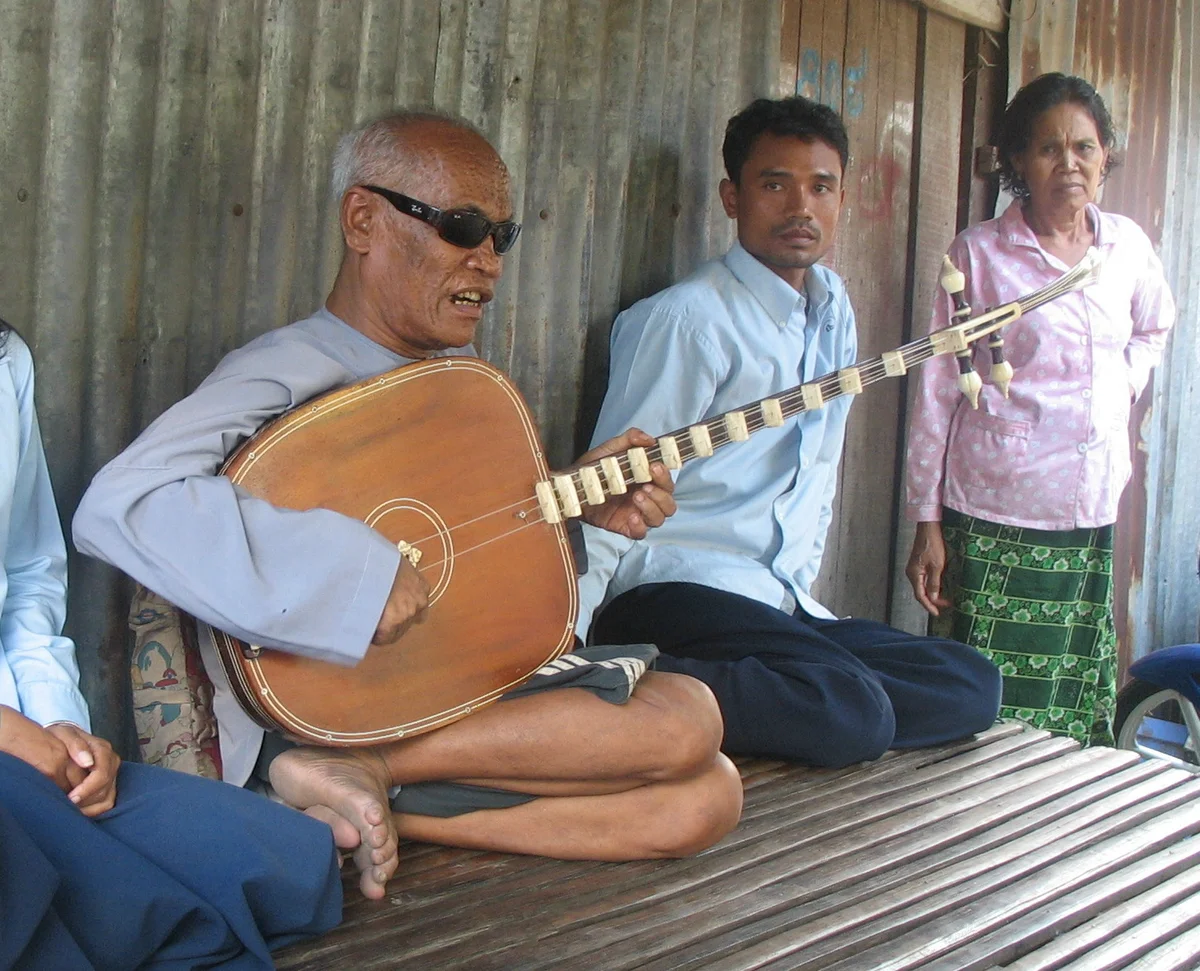
Chapei dang veng combines a long-necked lute with singing. Its repertoire includes traditional poetry, folktales, Buddhist stories, education, satire and commentary on contemporary affairs. UNESCO’s account emphasises the combination of musical ability, wit, improvisation and storytelling required of a performer.
Kong Nay’s significance lay in his command of that expressive tradition. His performances joined inherited material with newly composed and improvised songs, allowing entertainment and cultural knowledge to move together. Describing him as a Cambodian bard and chapei master is more informative than making a foreign musician’s nickname the main explanation of his work.
Cultural rebuilding and teaching
Fukuoka’s citation records that Kong Nay survived the Khmer Rouge era and resumed performing amid continuing conflict. He won chapei competitions, including one in Phnom Penh in 1991. From 1991 to 2007, he worked as a performer with Cambodia’s Ministry of Culture and Fine Arts.
He trained musicians through Cambodian Living Arts from 2003 to 2012. Its 2014–2015 annual report also names him on the board of the Community of Living Chapei. Younger performers developed demonstrations, teaching and independent troupe management, connecting his own performance experience with efforts to sustain the art beyond one celebrated musician.
New audiences and a continuing tradition
Kong Nay’s later work reached beyond conventional performance settings. UNESCO documented his public-health songs about handwashing and distancing during COVID-19. His appearance with VannDa on Time to Rise in 2021 connected chapei with a younger musical audience, demonstrating its continuing capacity for public communication.
The tradition entered UNESCO’s Urgent Safeguarding List in 2016; that was recognition of chapei, not a personal UNESCO award. Kong Nay received the Fukuoka Arts and Culture Prize in 2017 and was recognised as a Living Human Treasure. He died on 28 June 2024, as confirmed by the prize organisation’s obituary.
Quick answers
Frequently asked questions about Kong Nay
- What instrument did Kong Nay play?
- The chapei dang veng, a Cambodian long-necked lute, which he played while singing.
- Who taught Kong Nay?
- His uncle. Fukuoka’s official career record dates the beginning of his instruction to 1957.
- Did he receive a personal UNESCO award in 2016?
- The 2016 inscription concerned the Cambodian musical tradition on UNESCO’s Urgent Safeguarding List, not a personal award to Kong Nay.
- When did Kong Nay die?
- He died on 28 June 2024, confirmed by the Fukuoka Prize organisation’s obituary.
Keep exploring
Lives connected to this story
- Arn Chorn-Pond
Read about Cambodian Living Arts and another musician’s different role in cultural recovery.
- Sinn Sisamouth
Compare another Cambodian musical career while distinguishing popular song from chapei storytelling.
Sources and further reading
Explore the evidence
These references support the biography and offer further reading. Official records, first-person accounts and independent reporting provide different perspectives; image records document attribution and licensing.
- 1. Fukuoka Prize · laureate citationMusical career, rebuilding and 2017 Arts and Culture Prize
The 2017 award was Fukuoka’s Arts and Culture Prize, not a Ramon Magsaysay Award.
- 2. Fukuoka Prize · official career recordExplicit birth date/place, uncle’s lessons and ministry/teaching dates
The teacher was his uncle, not his father. The 2001 Master of Chapey certification and 2007 cultural decoration are different recognitions; no guessed Living Human Treasure conferral year is added.
- 3. Fukuoka Prize · obituary28 June 2024 death
- 4. UNESCO · Chapei Dang VengTradition and 2016 safeguarding inscription
The 2016 listing recognises the tradition and its safeguarding needs; it is not a personal award or proof that transmission challenges were solved.
- 5. UNESCO · living heritage and COVID-19Kong Nay’s public-health songs
- 6. Cambodian Living Arts · 2014–2015 reportCommunity of Living Chapei board and younger performers
- 7. UC Davis · Cambodian American studiesVannDa collaboration and 2021 Time to Rise
- 8. Cambodia government report via UNESCOKong Nai spelling and Living Human Treasure recognition
The government report uses Kong Nai and identifies Living Human Treasure status. That variant is retained for search without creating another person record.
- 9. Wikimedia Commons · n ole7 June 2007 photograph with reviewed Flickr licence
The original Flickr account is 53658861@N00, displayed as n ole and reviewed as naole. The complete group photograph, including his instrument, is retained rather than newly cropped.