In this biography
Quick facts
- Born
- 9 October 1940
- Died
- 8 December 1980
- Birthplace
- Liverpool, England
- Country
- United Kingdom
- Nationality
- English
- Known for
- The Beatles, the Lennon–McCartney partnership, Plastic Ono Band, Imagine and peace campaigns with Yoko Ono
- Early group
- The Quarrymen, which developed into the Beatles
- Songwriting partnership
- Lennon–McCartney
- Imagine album
- US release 9 September 1971; UK release 8 October 1971
- Creative partner
- Yoko Ono: recordings, films, art and peace campaigns
Why this life matters
His voice and writing helped expand popular music’s subjects and studio possibilities, through partnerships whose creative achievements coexist with a complicated personal history.
Timeline
Key moments
Born in Liverpool
John Winston Lennon was born on 9 October to Julia and Alfred Lennon.
Music and art school
He met Paul McCartney in 1957 and entered Liverpool College of Art. His mother Julia died in 1958.
Family and international fame
Ringo Starr joined the Beatles in 1962, the year Lennon married Cynthia Powell. Julian was born in 1963; In His Own Write appeared in 1964.
Work and campaigns with Ono
Lennon and Yoko Ono married and used the Bed-In events and other public projects to campaign for peace.
Two major solo albums
John Lennon/Plastic Ono Band appeared in 1970, followed by Imagine in 1971; Lennon moved to New York in the early 1970s.
A break and a return
After Sean’s birth in 1975, Lennon stepped back from public music-making. He and Ono released Double Fantasy in November 1980.
Killed in New York
Lennon was shot outside the Dakota building on 8 December and died that evening, aged forty.
Liverpool, family and the beginnings of a partnership
John Winston Lennon was born in Liverpool on 9 October 1940 to Julia and Alfred Lennon. Following his parents’ separation, he lived at Mendips with his aunt Mimi Smith and her husband George from 1946. Julia remained in his life until she was killed by a car in July 1958. The National Trust’s account describes a stable home with Mimi alongside this family disruption. Neither a story of unbroken deprivation nor one of effortless security captures those circumstances.
In 1957 Lennon met Paul McCartney at the church fête where the Quarrymen were playing. Their shared enthusiasm became a working relationship: learning songs, testing ideas and composing in their Liverpool homes. Lennon also entered the College of Art, where his friendships included Stuart Sutcliffe and Cynthia Powell. Music developed within a wider interest in drawing, wordplay and performance, rather than replacing an otherwise empty creative life.
Marriage, collaboration and public protest
Lennon married Cynthia Powell in August 1962, and their son Julian was born the following year. The National Portrait Gallery’s account of their family portrait describes the pressure of touring, secrecy and his drug use on the marriage. It supplies a corrective to the apparently harmonious domestic scene staged for the camera. Public images, whether a family photograph or a peace campaign, need to be read with their circumstances in view.
His partnership with the artist Yoko Ono brought experimental recordings, films and public events into the same field of activity. They married in 1969 and used the Amsterdam Bed-In to discuss nonviolent protest with reporters. Ono was an established artist and an active collaborator, not simply the subject of his songs. Their work joined the attention available to a famous musician to forms of conceptual art, with the audience and the reporting becoming part of the event.
Solo records and a life in New York
John Lennon/Plastic Ono Band appeared in 1970, followed by Imagine in 1971. These records offer different settings for direct emotional address: the former’s exposed performances and the latter’s fuller arrangements are related choices, not a simple progression from difficult music to a single peace anthem. Imagine includes intimate uncertainty and anger as well as the title song. It was produced by Lennon, Ono and Phil Spector, with significant contributions from its players and arrangers.
Lennon moved to New York in the early 1970s. His subsequent recordings continued alongside political activity and changes in his family life. After Sean’s birth in 1975 he withdrew from regular public music-making for several years. Double Fantasy, released in November 1980, presented new work by both Lennon and Ono. His later American residence is part of an English musician’s transatlantic history; it does not change his Liverpool birthplace or erase the collaborative British career that preceded it.
Personal accountability and the work that survives
The peace campaigner’s public commitments must be considered alongside his conduct. In his 1980 interview with David Sheff, Lennon acknowledged violence towards women and described regretting it. That is an attributed admission, not a licence to diagnose him or invent episodes. It also does not establish that his account of having changed resolves the experiences of others. The tension belongs in his biography without turning either his music or his victims into a device for a simple redemption story.
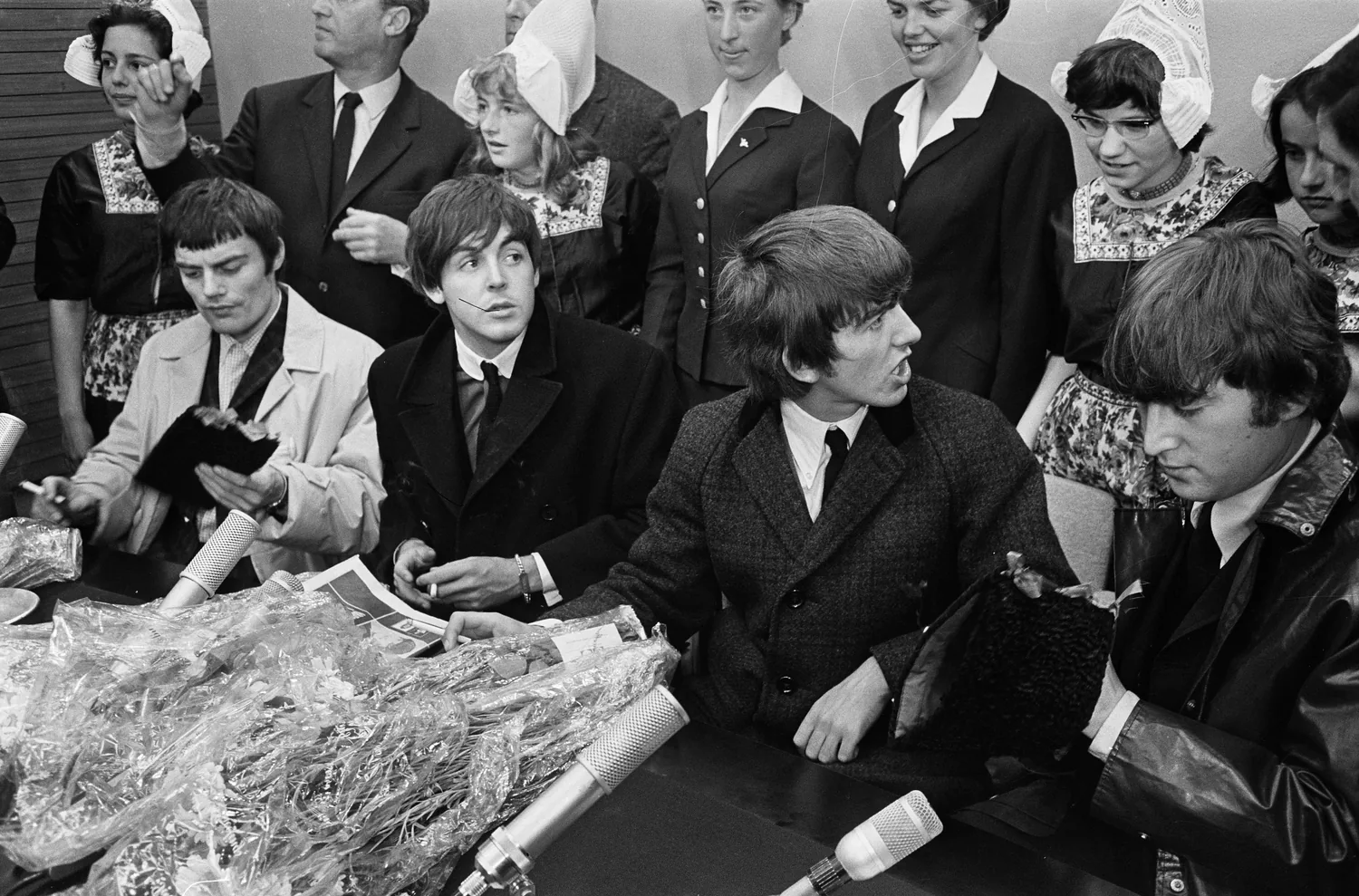
Lennon was shot outside his New York home on 8 December 1980 and died aged forty. Memorialisation has often made him a symbol of peace, but the surviving work offers more than one symbolic role: singer, inventive collaborator, satirist and argumentative public figure. Reading credits, interviews and contemporary images separately helps preserve that complexity. The photograph here records a 1964 group press conference, with Lennon at the far right, years before the solo recording sessions associated with Imagine.
Quick answers
Frequently asked questions about John Lennon
- Was John Lennon English or American?
- He was English, born in Liverpool. He lived in New York during the 1970s and died there in 1980; that later residence forms part of his transatlantic life.
- Did John Lennon write the Beatles’ songs alone?
- No. His partnership with Paul McCartney was central, and the Beatles’ recordings also depended on George Harrison, Ringo Starr and their studio collaborators. A shared writing credit and the making of a finished recording describe different contributions.
- Was Imagine only a song?
- Imagine is both a ten-track 1971 album and its opening song. The US album release preceded the October 1971 single; the UK album appeared in October too.
- Is this a real photograph of John Lennon?
- Yes. Harry Pot photographed the Beatles at Schiphol on 5 June 1964. Lennon is at the far right; the complete frame is retained and the exact Nationaal Archief record releases it under CC0.
Keep exploring
Lives connected to this story
- Nina Simone
Compare another musician whose recordings and public commitments became part of a wider history of political protest.
- Frank Sinatra
Explore how another singer’s albums depended on arrangements, instrumentalists and production as well as a distinctive public voice.
Sources and further reading
Explore the evidence
These references support the biography and offer further reading. Official records, first-person accounts and independent reporting provide different perspectives; image records document attribution and licensing.
- 1. Oxford University PressJohn Lennon: public extract from the Oxford Dictionary of National Biography
The public Oxford DNB extract supplies birth, parentage and death details; the complete subscription biography was not read. No wartime air-raid birth anecdote is adopted.
- 2. National TrustHistory of the Beatles’ childhood homes
- 3. Liverpool John Moores UniversityJohn Lennon: College of Art profile
- 4. National Portrait GalleryThe Lennon Family: NPG P732, historical family context
- 5. Rock & Roll Hall of FameJohn Lennon: collaboration and solo career
- 6. John Lennon official websiteAbout: retrospective essays and career context
Selected career passages and the estate’s retrospective essays were read. Their celebratory judgements are not treated as independent findings, and no complete recording catalogue or interview archive was reviewed.
- 7. Penguin Random HouseJohn Lennon: author profile and illustrated books
- 8. John Lennon official websiteArtworks: selected films, drawings and collaborative events
- 9. John Lennon official websiteAmsterdam, 25 March 1969: Lennon on nonviolent protest
- 10. David Sheff / Songwriter, via World Radio HistoryReprinted 1980 Playboy interview: selected page 18
The search service’s cached scan transcription of page 18 was read for Lennon’s account of violence in the David Sheff interview. Direct PDF access returned 403. The scan’s URL says 1982, while its printed page footer says January/February 1981; the interview itself is identified as 1980. No song lyrics are quoted.
- 11. John Lennon official websiteImagine: album credits and territorial release dates
- 12. Library of Congress / Kenneth WomackImagine: National Recording Registry essay
- 13. Nationaal ArchiefAnefo 916-5130: Schiphol press conference, Harry Pot, 5 June 1964, CC0
Exact archive metadata and embedded original-download URL read, original downloaded and visually inspected. The metadata lists dimensions in portrait order, but the supplied, correctly oriented file is landscape 3648 × 2406. All four seated musicians, background people and marks are preserved.
- 14. Nationaal ArchiefExact complete original image: 962c10f0-508c-4c51-9f45-9722c58475d7