In this biography
Quick facts
- Born
- 24 February 1948
- Died
- 5 December 2016
- Birthplace
- Mysore State, India (now Karnataka)
- Country
- India
- Nationality
- Indian
- Known for
- A major film career, leadership of the AIADMK and successive Tamil Nadu governments
- Political party
- All India Anna Dravida Munnetra Kazhagam (AIADMK)
- Rajya Sabha
- 1984–1989, representing Tamil Nadu
- First chief-ministerial government
- 1991–1996
- Amma canteens
- First phase opened in Chennai on 19 February 2013
Why this life matters
Her career shows how cinema, women’s leadership, welfare delivery and personal authority could reinforce one another. Popular devotion and repeated victories must be assessed alongside public institutions, expenditure and the distinct outcomes of judicial proceedings.
Timeline
Key moments
Born in Mysore State
Born on 24 February; educated in Bangalore and Chennai.
Film career
Became a prominent actor in Tamil and Telugu cinema, with work in other languages.
Entered AIADMK and Parliament
Joined the party associated with M. G. Ramachandran and entered Rajya Sabha in 1984.
Contested succession and electoral rise
After MGR’s death, consolidated party leadership and became chief minister in 1991.
Amma Unavagam began
Subsidised municipal canteens became a prominent welfare initiative.
Conviction, acquittal and return
A trial conviction removed her from office; the High Court acquitted her in May 2015 and she returned.
Final victory and death
Returned to government after the election and died on 5 December.
Posthumous procedural distinction
The Supreme Court restored convictions of surviving co-accused; appeals against Jayalalithaa had abated after her death.
A film career created recognition before political office
Jayalalithaa was born on 24 February 1948 in Mysore State, now Karnataka, and was educated in Bangalore and Chennai. Accounts differ in how precisely they locate her birthplace, so this profile uses the verified state rather than choosing between Mysore city and Melukote. Her mother was also an actor, and film work became an important source of family support.
She developed a substantial career in Tamil and Telugu cinema, with appearances in other languages, and trained in music and dance. The British Film Institute’s obituary places her performances within a history in which cinema and political recognition were closely linked. Screen visibility gave her an audience, but did not make the later struggle for party leadership automatic.
MGR’s patronage was followed by a difficult succession
Jayalalithaa joined the AIADMK in 1982 under M. G. Ramachandran, the film star and chief minister known as MGR. She became a prominent party communicator and represented Tamil Nadu in Rajya Sabha from 1984 to 1989. Her speeches and organisational role helped turn a familiar actor into a political figure with responsibilities beyond the screen.
MGR’s death in 1987 produced a succession struggle. Jayalalithaa eventually consolidated leadership of the AIADMK and became chief minister in 1991. Gender mattered to that ascent: she gained authority in a political arena dominated by men, while encountering hostility that cannot be understood simply as ordinary disagreement about policy.
Repeated victories coexisted with interruptions and concentrated authority
Her first government lasted from 1991 to 1996. Later electoral returns and interruptions made her career a series of periods in office, rather than an unbroken administration through 2016. The AIADMK and its principal rival, the DMK, dominated state politics, while national parties frequently needed relationships with these regional organisations.
Jayalalithaa’s authority became closely identified with the party itself. Admirers called her Amma, meaning mother, and treated her leadership as protective and decisive. That personal bond was a source of electoral strength, but it also made accountability and succession difficult questions. The devotion of supporters cannot substitute for examining what administrations did and how public decisions were made.
Amma branding made welfare highly visible
The Amma Unavagam canteens, launched in Chennai in February 2013, offered prepared food at very low prices. Municipal corporations operated the scheme through women’s self-help groups. Its visibility connected an everyday benefit to Jayalalithaa’s public identity, especially for workers and others for whom a cheap cooked meal could ease a constrained household budget.
The programme depended on public finance, purchasing, kitchens and the labour of women who prepared and served meals. Later reporting on workers’ low wages and insecure conditions adds a necessary perspective to accounts centred entirely on grateful beneficiaries. The canteens were a governmental initiative with practical value and trade-offs, not a personal gift produced without costs.
The corruption case changed office-holding and requires a precise chronology
A special court convicted Jayalalithaa and three others in a disproportionate-assets case in September 2014, and she lost office. The Karnataka High Court acquitted them in May 2015, allowing her political return. The state of Karnataka appealed. A biography that stops at either the conviction or acquittal leaves an incomplete account of the case’s later course.
By the Supreme Court’s February 2017 judgment, Jayalalithaa had died and the appeals against her had abated. The Court nevertheless examined her role in its reasoning and restored the trial convictions of the surviving co-accused. Abatement after death, a High Court acquittal and the convictions of other defendants are distinct legal events; she should not be described as personally receiving a new executable sentence in 2017.
Death exposed the succession problem of a personal political system
Jayalalithaa returned to government after the 2016 election, but a prolonged illness ended in her death on 5 December. Large crowds mourned her and her burial became an event of major political significance. Reuters’s contemporary account describes both the depth of devotion and the need for the AIADMK to maintain unity after the loss of its dominant leader.
Her legacy joins a substantial film career, a remarkable ascent to political power and visible welfare provision with concentrated authority and a serious corruption case. Those strands should remain in the same account. They explain why her influence survived her death, and why the organisation built around her faced a difficult transition when personal leadership could no longer hold it together.
Quick answers
Frequently asked questions about J. Jayalalithaa
- Was Jayalalithaa the first woman ever to be Tamil Nadu chief minister?
- No. Janaki Ramachandran briefly held the office before her. Jayalalithaa’s importance rests in her own repeated electoral leadership, not that inaccurate first-ever claim.
- Who operated the Amma canteens?
- Municipal corporations, working through women’s self-help groups. Jayalalithaa’s government launched the programme, but its daily operation required public workers, finance and administration.
- Did the Supreme Court convict her after her death?
- The appeals against her abated because she had died. The 2017 judgment examined her role and restored the convictions of surviving co-accused; those are different procedural outcomes.
- Why is only Mysore State given as her birthplace?
- The sources consulted differ between Mysore city and Melukote. They agree on the then Mysore State, now Karnataka, so the narrower locality is withheld.
Keep exploring
Lives connected to this story
- Mamata Banerjee
Compare another woman leader’s combination of regional organisation, welfare and personal authority.
- Mayawati
Explore a different route to state leadership and disputes over representation and expenditure.
- Narendra Modi
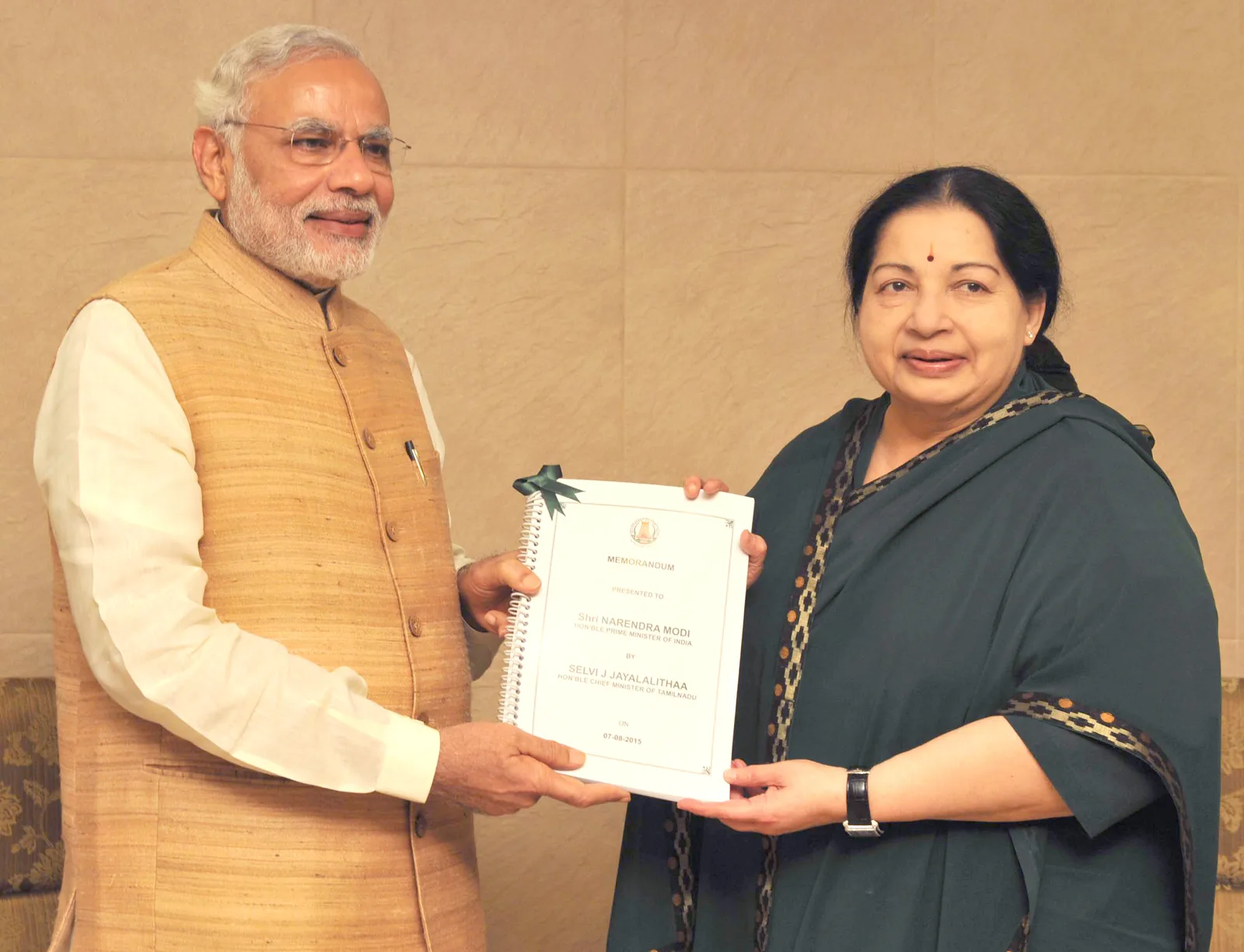
Read about the prime minister shown meeting her in the 2015 illustration.
Sources and further reading
Explore the evidence
These references support the biography and offer further reading. Official records, first-person accounts and independent reporting provide different perspectives; image records document attribution and licensing.
- 1. Rajya Sabha SecretariatObituary reference to Jayalalithaa, 6 December 2016
The obituary synopsis supplies education, film work, parliamentary service and death. Its Mysore-city birthplace conflicts with a Melukote listing elsewhere; only the agreed state is used. The synopsis itself says it is not the authoritative verbatim proceedings.
- 2. Debika Ray / British Film Institute, Sight and SoundJayalalithaa Jayaram: film and political career, February 2017
- 3. The Indian ExpressJayalalithaa: life dates and biographical overview
- 4. Reuters / Investing.comJayalalithaa’s burial and political succession, 6 December 2016
- 5. Greater Chennai CorporationHealth department: Amma Unavagam target groups and subsidised menu
- 6. The New Indian ExpressFirst phase and expansion to Chennai’s 200 wards, 3 April 2013
- 7. The News MinuteAmma canteen workers describe wages, conditions and insecure status, 5 December 2019
- 8. The Indian Express2014 conviction and 2015 acquittal and return: chronology, 23 May 2015
- 9. Supreme Court of India / Indian KanoonState of Karnataka v Jayalalithaa and others, 14 February 2017
Opening procedural account, selected role discussion and concluding disposition read; the complete thousands of lines of asset evidence were not read. Abatement is distinguished from the surviving defendants’ convictions.
- 10. Supreme Court of India / Indian KanoonReview petitions concerning abatement after Jayalalithaa’s death, 5 April 2017
- 11. Prime Minister’s Office / Wikimedia CommonsModi meets Jayalalithaa in Chennai, 7 August 2015: complete PIB photograph 68312
- 12. Government of IndiaGovernment Open Data Licence–India, Gazette notification, February 2017
- 13. Press Information Bureau, IndiaCopyright policy: free reproduction and third-party exclusion
- 14. Prime Minister’s Office, IndiaCopyright policy: accurate reproduction with source acknowledgment