In this biography
Quick facts
- Born
- 4 April 1939
- Died
- 23 January 2018
- Birthplace
- Witbank, now eMalahleni, South Africa
- Country
- South Africa
- Nationality
- Not independently established
- Known for
- Grazing in the Grass, jazz ensembles, exile-era recordings and anti-apartheid cultural work
- Early ensembles
- Huddleston Jazz Band and Jazz Epistles
- New York studies
- Manhattan School of Music, from 1960
- US number-one hit
- Grazing in the Grass, 1968
- Grammy record
- Three nominations; no competitive wins
- Memoir
- Still Grazing, with D. Michael Cheers, 2004
Why this life matters
His career connects musical exchange with the unequal conditions under which people travel and perform. It also distinguishes commercial recognition from an artist’s wider political and cultural commitments.
Timeline
Key moments
Witbank and musical apprenticeship
Piano, trumpet tuition and youth ensembles precede professional collaboration.
Theatre and modern jazz
King Kong and the Jazz Epistles form part of the early career.
Study in New York
MSM’s own record establishes enrolment before the 1961 date in some biographies.
Hit and nomination
The commercial breakthrough precedes a Grammy nomination, not a competitive win.
Exile-era work and homecoming
African collaborations and public advocacy continue before his return.
Memoir and later work
Autobiography, continuing performance and a heritage initiative precede his death.
A trumpet opened possibilities within a collective musical world
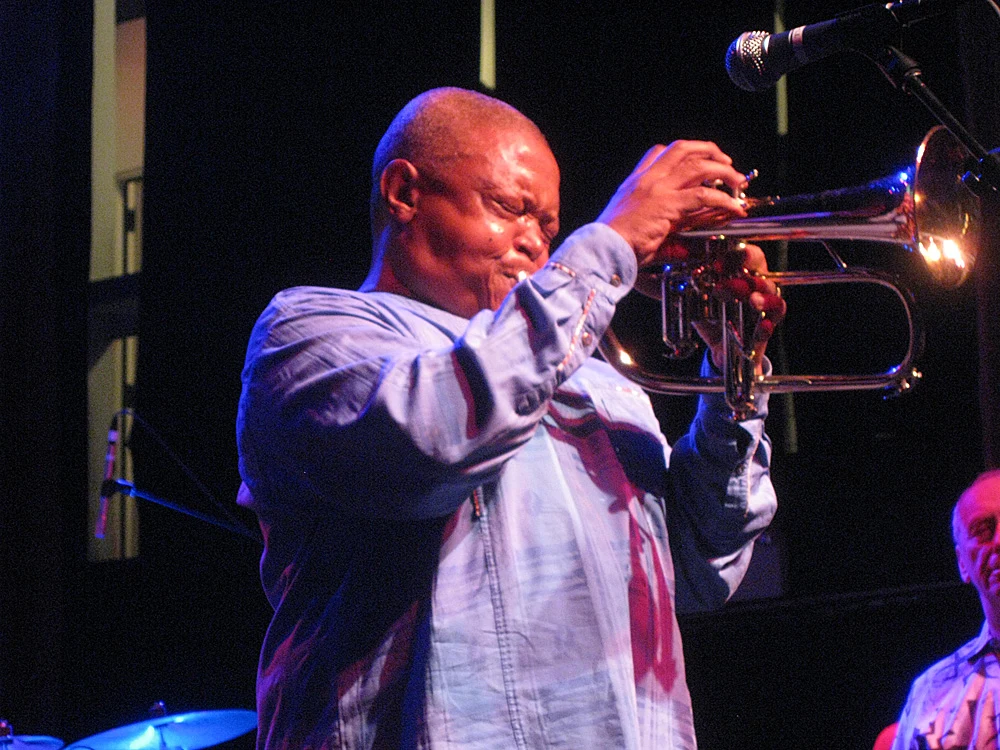
Hugh Masekela was born in Witbank on 4 April 1939. Early piano playing preceded the trumpet, with Father Trevor Huddleston helping him obtain an instrument and opportunities for tuition. His development was social as well as individual: youth-band rehearsals, professional players and the Johannesburg music scene supplied models and practical experience.
He later worked in the orchestra of King Kong and with the Jazz Epistles, alongside musicians including Kippie Moeketsi, Jonas Gwangwa and Abdullah Ibrahim. King Kong was a stage musical, not a film about the trumpeter. These collaborations make the beginning of his career more specific than an isolated prodigy discovering a ready-made personal style.
Exile and classical-trumpet study created new connections
Masekela left South Africa in 1960. Manhattan School of Music records his enrolment that year, corroborating the official career chronology rather than the 1961 date found in another retrospective. He studied classical trumpet while encountering a much broader American musical environment.
At MSM he met Stewart Levine and Larry Willis. The school’s account connects those student relationships with later recording and production work, including Chisa. Scholarship assistance and colleagues such as Miriam Makeba mattered to the opportunities available. An international career was therefore built through relationships and institutions, not just the decision to leave home.
An American hit did not define the whole repertoire
Grazing in the Grass became a number-one American pop hit in 1968. It brought a new level of visibility, but commercial success and institutional awards are different records. The Recording Academy lists a 1969 instrumental-performance nomination for the song, alongside later nominations for Sarafina! and Jabulani; it records no competitive Grammy wins.
His output extended across jazz, popular songs, African collaborations and theatre. Listeners approaching him through one short instrumental can therefore miss much of the working career. The useful distinction is not between supposedly pure jazz and everything else, but between individual recordings, their collaborators and the circumstances in which they circulated.
Cultural advocacy also involved disagreements and personal costs
African musical exchange remained central during the years abroad. His participation in Paul Simon’s Graceland touring also entered debate over the anti-apartheid cultural boycott. SAHO records Masekela’s defence of Simon; that position should be identified as part of a disagreement, not presented as unanimous approval by opponents of apartheid.
The 2004 memoir Still Grazing was written with D. Michael Cheers. Publishers Weekly’s contemporary review describes its account of substance misuse and recovery alongside musical achievements. This is a published retrospective account, not a new medical assessment or a claim that the complete memoir has been independently verified. It complicates an otherwise frictionless story of fame and activism.
Return and later institutions extended the legacy
Masekela returned to South Africa in 1990 and continued recording and performing. The official chronology includes later theatre work, No Borders and a heritage foundation established in 2015. These were active projects after the best-known hit, rather than merely commemorations of a career already over.
His family announced his death on 23 January 2018. A later partnership involving the Heritage Foundation, ELMA and MSM supported six South African music students through full degree scholarships. The school now describes that scheme as closed to new applicants. Its documented recipients provide a concrete educational legacy without suggesting that one institution represents every aspect of his influence.
Quick answers
Frequently asked questions about Hugh Masekela
- Did Hugh Masekela win a Grammy for Grazing in the Grass?
- No. The Recording Academy lists a 1969 nomination, not a win.
- When did he begin studying at Manhattan School of Music?
- The school records enrolment in 1960.
- Was he only a trumpeter?
- His career also included flugelhorn, singing, composition, bandleading, recording and theatre.
- Who helped write Still Grazing?
- D. Michael Cheers co-authored the 2004 memoir with Masekela.
Keep exploring
Lives connected to this story
- Miriam Makeba
Trace a collaborator’s own recording career, exile and documented 1990 homecoming.
- Nelson Mandela
Read the political history behind liberation-era cultural advocacy.
- J. M. Coetzee
Compare another South African cultural career that developed across countries and forms.
Sources and further reading
Explore the evidence
These references support the biography and offer further reading. Official records, first-person accounts and independent reporting provide different perspectives; image records document attribution and licensing.
- 1. Hugh Masekela official siteBiography — selected early career, return and later work
- 2. South African History OnlineHugh Masekela — selected early ensembles and cultural-boycott debate
Early ensembles and attributed boycott debate used. Its Grammy-win wording, 1961 exile date and 1992 Mandela-release claim are not adopted.
- 3. Manhattan School of MusicVirtual yearbook — 1960 enrolment and classical-trumpet study
- 4. Manhattan School of Music2020 scholarship announcement — selected historical career record
- 5. Recording AcademyHugh Masekela — three nominations, zero competitive wins
Annual award table takes precedence over retrospective winner claims; 1968 hit and 1969 nomination are distinct.
- 6. Publishers Weekly19 April 2004 — review of Still Grazing by Masekela and D. Michael Cheers
Contemporary review and bibliographic record, not a full-memoir reading claim.
- 7. Hugh Masekela family / official siteNews archive — 23 January 2018 family statement
- 8. Manhattan School of MusicHeritage scholarship — recipient support and closure to new applicants
- 9. H.L.I.T. / FlickrHugh Masekela (1) — exact originating photograph and current CC BY 2.0 grant
Actual HTTP200 page gives named owner and current CC BY2; origin original is byte-identical to selected full Commons file. Embedded camera/software metadata inspected; no unnamed agency copyright inferred.