In this biography
Quick facts
- Born
- 28 October 1908
- Died
- 19 August 2000
- Birthplace
- Kimberley, Cape Colony (now South Africa)
- Country
- South Africa
- Nationality
- Not independently established
- Known for
- Anglo American and De Beers leadership, liberal political funding and the Urban Foundation
- Full name
- Harry Frederick Oppenheimer
- Parliament
- United Party MP for Kimberley, 1948–1957
- Anglo American chair
- 1957–1982
- De Beers chair
- 1957–1984; board retirement followed later
Why this life matters
His career shows why a corporate leader’s reform commitments, company practices and the distribution of economic power require separate examination.
Timeline
Key moments
Kimberley and education abroad
Born in Kimberley; schooling in England and Oxford studies precede a return to South Africa.
Parliamentary service
Represents Kimberley for the United Party before leaving to lead the mining groups.
Corporate succession
Succeeds Ernest Oppenheimer as chairman of Anglo American and De Beers.
Urban Foundation initiative
Business-led discussions after Soweto lead to a private reform and development organisation.
Distinct departures and a library
Leaves the two chairmanships at different dates; the Brenthurst Library building opens in 1984.
Death
Dies on 19 August, leaving a contested industrial and political legacy.
A mining-family upbringing preceded an international education
Harry Frederick Oppenheimer was born in Kimberley on 28 October 1908, the son of Ernest and May Oppenheimer. Family connections placed him close to the diamond business from childhood. His later career began with advantages of wealth, access and expectation, rather than an independent discovery that created the industry from nothing.
After schooling in England, he studied at Oxford and returned to South Africa in 1931. Apprenticeship in the family enterprise overlapped with the Depression and personal bereavements. Nicky Oppenheimer’s affectionate tribute records these pressures, but its family perspective must be distinguished from an independent assessment of the resulting business power.
Succession expanded an existing corporate system
When Ernest died in 1957, Harry succeeded him as chairman of Anglo American and De Beers. He did not found either company. The distinction matters because he inherited established relationships, assets and management structures, then helped expand mining and industrial operations in southern Africa and beyond.
Anglo’s contemporary annual review describes his chairmanship through 1982 and its period of international expansion. De Beers was a separate company with a different later departure date. A family’s influence across enterprises did not turn them into one legal entity or make the chairman personally responsible for every operating decision.
His liberal politics had important limits
Oppenheimer represented Kimberley as a United Party MP from 1948 to 1957 and became a prominent financial spokesman. After leaving Parliament for corporate leadership, he supported the Progressive Party. His political influence therefore continued through funding and relationships, not simply through holding an elected seat.
Roger Southall’s review of Michael Cardo’s biography stresses that this liberalism was not initially a commitment to universal suffrage. Oppenheimer favoured a qualified common franchise and sought constitutional alternatives to both National Party rule and the liberation movement’s demands. Opposition to particular apartheid policies should not be collapsed into a lifelong endorsement of equal political power.
Workers challenged the distance between reform and practice
Mining profits were inseparable from low-paid African labour and the migrant system. In a 1986 public exchange, union leader Cyril Ramaphosa challenged business publicity about charitable spending while drawing attention to wages and workers’ living conditions. His criticism was a contemporary labour argument, not a criminal judgment against Oppenheimer.
The 1997 TRC business hearing likewise separated corporate accounts of reform from difficult questions about accumulated privilege. Anglo’s representatives emphasised changes in union recognition and urbanisation; commissioners challenged the possibility that selective reform had protected existing power. These competing accounts require more than accepting either philanthropic expenditure or hostile rhetoric as the complete record.
Institution building outlasted his corporate chairmanships
Oppenheimer helped establish the Urban Foundation in the 1976–1977 period, connecting business resources with urban policy and development. Another project, the Brenthurst Library, gave inherited collections a purpose-built home in 1984. The library’s own history describes preservation, research access and publication, rather than treating the collection as a newly created personal trophy.
He left Anglo’s chair in 1982 and De Beers’ in 1984, while remaining influential afterwards. He died on 19 August 2000. His legacy includes substantial institutions and political intervention, but also concentrated economic power and disputed reform. Retirement dates, later board service and family continuity should not be treated as interchangeable events.
Quick answers
Frequently asked questions about Harry Oppenheimer
- Did Harry Oppenheimer found Anglo American?
- No. He succeeded his father Ernest as chairman in 1957 and expanded an existing group.
- Did he leave both major chairmanships in the same year?
- No. Anglo’s chairmanship ended in 1982 and De Beers’ in 1984; later board service was a separate matter.
- Did his early liberalism support universal suffrage?
- Not initially. The cited scholarly review distinguishes his qualified-franchise position from universal political rights.
- Was the Urban Foundation a government department?
- No. It was a privately financed organisation pursuing development and policy reform.
Keep exploring
Lives connected to this story
- Ernest Oppenheimer
Distinguish the founder’s international finance career from Harry’s later succession and political choices.
- Vinny Lingham
Compare a different generation’s movement between entrepreneurship, investment and corporate leadership.
Sources and further reading
Explore the evidence
These references support the biography and offer further reading. Official records, first-person accounts and independent reporting provide different perspectives; image records document attribution and licensing.
- 1. Nicky Oppenheimer / The Brenthurst LibraryHarry Frederick Oppenheimer: a son’s tribute, used as family testimony
- 2. Roger Southall / The Conversation, republished by Polity2023 scholarly review: business expansion, parliamentary service and the limits of qualified-franchise liberalism
A scholarly review, not a claim to have read Cardo’s entire biography or all family papers. Its political qualifications are preserved.
- 3. Anglo American2000 annual review, chairman’s statement: Harry Oppenheimer’s 1957–1982 chairmanship
- 4. Oliver Aiken / University of Cambridge2024 doctoral thesis: selected biographical footnote 214, education, dates and chairmanships
- 5. JCKHarry Oppenheimer Dies at 91: succession and distinct chairmanship and board departures
- 6. Cyril Ramaphosa and Harry Oppenheimer / Weekly Mail archive13 June 1986: contrasting arguments about labour, business and political reform
- 7. Truth and Reconciliation Commission / Department of Justice1997 business hearing: selected Anglo claims, urbanisation discussion and commissioners’ challenges
Selected testimony and questioning are identified as such, not presented as a complete TRC finding about an individual.
- 8. Dan Smit / Transformation 18, 1992The Urban Foundation: Transformation Possibilities, selected printed pages 35–38
- 9. The Brenthurst LibraryCollection history: inherited holdings, scholarly publication and the 1984 library building
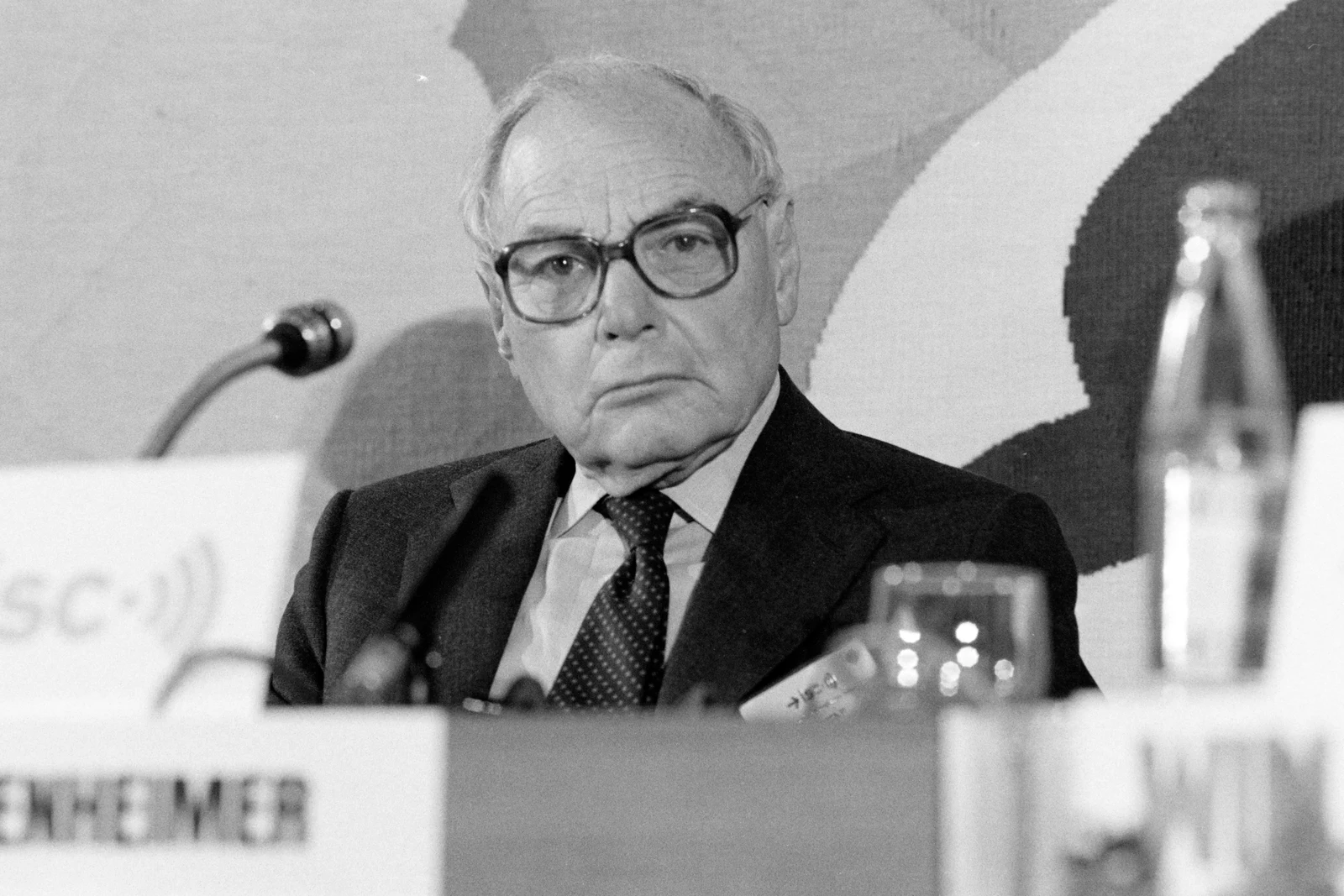
- 10. Universitätsarchiv St.Gallen / Regina KühneHarry F. Oppenheimer, 13th International Management Symposium, 1983, HSGN 028/00544
The supplying archive explicitly releases this exact portrait. A separate Anefo family with an Ernest/Harry cataloguing discrepancy was not used.
- 11. Universitätsarchiv St.GallenArchive’s explicit rights declaration and CC BY-SA 4.0 release
- 12. Creative CommonsAttribution-ShareAlike 4.0 International